By Thierry Valle
Brussels (1st May 2026) — The world map hanging on the wall of a classroom or in a UN chamber is generally perceived as a neutral source of information, a simple navigational tool. Who, looking at it, would suspect that in the age of satellites, this world map is still based on the measurements of Gerardus Mercator, who in 1569 drew the world map we know today ?
1569–2026: the persistence of a geographical error
The Republic of Togo is preparing to table a resolution at the United Nations General Assembly aimed at changing the world map. The text, put forward by Togo’s permanent delegation to the UN and backed by several African Union member states — including Ghana, Senegal and South Africa — is expected to be tabled during the 81st session of the General Assembly, which opens in September 2026. This initiative reminds us that cartography is rarely merely a matter of geography. It is a major political statement.
By challenging the long-standing dominance of the Mercator projection, Togo seeks to correct a visual distortion which, for several centuries, has not only diminished the physical reality of the African continent, but also the very place of Africans and people of African descent in the world narrative.
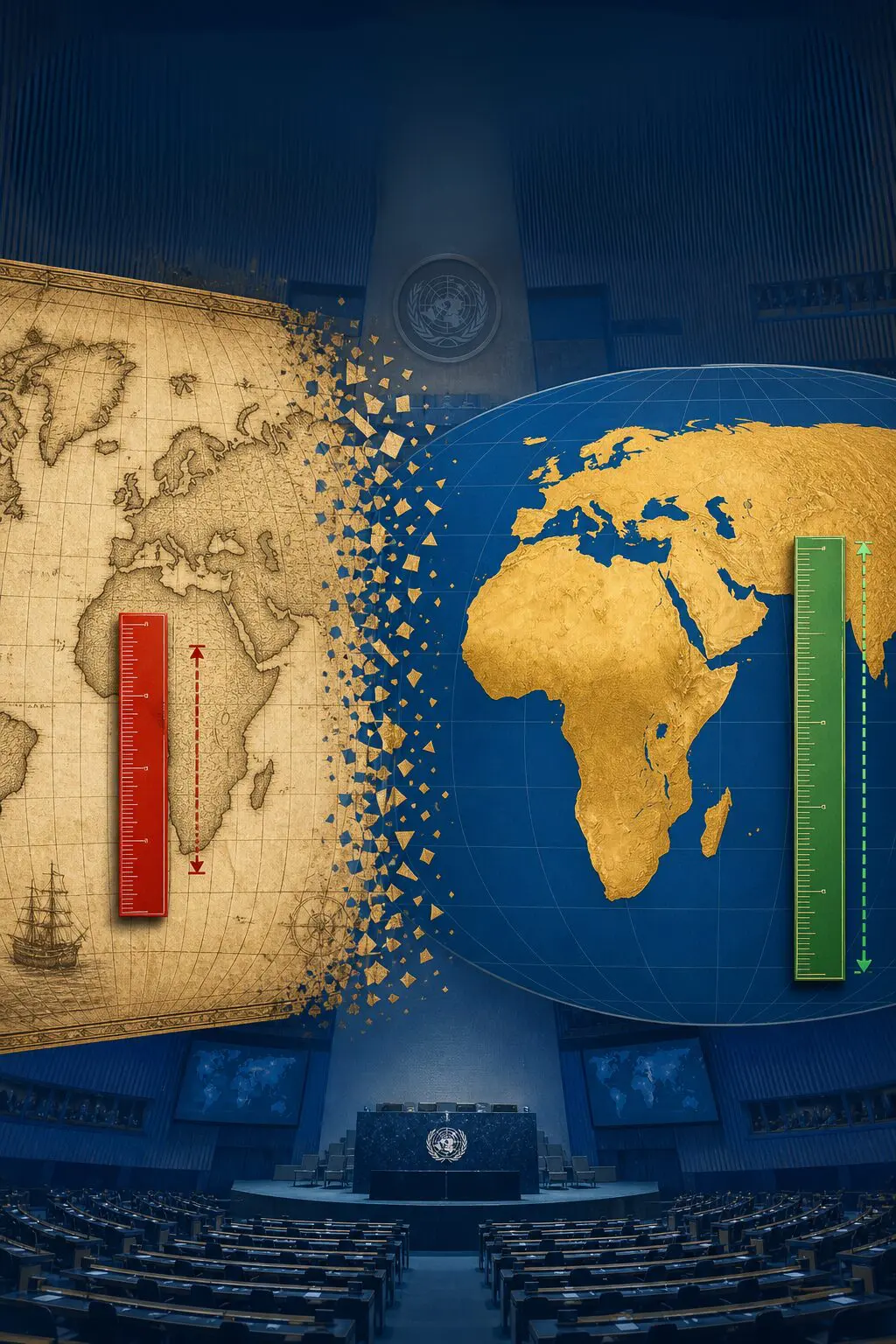
This initiative, which has sparked heated debate in the media and African diplomatic circles, aims to replace the current standard map—the Mercator projection—with a representation that reflects the true size of the continents. The underlying argument is simple yet profound: the map currently in use does not show the African continent as it really is, but as it was perceived by 16th-century European navigators and colonialists. For Togo and its allies, correcting this map is a matter of geopolitical justice and a recognition of geographical truth.
From scientific racism to visual distortion
To understand the significance of Togo’s proposal, we need to look at the history of geography. In 1569, the Flemish geographer Gerardus Mercator devised a cylindrical projection that revolutionised navigation. By representing lines of constant course as straight segments, his map enabled sailors to chart a straight course across the ocean. It was a triumph of European practicality.
However, the mathematical trade-off of the Mercator projection is the distortion of size. On this map, Greenland — which is roughly the size of the Democratic Republic of the Congo — appears to be about the same size as the entire African continent, and Europe appears significantly larger than it actually is.
This visual distortion reflected the worldview of the 16th century.
In the 19th century, the era of the industrial and scientific revolution in Europe, the evolution of the world map did not undergo a revolution.
Does this oversight reflect the scant attention paid at the time to the question of the sovereignty of the African continent ?
Indeed, the 19th century was also the century of Western pseudoscientific theories of racial hierarchy.
In 1839, Samuel George Morton, an American physician and naturalist, published Cranea Americana, a controversial work attempting to establish a hierarchy of races based on skull size. Morton, like many European thinkers of his time, sought to prove the intellectual superiority of the Caucasian race through biological measurements. The coexistence of these pseudosciences with the continued use of the Mercator projection is no coincidence: both are part of the same classification system in which Europe serves as the benchmark and the rest of the world is measured in relation to it.
Shaping perception, shaping power
Today, as the world faces a resurgence of far-right ideologies and a retreat into narrow national identities, this long-standing cartographic bias is no longer acceptable.
Anti-racism and civil rights movements, from Black Lives Matter in the United States to the struggles against police violence in Europe, are fighting to claim space — both physical and symbolic — in societies that have long marginalised them. In June 2020, the statue of the slave trader Edward Colston was thrown into the water in Bristol; in 2021, the European Commission acknowledged systemic racism within its institutions. These partial victories show that the physical representation of hierarchies can be deconstructed.
Today, Africa’s ‘smallness’ on the Mercator projection serves to reinforce, almost unconsciously, the perception of African peoples as ‘other’. It visually validates the exclusionary policies that are resurfacing on the political scene.
By visually diminishing the African continent for the past 500 years, the West has, metaphorically, diminished the humanity of those who originate from it.
Togo’s diplomatic push argues that this is not merely a technicality. Perception shapes policy. If a generation of decision-makers is conditioned to see Africa as physically smaller than Europe or North America, this unconsciously reinforces notions of diminished importance. Projections such as the Gall-Peters projection or other equal-area maps — such as the Mollweide projection or the authaGraph projection developed in Japan — show Africa on its true colossal scale. It is a striking visual correction that demands a recalibration of the reader’s preconceptions.
‘No hierarchy of atrocities’, but a hierarchy of geography
This initiative comes at a particularly sensitive juncture in diplomatic relations between the North and the South. It coincides with the March 2026 resolution on the transatlantic slave trade, on which a significant number of Western nations, including France, chose to abstain.
There is a compelling parallel to be drawn here: when France and other European states abstained on the resolution concerning slavery, they cited legal technicalities relating to the definition of crimes, arguing against a “hierarchy of atrocities”. They claimed that suffering cannot be ranked.
Yet, maintaining the Mercator projection as the standard forces the world to adhere to a ‘geographical hierarchy’ that suggests a reluctance to dismantle structures of domination, whether moral or spatial. It is not that the two decisions stem from the same intention. It is simply that they produce the same effect: Africa is recognised as a victim in discourse, but remains marginalised in representations.
This is a critical contradiction. On the one hand, Africa is placed at the forefront of victims of crimes against humanity; on the other, it is downplayed visually.
An opportunity for France to realign its diplomatic stance
For France in particular, this new resolution presents a unique diplomatic opportunity. Having faced criticism from its own overseas territories and its African partners for abstaining in the vote on slavery, Paris now has a chance to demonstrate a shift in perspective.
Supporting Togo’s resolution to adopt a more accurate map would be a concrete gesture on France’s part, demonstrating a willingness to view the world through the lens of fairness rather than through that of historical habit or colonial nostalgia.
It is an opportunity to align the ‘universalism’ that France cherishes with the physical reality of the world in which it lives.
By voting to expand Africa’s presence on the world map, France and other Western nations would take a symbolic step towards increasing the space given to African voices in global governance.
So the map becomes a symbol of justice
Maps are tools of power. They define what is central and what is peripheral.
As the Togolese delegation prepares to present this text, the eyes of the African continent and the diaspora will be fixed upon it. The hope is that France and the other nations that missed the chance to fully acknowledge the historical crimes of the past will not miss this new opportunity to restore the African continent to its rightful place.
Correcting the map will not change the borders or resources on the ground. It is not about transforming physical geography, but about transforming mental geography—the way we perceive the relative importance of peoples and territories. In a world where justice is often hampered by bureaucracy and obscured by technicalities, and where far-right rhetoric seeks to resurrect the ghosts of pseudo-racial theories from centuries past, a shift in perspective on the world map would be a significant symbolic act of redress.
It is time for world maps on every wall across the globe to depict the world in its true proportions, so that every citizen of this world may find their rightful place upon it.
Sources
Anadolu Agency (AA), ‘Togo to advocate for a more accurate cartographic representation of Africa at the UN’, 16 April 2026. URL: https://www.aa.com.tr/fr/afrique/le-togo-defendra-a-l-onu-une-representation-cartographique-plus-fidele-de-l-afrique/3916790
Pouvoirs d’Afrique, “World cartography: the African Union mandates Togo to correct the world map at the UN”, 7 April 2026. URL: https://pouvoirsafrique.com/article/3941/bcartographie-mondiale-lunion-africaine-mandate-le-togo-b
Mali Actu, “Africa: world map finally corrected at the UN for historical justice”, April 2026. URL: https://maliactu.net/afrique-la-carte-du-monde-enfin-corrigee-a-l-onu-pour-une-justice-historique/
Yeni Şafak, “UN: Togo advocates for better mapping of Africa”, April 2026. URL: https://www.yenisafak.com/fr/international/onu-le-togo-defend-une-meilleure-cartographie-de-lafrique-55887
Travel Card Journal, “At the UN, Togo advocates for a new world map: Africa in search of its rightful place”, April 2026. URL: https://travelcardjournal.com/a-lonu-le-togo-defend-une-nouvelle-carte-du-monde-lafrique-en-quete-de-sa-juste-place/
AIP (Ivorian Press Agency), “Togo to advocate for a more accurate cartographic representation of Africa at the UN”, 16 April 2026. URL: https://www.aip.ci/electionpresidentielle2025/article.php?id=352610
Prémices Média, “New world map: Togo at the forefront of correcting distortions regarding Africa”, April 2026. URL: https://premicesmedia.com/nouvelle-carte-du-monde-le-togo-en-premiere-ligne-pour-corriger-les-distorsions-sur-lafrique/
Official X (Twitter) account of Togolese Diplomacy (@DiplomatieTogo), post dated 19 April 2026. URL: https://x.com/DiplomatieTogo/status/2047617024168231096
Mali Actu, ‘The African Union urges the UN to adopt a new world map to restore Africa’s true size’, April 2026. URL: https://maliactu.net/lunion-africaine-pousse-lonu-a-adopter-une-nouvelle-carte-du-monde-pour-retablir-la-vraie-taille-de-lafrique/