Cleopatra Selene II had a turbulent life from the very beginning. She came into the world during one of the most famous and turbulent periods for Egypt and Rome – as the only daughter of Cleopatra and Mark Antony during their alliance after the assassination of Julius Caesar
As political allies and lovers, Antony and Cleopatra tried to consolidate their power by declaring their twin children – Cleopatra Selene II and Alexander Helios – rulers of various territories in North Africa and Asia. However, the parents’ ambitious plans failed when in 30 BC they were defeated by their enemy Octavian, which led to both of them committing suicide.
And the children were soon taken prisoner by this same enemy. Initially, they were scattered around Rome, but later they were placed in the care of Octavia, Antony’s former wife. As Cleopatra Selene II grew up, she received a strong Roman education – but she also became one of the last connections to the Egyptian Ptolemaic dynasty.
Let’s take a look at her story.
Mark Antony and Cleopatra’s relationship – and their plans for their children
The story of Cleopatra Selene II begins with her parents, of course. Her mother was only 14 years old when Antony first met her, and he himself was about 14 years older than her. Despite the meeting, their fateful relationship would begin many years later.
After the assassination of Julius Caesar in 44 BC, Antony successfully defeated Caesar’s opponents and in 41 BC asked Cleopatra to come visit him in Anatolia, modern-day Turkey.
He was soon captivated by Cleopatra, who was then in her late 20s. As the Greek biographer Plutarch put it: “She used to visit Antony at the very moment when women are at their most radiant in beauty and intellectual power.” Cleopatra then invited Antony to come see her in Alexandria, Egypt, an offer he accepted.
Antony and Cleopatra became lovers, and in 40 BC she gave birth to twins, Alexander Helios and Cleopatra Selene II.
Helios, representing the “sun,” and Selene, representing the “moon,” were meant to symbolize a new era. The mother hoped that her father would defeat the Parthian Empire in the east, similar to Alexander the Great’s conquest of Persia.
He would see his children for the first time when they were three years old, but he immediately adopted them as his own. In 36 BC Cleopatra gave birth to another son, Ptolemy Philadelphus, also raised by Antony.
In the following years, the couple made grand plans for their children. When Selene and Helios were still babies, they were proclaimed rulers of various regions: the girl received Crete and Cyrene (located in modern-day Libya), and the boy was king of Armenia, Media, and Parthia. The young Ptolemy Philadelphus was proclaimed king of Syria, Phoenicia, and Cilicia. Meanwhile, Cleopatra’s eldest son, Caesarion (who is believed to be the father of Julius Caesar), was given the particularly lofty title of King of Kings.
But the deaths of Antony and Cleopatra in 30 BC interrupted these plans.
Selene II after the death of her parents
Around 33 BC, Mark Antony divorced his wife Octavia and married Cleopatra. This caused great discontent on the part of Octavian, who was her brother. The controversial divorce, combined with Antony’s willingness to aid Cleopatra in her own political ambitions, eventually led to the outbreak of a brutal war between the two men.
At the Battle of Actium, Antony and Cleopatra’s forces were defeated by Octavian. Then, when the victor invaded Egypt, the couple committed suicide rather than be captured, humiliated, and executed.
But Cleopatra’s eldest son, Caesarion, was soon executed as well. But Selene, Helios, and Philadelphus were taken prisoner by the Romans. The fate of Philadelphus is unclear from this point on, although it is assumed that he died soon after his capture.
Octavian took Selene and Helios back to Rome, dressed them as the sun and moon to mock their celestial names, and paraded them through the streets in gold chains. Only 11 years old at the time, the twins were also forced to walk before an effigy of their deceased mother. Despite this cruel treatment, Octavian later entrusted the two to the care of his sister Octavia, and although technically still captives, they lived in relative comfort. From this point on, Helios disappears from the historical record. It is believed that he died of illness, but more sinister theories point to murder.
As for Cleopatra Selene II, she not only lived to adulthood, but also received a solid Roman education, studying Greek and Latin literature, philosophy, and rhetoric. She was also fluent in many languages. She is considered to be as intelligent as her mother – and more beautiful.
Perhaps most notably, she is one of the last remaining connections to the Ptolemaic dynasty of Ancient Egypt.
Oblivion
When Cleopatra Selene II grew up, Octavian arranged a marriage between her and Juba II, King of Mauretania (located in modern-day Morocco and Algeria). Like his future wife, Juba II was raised in Rome after his father’s defeat (in this case by Julius Caesar in 46 BC).
Although also being paraded around Rome as a captive, Juba II was given a somewhat comfortable life at an early age and a good education. He eventually befriended Octavian, which later proved to be beneficial – especially after Octavian became Emperor Augustus.
Around 30 BC, Octavian declared him King of Numidia. About 5 years later, Juba and Selene married. During their marriage, the couple had two children: Ptolemy Mauretania and a daughter, whose name is unfortunately unknown today.
The couple were soon tasked with governing the kingdom of Mauretania. Under the watchful eye of the Romans, they proposed new rules, urban plans, and public works, drawing inspiration from artists and architects from all over the Mediterranean in the process. Thus, under their rule, the kingdom became particularly prosperous.
Although Cleopatra Selene II was now queen, she never forgot where she came from – and found creative ways to honor her mother’s legacy in Mauretania, exhibiting portraits of former Ptolemaic leaders and proudly introducing herself as “Cleopatra, daughter of Cleopatra”, despite her mother being considered an enemy of Rome.
Her success as a monarch continued until her death around 5 or 6 BC. She was only about 35 years old when she died, meaning she outlived her mother by even less. Although the circumstances of her death remain a mystery, most historians believe that the cause was natural causes.
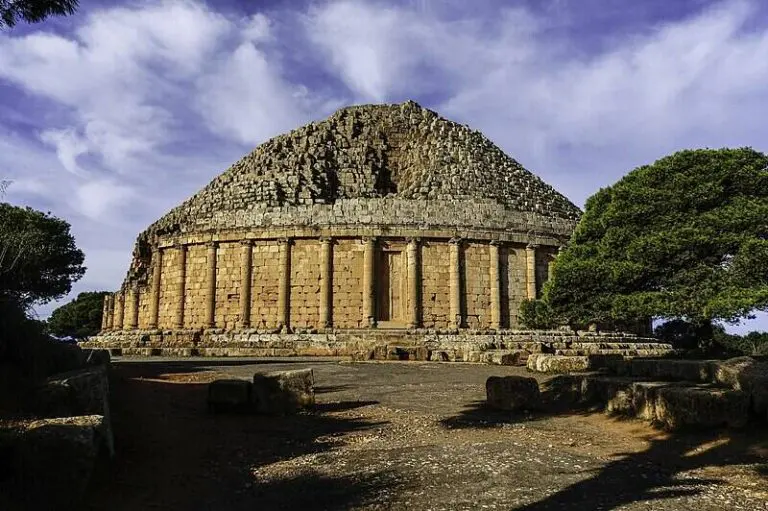
Cleopatra Selene II is buried in the Royal Mausoleum of Mauretania in present-day Algeria, which was commissioned by her husband. After his death in 23 BC, the two were reunited and buried together.
Their son ruled Mauretania until Emperor Caligula executed him. The kingdom was then divided into two provinces, with the influence of Juba II and Cleopatra Selene II fading into the past.
However, Selene’s legacy as one of the last of the Ptolemies continues to exist in ancient records, archaeological sites, and even popular culture, despite the missing pieces of her story.
Photo: The Royal Mausoleum of Mauretania, the original tomb of Cleopatra Selene II and Juba II. Wikimedia Commons/CC BY-SA 2.0