* By Martin Hoegger
The conference organised by the Patriarchal Academy of Crete in Heraklion on 8 and 9 October 2025 confirmed to me that safeguarding creation has become a point of unity between Christian denominations. Professors Angeliki Ziaka and Vasiliki Stathokosta showed, each in their own way, that ecology is now a privileged field of ecumenical dialogue.
One creation, many denominations
Faced with the climate emergency, Christian churches are uniting to defend creation. The World Council of Churches (WCC), which brings together more than 600 churches worldwide, is actively participating in COP 31 in Belém, Brazil. Its programme, Care for Creation and Justice for Community, closely links the protection of nature with social justice. For Angeliki Ziaka, “it is not just a question of saving the planet, but of restoring man’s relationship with God, with his neighbour and with creation”.
Every year, the Season of Creation (from 1 September to 4 October) symbolises this spiritual unity. Born in Orthodoxy and recognised by Pope Francis, it brings together Catholics, Protestants and Orthodox Christians in prayer and action for our common home.
Climate justice and universal responsibility
The ecological crisis reveals a profound injustice: the poorest suffer the greatest impact, even though they contribute the least to global warming. That is why the WCC advocates for global “climate justice” in cooperation with other religious traditions and international institutions.
At COP 29 in Baku, Metropolitan Iakovos of Arethousa called for an “ecological conversion”: transforming the heart before transforming practices. This vision, shared by Pope Francis in his encyclical Laudato si’, is inspiring growing dialogue.
The WCC is also engaging with young people through the Churches Commitments to Children programme, which offers educational and legal tools for climate action. The publication Churches for Children through Climate Justice links ecology, human rights and the dignity of the most vulnerable.
The spiritual roots of the ecological crisis
For Vasiliki Stathokosta, the ecological crisis has its roots in the rupture between humanity and God. In seeking to dominate nature, humanity has forgotten that it is its guardian, not its master. Basil the Great already reminded us: “Our fields are drying up because love has died among us.”
The root cause of the ecological crisis is therefore spiritual: greed, the desire for power, and a lack of gratitude. “Ecotheology,” born out of contemporary ecumenical dialogue, seeks to restore the cosmic dimension of the Christian faith. All creation is a gift from God, entrusted to humankind to be protected in a spirit of gratitude. As Stathokosta points out, “Christian ecology is not a political programme, but a prophecy of reconciliation between humanity and nature, between justice and grace.”
Towards an ecumenical ecotheology
For several decades, the WCC and the Conference of European Churches have been integrating ecology into their theological and social reflection. The Charta oecumenica (Ecumenical Charter) calls for the values of peace, justice and integrity of creation, based on three pillars: conversion of the heart (metanoia), pursuit of justice and peace.
The Orthodox Church adds a fourth: sobriety. Patriarch Bartholomew nicknamed “the green patriarch”, calls for an ascetic and moderate lifestyle. For him, “to destroy the created world is to sin against God.”
Ecumenical eco-theology is also a spiritual pedagogy. The liturgy, in which nature participates in divine praise, becomes a school of reconciliation with nature. The water of baptism and the bread and wine of the Eucharist remind us that creation is called to be transfigured.
A faith that unites, a hope that acts
Despite their divisions, churches are discovering in ecology a space for unity and cooperation. The protection of creation transcends denominational and religious boundaries. The WCC is increasing its partnerships with interfaith organisations, scientists and public institutions to promote concrete and sustainable solutions.
Thus, ecology becomes a place of common witness: a faith lived in responsibility and solidarity. To preserve the earth is to honour the Creator; to serve life is part of the Gospel.
Ecology is no longer a secondary issue, but a sign of the times. It reveals humanity’s spiritual vocation: to collaborate with God in preserving the beauty and diversity of the world. Through their shared commitment, the churches affirm that justice, peace and sobriety are inseparable from the Christian faith.
In a world marked by fragmentation and fear, their voice becomes prophetic: that of a faith that connects, a hope that acts, and a love that cares for the earth as well as the human heart.
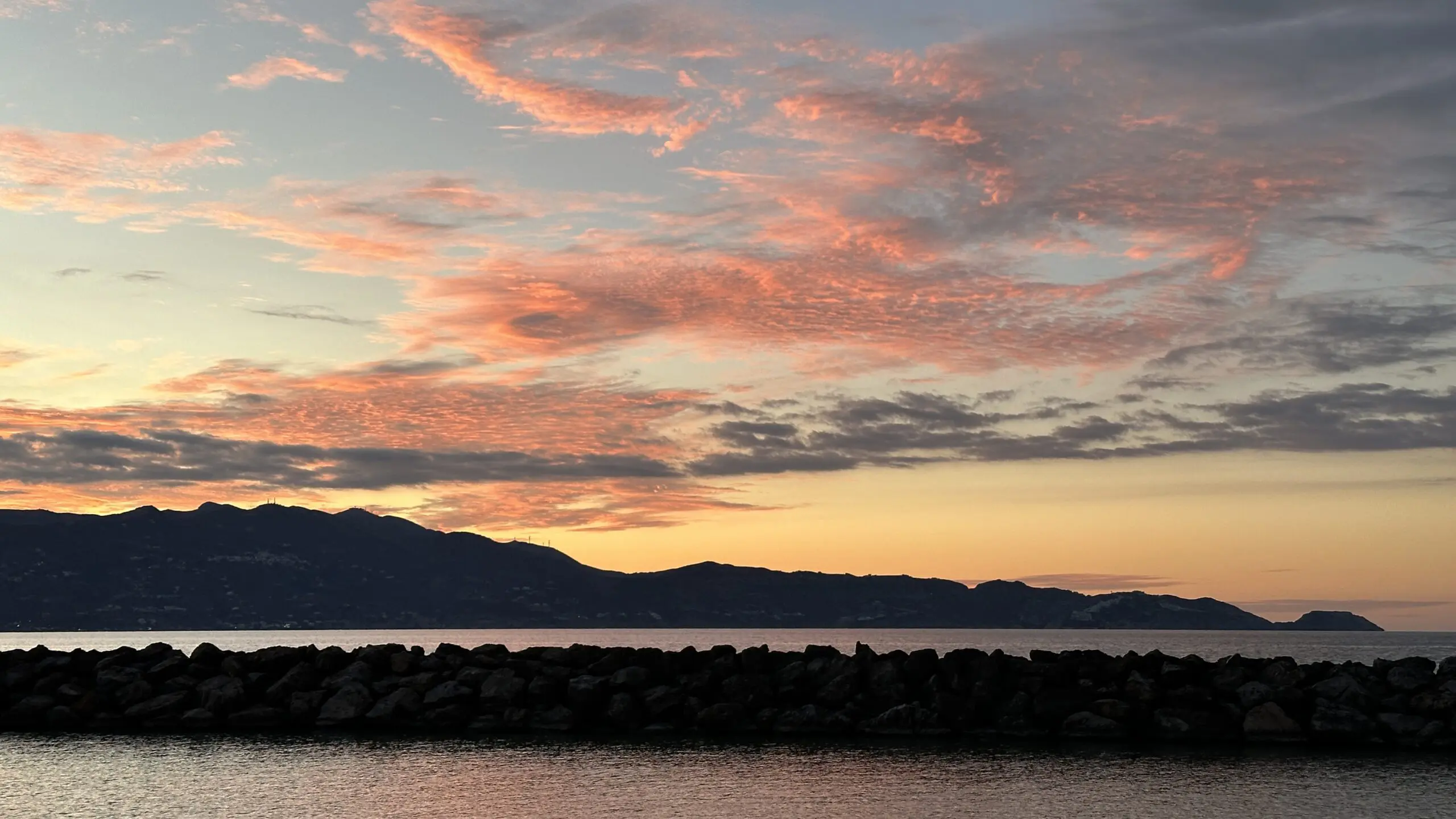
Photo: Sunset in Heraklion
* Martin Hoegger is a reformed theologian and author living in Switzerland. He participated in the Heraklion conference. https://www.hoegger.org
For other articles on the theme of this Symposium, see here: https://www.hoegger.org/article/eco-theology