The eyes of a pigeon
Folk wisdom attributes extraordinary keenness to the eagle and the falcon. But as ornithologists have found, pigeons see no worse. In addition, at great distances they perfectly distinguish colors. These abilities of pigeons decided to use the coastal rescue services in Canada. Special training was conducted for birds. They were taught to distinguish orange spots in the water, i.e. the color of life jackets and inflatable boats. Experiments have shown that a well-trained bird detects the orange spot in the sea three times better than the most observant and experienced pilot.
About the flight of pigeons
Young pigeons fly quite clumsily at first. Previously, it was believed that they master the art of “aerobics” thanks to training. To test this, they conducted an experiment: some pigeons were released into the wild, and the rest were placed in cages so narrow that they could not even spread their wings. When the pigeons released into the wild learned to fly, they also released the captive ones, and it turned out that they flew no worse than the free ones. So the main role in mastering the flight is not played by training, but by the maturation of the birds.
Who shows the way
Some time ago, biologists believed that old experienced birds, which have repeatedly made flights from north to south and back, show the way to the young. Indeed, wild geese and ducks, and cranes make migratory journeys in flocks consisting of old and young birds. In these cases, the leading role of the old is obvious. A detailed study of the flights using the ringing method showed that many young finches head south earlier than adults.
Birds are afraid of artificial snakes
Nowadays, various methods are used to scare birds away from agricultural crops. These can be, for example, stuffed birds with spread wings, imitating a signal of danger. An unexpected and very effective means of repelling turned out to be artificial snakes. The experiments carried out gave excellent results. Damage to green plantings, for example, decreased by 17 percent compared to areas where other scarecrows were used. In the absence of means of such protection, the losses were 30 percent, and when artificial snakes were used – only 3 percent. Snakes scare birds away with their appearance, and in addition, birds do not get used to them /unlike other scarecrows/.
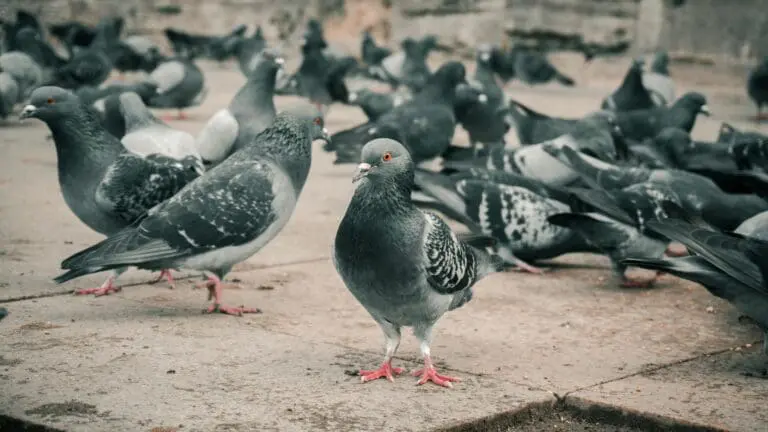
Illustrative photo: https://www.pexels.com/photo/close-up-shot-of-feral-pigeons-14720798/