
You may not think of your dog drinking water by burying his nose in his bowl (and splashing a lot of it all over the floor) as an engineering marvel. But after reading this, that might change! A study by Virginia Tech into the mechanics of how dogs drink water has found that what may seem like a completely random (and rather wet) instinctive habit is actually something far more interesting and complex. Behind each “sip” lies a whole process that involves precise coordination between the tongue, gravity, and speed of movement—something that happens in a split second and is almost impossible to capture with the naked eye.
There’s also a curious physiological feature that makes the way our furry companions drink water even more intriguing. In humans, as well as in some herbivores (such as horses or cows), the cheeks form a tight seal around the teeth. This allows us to hold food in our mouths, chew and drink normally, and also to create a vacuum (for example, when drinking through a straw). In dogs and cats (and most carnivores), this is not the case. Their cheeks do not fit tightly against the teeth, leaving more free space on the sides of the mouth. Their lips are also looser, which means they cannot close tightly. This is because, as carnivores, they must be able to open their mouths extremely wide to catch and hold their prey.
Dogs’ lips cover the entire mouth and do not allow for the tight seal that humans have. As a result, they cannot simply contract their lips and use their cheek muscles to create a vacuum to suck in water.
In other words, our pets can’t just “drink” water the way we do. And, unfortunately (or rather, to our amusement), there are no straws specifically designed for dogs! Instead, nature has created a completely different mechanism—one that relies on rapid, rhythmic tongue movements, combined with physical forces like inertia and gravity. What looks like a chaotic splash is actually a well-calculated process that allows the animal to efficiently capture and swallow water. And this is where science comes in and gets really interesting!
The Difference Between Drinking Water in Cats and Dogs
At first glance, it seems that all pets drink water in the same way. But if we compare how dogs and cats do it a little more carefully, we will notice that there is a significant difference—and it is not just visual, but purely physical.
Cats drink surprisingly elegantly. They barely touch the surface of the water with the tip of their tongue, then pull it up with a quick but precise movement. This creates a thin stream of water that the cat catches by closing its mouth at the right time. The whole process is extremely well coordinated – a balance between gravity and inertia, which leads to minimal splashing. That’s why cats almost never leave wet marks around their pans.
With dogs, the situation is completely different. Instead of delicately “pulling” the water, they literally “hit” it with their tongue – it dips into the liquid, and then pulls it up at high speed, curving back into a shape resembling a ladle. This movement creates an acceleration that can reach up to five times the force of gravity. The result is the formation of columns of water that rise upwards and that the dog quickly catches with its mouth before they fall apart. This method is effective, but also much more chaotic. That’s why quadrupeds often splash water around them – not because they’re careless, but because they use a completely different, dynamic mechanism.
While cats rely on precision, dogs use force and speed. Both approaches are impressive, each in its own way.
Do all dogs drink the same way?
At first glance, it may seem that different breeds have completely different ways and mannerisms of drinking water – especially when you compare a small Chihuahua to an English Bulldog, with its sagging cheeks, for example. In fact, from a scientific point of view, the mechanism is the same in all quadrupeds.
“Dogs curl their tongues back, forming them into a scoop,” explains Dr. Seungwan Jung of Virginia Tech. “The tongue then scoops up some water, and a column of water is simultaneously created underneath. The animal bites and swallows part of this column, while the remaining water is returned back. It is this process that is behind the characteristic sloshing sound that we observe almost every time our pet drinks,” Dr. Jung further commented.
Regardless of size, breed, or age, all dogs use the same basic technique. It’s a universal biomechanical model based on rapid tongue movement, inertia, and gravity. The differences come not from the way they drink, but from their anatomy. “All breeds drink the same way, but their anatomy determines how much water they’ll splash in the process,” Dr. Gaylord Brown of Delta Rescue tells PetMD. Dogs with larger heads, longer tongues, and looser lips and cheeks hold more water, which easily spills around them. That’s why they often appear to splash more water when they drink. In smaller breeds, the process is the same, but the scale is smaller, making the splashes less noticeable.
Whether your dog drinks quietly or leaves a puddle behind, there’s an impressive mechanism behind it—precise, efficient, and completely universal across the species.
How to Deal with All the Spilled Water
Living with a dog often means… water everywhere. Especially in the area where their bowls are placed. And it’s not just a few drops, but small “water accidents” that the animal causes while drinking. Because, as Dr. Brown comments, “dogs can’t control how much water they’re going to splash.” But what can owners do to limit the damage?
The first and most obvious measure is to use a suitable bowl mat for your pet’s bowl. Larger, absorbent, and easy-to-clean pads or a pet fountain can catch most of the splashes. It’s a good idea to place the bowl in the center of the mat, so that even with more vigorous drinking, the splashes fall onto the absorbent surface and not onto the floor.
The next step is to carefully position the bowl itself. If your dog is standing on a slippery floor or near furniture, splashed water can cause everything from slips to stains on your furniture. That’s why placing your dog on a mat and in the right place is key.
Ultimately, a little patience and preparation are all it takes. Splashing water is just part of a dog’s natural behavior, especially if they’re energetic or excited. Invest in comfortable accessories, absorbent mats, and place bowls on easy-to-clean flooring. And you’ll find that these little water adventures aren’t as much of a problem anymore.
How much water should dogs drink?
The question “how much water should my dog drink?” often worries owners. However, its answer is not unambiguous or universally valid, as it depends on several key factors. The most important of these are the animal’s activity level, the type of food, and environmental conditions, explains Dr. Brown. “Dogs should drink approximately 30 ml of water per kilogram of body weight per day,” he adds. However, this amount varies greatly depending on the temperature, activity level and the dog’s diet.
For example, dogs that eat mainly canned food often drink less water, as canned food contains up to 70 percent water. At the opposite end, dry food contains much less water, which means that the dog must compensate by drinking more often. In addition, in hot weather, the need for hydration can triple – not because of thirst, but because of the natural cooling process through panting. Exercise and physical activity also increase the need for water – depending on the duration and intensity of the workout, the dog may need three to four times as much fluid.
The most important rule for owners is to prevent dehydration. “Water is vital for temperature regulation and for all the basic functions of the dog’s body,” emphasizes Dr. Brown. “Its lack can lead to serious health problems and even death.” The dog’s anatomy is designed to provide constant access to water and protect the body from dehydration – from regulating temperature through panting to the precise functioning of the kidneys and circulatory system.
A practical tip for owners is to observe their dog’s behavior. Often, they will show signs of thirst by visiting the water bowl more often, licking it intensely or looking for damp places. Providing clean, fresh water at all times, placed in an easily accessible place, is the best way to ensure the health and comfort of your pet. A little effort on your part can prevent serious health problems and keep your dog active, lively and happy.
In conclusion, drinking water in dogs is much more than a simple habit – it is a finely coordinated physiological process that combines strength, speed and anatomical precision. From the way a four-legged friend uses their tongue to regulating their body temperature through panting, every drop of water plays a vital role in their health and well-being. Understanding this unique process not only helps us take better care of our pets, but also reminds us of how amazingly structured his body is.
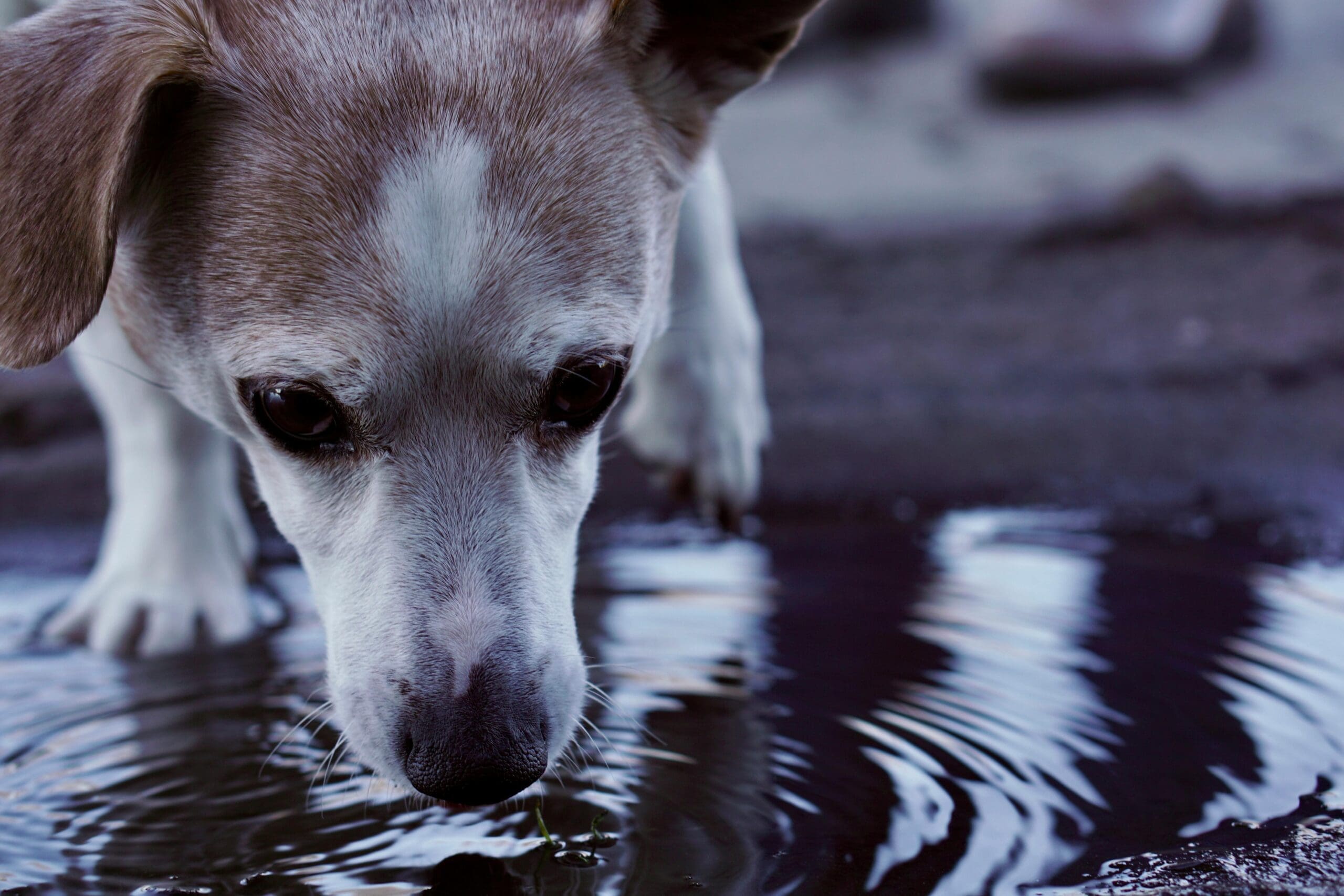
Illustrative photo; pexels-alina-klass-159588013-15881252