

By BRIDGES team
During the URI Europe Regional Assembly, “Sacred Earth, Shared Humanity: URI Europe Responses to Violence and Harm,” held from 29 April to 3 May 2026 at the Martí Codolar Centre in Barcelona, the Cooperation Circles of the United Religions Initiative (URI) came together to reconnect, exchange experiences and wisdom, celebrate their rich diversity, and co-create meaningful joint actions for the months ahead. The Assembly brought together more than 50 participants from 14 European countries and more than 10 traditions, alongside representatives from the global URI network in the United States and Argentina.
The event was sponsored by URI and generously hosted and supported by AUDIR CC (Associació UNESCO per al Diàleg Interreligiós), whose accompaniment throughout the gathering contributed to creating an inspiring and impactful space dedicated to strengthening shared commitments to peace, dialogue, justice, and the healing of both human and Earth communities.
The Assembly brought together European Cooperation Circle leaders and members of the URI Europe leadership team in a space of encounter, exchange, and collaboration – a space where relationships could be renewed and deepened, and where a shared vision and concrete pathways for collective action could emerge. Participants engaged in deep listening, mutual learning from diverse local and regional realities, and recognition of the unique gifts, experiences, and capacities that each member contributes to the wider URI network.
Aligned with URI’s Strategic Framework, the Assembly focused on strengthening the vitality and visibility of the network, building capacity and connections across Europe, and increasing collective impact in addressing religiously motivated violence, injustice, and ecological harm. Participants reflected on current local, European, and global challenges and explored how coordinated interfaith action can contribute to lasting peace, justice, and healing.
At this critical moment in history, the value of gathering face to face was strongly affirmed. Meeting in person enabled participants to deepen trust, strengthen their sense of belonging, and align their intentions as a living and connected interfaith network.
The Assembly aimed to:
- Strengthen connections and collaboration among European URI Cooperation Circles and deepen the shared sense of community within the URI network;
- Exchange experiences, good practices, and lessons learned from diverse interfaith initiatives and local contexts;
- Support the growth, visibility, and capacity of Cooperation Circles to promote peace, justice, healing, and interfaith leadership;
- Explore collective responses to religiously motivated violence, social harm, and ecological challenges through cooperation and dialogue;
- Integrate Indigenous, spiritual, and traditional wisdoms while aligning European initiatives with URI’s global vision and priorities;
- Promote interfaith cooperation in Barcelona, Catalonia, and across Europe, while strengthening partnerships with organizations committed to peace, sustainability, and social cohesion.
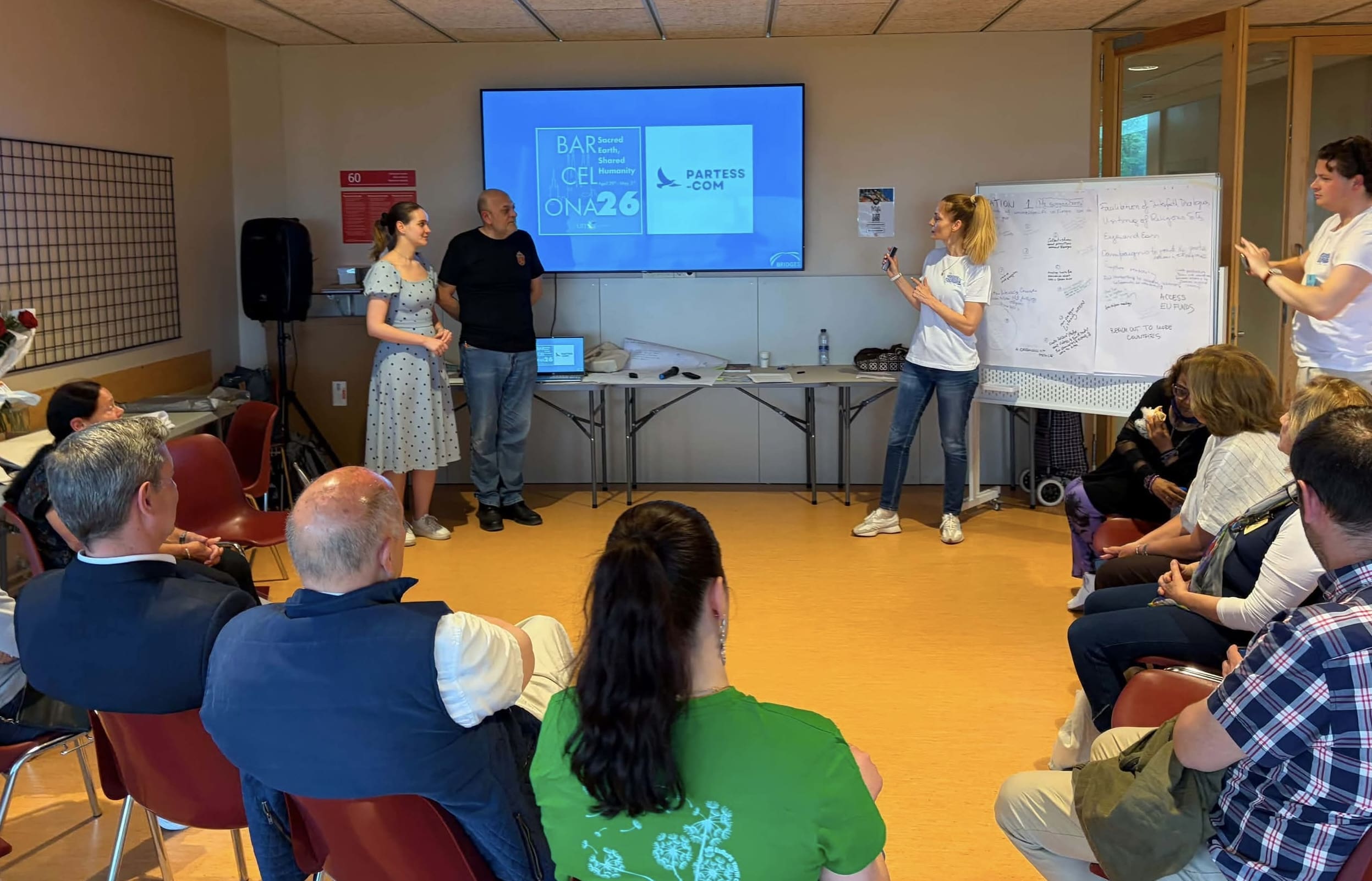
On the second working day of the Assembly, 1 May, the BRIDGES team delivered a 45-minute parallel session entitled “Participatory Approaches to Protecting Places of Worship, Schools, and Community Centers (PARTESS-COM)”, presenting the PARTESS-COM project and the Faith Guardian App. The session aimed to:
- Introduce the PARTESS-COM project, its partner organizations, context, core objectives, methodology, and expected impact;
- Present the Faith Guardian App as a practical tool for enhancing safety, prevention, and community engagement;
- Explore participatory approaches to security, emphasizing collaboration among institutions, communities, and stakeholders;
- Encourage dialogue and knowledge exchange on best practices for protecting vulnerable public and community spaces.
Participants were informed about the series of national and European training sessions organized within the framework of the PARTESS-COM project, with the support of the Brussels Police (PolBru) and safe.brussels. The project seeks to strengthen the security of places of worship and educational institutions through targeted training, awareness-raising activities, and access to effective security tools and resources. It also promotes cooperation among communities, practitioners, and public authorities in order to exchange promising practices and strengthen capacities in preventive security, crisis communication, and vulnerability assessment.
The training series is designed to share effective European practices and tools for securing public spaces, with particular attention to places of worship — including synagogues, mosques, churches, and other religious sites. The sessions highlight transferable methodologies related to preventive security, risk assessment, and crisis preparedness, and bring together representatives from law enforcement agencies, municipalities, and faith communities.
Participants were also introduced to an upcoming one-day capacity-building training programme to be held in Sofia as part of the EU-funded PARTESS-COM project. The training will be delivered by security experts with a specific focus on enhancing the protection of places of worship and faith communities. Designed as an interfaith initiative, it will bring together representatives of different faith traditions across Bulgaria to exchange experiences and strengthen cooperation.
The training programme will provide stakeholders with practical knowledge and skills related to:
- Extremism and preventive security concepts;
- Crisis communication;
- Basic vulnerability assessments;
- Practical application of available security resources;
- Mechanisms through which communities and citizens can report security-related incidents;
- The exchange of experiences, good practices, and proven solutions to common challenges.
Following a meeting with the municipal administration at the Barcelona City Council, the Commissioner for Citizen Relations and Cultural and Religious Diversity was introduced to the PARTESS-COM project and the Faith Guardian App. It was explained how the app provides three integrated services to support the preventive protection of places of worship and religious communities: a secure incident reporting tool that turns individual experiences into actionable data and, where necessary, connects users to law enforcement; a moderated and secure forum for peer-to-peer exchange; and a repository of evaluated security resources.
Together, these services help shift faith-based institutions from isolated vulnerability towards collective preparedness.
BRIDGES team


