*By Martin Hoegger
Under the luminous sky of Heraklion, between the Aegean Sea and the Cretan mountains, the International Symposium on Ecotheology was held in October 2025, organized by the Higher Patriarchal Academy of Crete. This spiritual and scientific event brought together thinkers from various Christian backgrounds to reflect on humanity’s responsibility in the face of the ecological crisis. Two presentations particularly interested me: that of Orthodox theologian Augustinos Bairactaris and that of Norwegian Lutheran Aksel Johan Lund. Both, though from different traditions, agreed on the same diagnosis: the ecological crisis is first and foremost a spiritual and anthropological crisis.
Creation as a Sacrament of Divine Presence
For Augustinos Bairactaris, professor at the Patriarchal Academy of Crete, the ecological crisis reveals humanity’s rupture with God and, consequently, with creation. By absolutizing reason and technology, modernity has erased the sense of the sacred. Humanity, having become the owner of the world, has forgotten that it is only its guardian. The universe is not a neutral object to be exploited but a gift to be received and celebrated with gratitude.
This loss of the sacred has led to a distorted form of freedom, turned into limitless license. By aspiring to be a demiurge, humanity has broken the harmony of creation. The ecological crisis becomes a mirror of human pride and selfishness. In response, theology offers a language of reconciliation. Ecotheology, born in the ecumenical context of the World Council of Churches, proposes an integral vision in which faith, justice, and the care of creation converge.
Drawing on the “Justice, Peace and the Integrity of Creation” program, Bairactaris emphasizes three core convictions: the earth belongs to God; humanity is its steward; and every creature has inherent value. He calls for an “ecological diakonia,” a ministry of the Church serving reconciliation between God, humanity, and nature. This diakonia has two dimensions: local—through solidarity and sharing—and global—through commitment to peace, social justice, and climate protection. Liturgy, charity, and social action thus become three expressions of one and the same service of love.
Overcoming Anthropocentrism
Norwegian pastor and researcher Aksel Johan Lund, a member of the Theological Council of the Church of Norway, addresses the same issue from another perspective. For him, the root of ecological disaster lies in anthropocentrism—the conviction that the human being occupies the highest place in creation. This idea, inherited from modernity and certain religious interpretations, has turned the non-human world into a mere instrument serving humanity’s needs.
Lund draws on the philosophical concept of “othering” to show that anthropocentrism functions as a form of exclusion. Humanity has marginalized nature, animals, and the elements, reducing them to “others” without intrinsic worth. This logic of separation has justified domination over the living world.
To overcome it, Lund turns to Maximus the Confessor, who teaches that all creatures participate in the same divine will. Humanity is not above the world but part of it. All creatures share a common origin and breath. Theology, therefore, should ask less what distinguishes humanity from other beings and more what unites them. Creation is not the “other” of humanity but its sister and its mirror. As Saint Paul writes, “the whole creation has been groaning in labor pains.” Our salvation cannot be separated from its own.
A Spirituality of Relationship and Responsibility
Both speakers call for a conversion of vision. Augustinos Bairactaris emphasizes that without transformation of the heart, no lasting ecology is possible. Lund argues for a theological reformation: moving from a theology of domination to a theology of relationship.
Ecotheology thus becomes a path of responsibility and gratitude. It invites us to contemplate the world not as a stock of resources but as a place of communion. It teaches us to see in the world’s beauty a sign of divine presence and to recognize in every living being a brother or sister in creation.
For both theologians, the ecological crisis mirrors our inner crisis. Humanity has forgotten that it is a creature among creatures. It needs a spiritual conversion: learning to bless rather than possess, to give thanks rather than dominate.
Ecotheology is neither an ideology nor a trend but a theology of gratitude. It reminds us that the world is a gift and that humanity is truly human only when it becomes eucharistic—that is, capable of saying “thank you.”
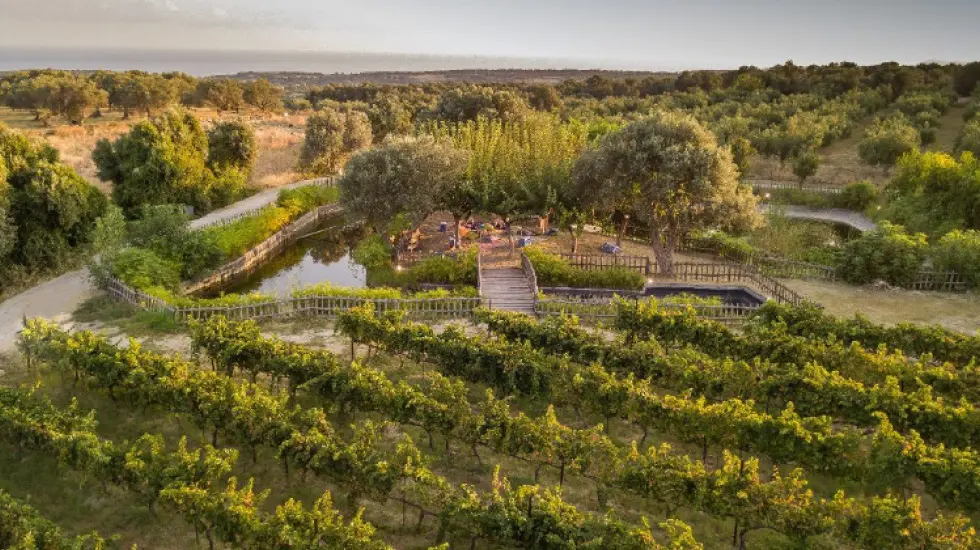
Photo: Agroecological Farm in Crete
* Martin Hoegger is a Swiss theologian and author. He participated in the Heraklion symposium. https://www.hoegger.org