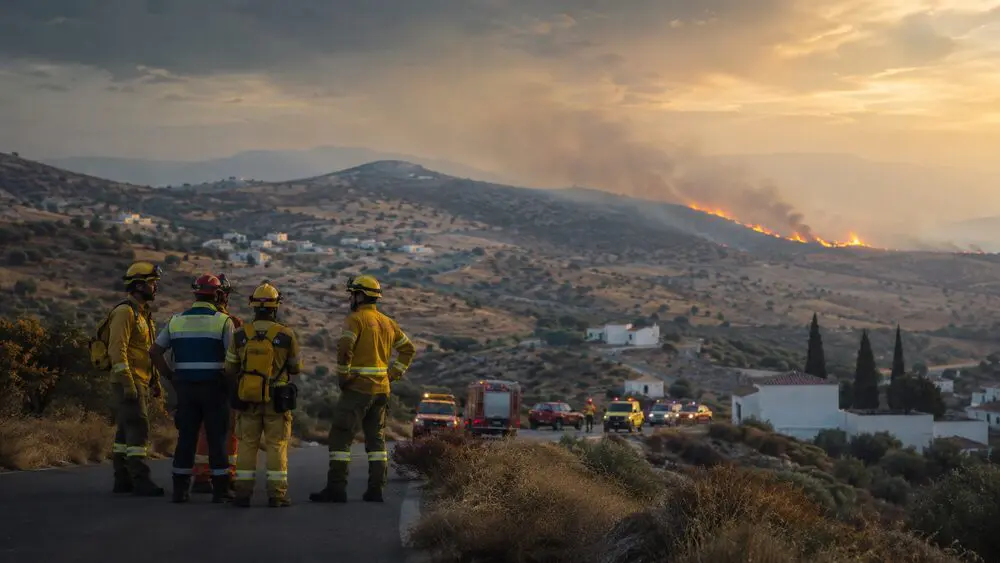
Deadly blaze in Los Gallardos raises questions over alerts, evacuation and Europe’s readiness for extreme summer fires
A fast-moving wildfire in Spain’s Almería province has killed at least 12 people and left others still unaccounted for, turning a local emergency into one of the country’s gravest recent climate-linked disasters. As firefighters work to contain the Los Gallardos blaze, the tragedy is sharpening scrutiny of public warnings, rural evacuation plans and Europe’s ability to protect people as heat, drought and wind make fires harder to predict.
The fire, which broke out near Los Gallardos in Andalusia, spread rapidly through dry scrubland and scattered rural settlements. Spanish public broadcaster RTVE reported that regional authorities had confirmed at least 12 deaths and 23 people not yet located, while officials urged caution over the provisional figures and said identification work was continuing.
Several people were also injured, including seriously burned patients transferred for specialist treatment. Search teams have been combing damaged homes and hard-to-reach areas where the fire has passed, while emergency crews continue to watch for reignition in terrain that officials have described as steep, dry and difficult for heavy machinery.
A Fire That Moved Too Quickly
Regional president Juanma Moreno said preliminary indications pointed to a broken electricity cable near a roadside as a possible starting point, though the cause remains under investigation. What turned a small fire into a deadly emergency, according to officials, was the combination of strong wind, dry vegetation and difficult access.
The blaze advanced with alarming speed, forcing local authorities to issue a mixture of evacuation and shelter-in-place instructions depending on the location. That distinction has become central to the public debate. In some dispersed homes and hamlets, residents were reportedly told to stay indoors; in others, they were told to leave. Authorities have said some victims may have died after trying to escape through unsafe routes.
The decision not to activate Spain’s ES-Alert mobile warning system has also drawn attention. Andalusian officials have defended the choice, arguing that a single mass message could have created confusion because different areas required different instructions and some zones had poor or damaged phone coverage. Critics are likely to press for a full accounting of whether alert procedures were adequate for a fast-moving fire in a fragmented rural landscape.
Preparedness Is Now A Rights Issue
The Almería fire is not only an environmental disaster. It is a public-safety and human-rights failure if vulnerable people cannot receive timely, understandable and practical instructions in a crisis. Rural residents, older people, foreign nationals, tourists, low-income households and people living in isolated homes may face higher risks when emergency communication depends on local knowledge, transport access or stable mobile coverage.
That matters because southern Europe is entering summers in which fire conditions are no longer exceptional. The European Times recently reported that Western Europe’s record heat is becoming a public-safety warning, with growing pressure on health systems, housing, infrastructure and civil protection agencies.
Public authorities will now face difficult questions. Were local warnings delivered quickly enough? Were evacuation routes clear and realistic? Did foreign residents and visitors understand official instructions? Were communities in scattered settlements adequately mapped and reachable? These are not abstract administrative questions; in a fire moving faster than people expect, they can decide who survives.
Europe’s Heat Warning
The wider climate context is stark. The EU’s Copernicus Climate Change Service said that June 2026 was the hottest June recorded for western Europe, with extreme heat contributing to health impacts, dryness and wildfire activity, particularly in the Iberian Peninsula and southern France.
Climate change does not remove the need to investigate the immediate cause of any individual fire. It does, however, alter the conditions in which sparks become disasters. Hotter air, drier soils, heavy vegetation growth followed by rapid drying, and stronger or shifting winds can make fires more explosive and less predictable.
For Spain, the challenge is especially acute. The country has long experience with wildfires, but the profile of risk is changing. Fires increasingly threaten not only forests but also peri-urban areas, tourist zones, isolated rural homes and infrastructure. Civil protection systems built around familiar seasonal patterns may struggle when extreme heat arrives earlier, lasts longer and overlaps with drought and wind.
The Test Is Protection
In the coming days, the immediate priority will remain humanitarian: identifying the dead, finding those still unaccounted for, supporting injured survivors and preventing further loss of life. Mourning must come before blame. But accountability should not be postponed indefinitely.
Europe’s climate debate often focuses on emissions targets, energy prices and industrial policy. The Los Gallardos fire shows another measure of climate governance: whether people receive protection when danger reaches their road, their home or their village.
That protection requires more than firefighters, however skilled and courageous. It requires clear alerts, multilingual communication, mapped evacuation routes, accessible shelters, resilient phone networks, land management, support for small municipalities and serious planning for people who cannot simply drive away at short notice.
The disaster in Almería is therefore both local and European. It is a tragedy for the families who have lost loved ones. It is also a warning to governments across the continent that preparedness is no longer a seasonal checklist. In a hotter Europe, it is a duty of care.