

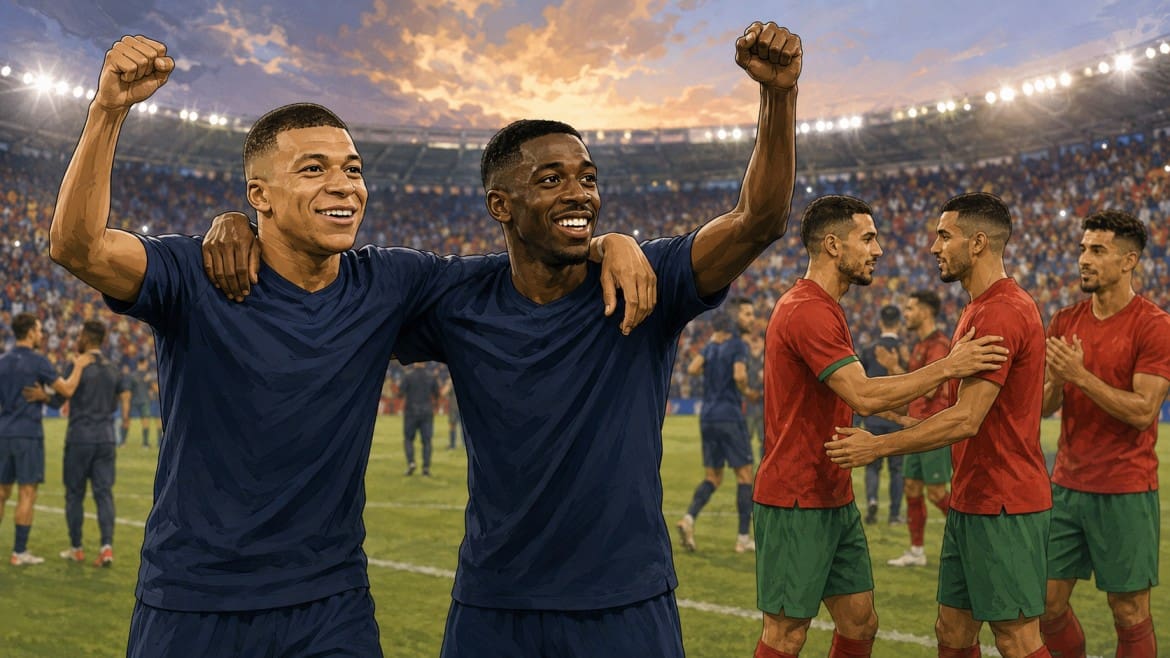
Mbappé and Dembélé ended Morocco’s resistance in Boston, but the quarter-final also showed how much this expanded tournament asks of Europe’s strongest sides
France reached the FIFA World Cup semi-finals with a controlled 2-0 win over Morocco in Boston, where second-half goals from Kylian Mbappé and Ousmane Dembélé turned a tense quarter-final into another statement of French tournament authority. Morocco leave after a campaign that again carried significance beyond one result, while France move closer to a final place with the pressure of European expectation still growing.
The match was decided in six second-half minutes. FIFA’s account of France’s 2-0 quarter-final win over Morocco described Mbappé as central to the breakthrough, with Dembélé adding the second soon after. Al Jazeera’s match coverage recorded the goals at 60 and 66 minutes, a short spell that changed the emotional weight of a contest Morocco had worked hard to keep alive.
A victory built on control
France did not need to turn the evening into spectacle. That may be the more revealing point. In knockout football, especially at a World Cup stretched across a larger field and a longer calendar, authority is often shown less through constant brilliance than through the ability to manage danger until the decisive moment arrives.
Morocco’s resistance made that patience necessary. They entered the quarter-final with the confidence of a side that has repeatedly forced established football nations to treat them as equals rather than romantic outsiders. Their organisation, athletic discipline and sense of collective responsibility kept the match balanced for long periods, even as France carried the heavier attacking threat.
When Mbappé scored, the match tilted sharply. When Dembélé followed, Morocco were left chasing not only two goals but the full machinery of a French side comfortable defending a lead, slowing tempo and using the clock as part of its game management.
Morocco’s exit is not a retreat
There is a danger, in elite sport, of making elimination sound like disappearance. Morocco’s defeat should not be read that way. Their run through the tournament has again confirmed the breadth of international football’s competitive map and the strength of a generation that has changed how opponents prepare for them.
For many Moroccan supporters in Europe, North Africa and the wider diaspora, this campaign was not only about progression through a bracket. It was about visibility, belonging and the right to see a national team carry itself with tactical seriousness on the game’s largest public stage.
That does not soften the sporting disappointment. Quarter-finals are not symbolic friendlies; they are opportunities that may not return in the same form. But Morocco’s place in this tournament has been earned by footballing substance, not sentiment, and that matters for how the defeat should be understood.
Europe’s burden grows heavier
For France, the win feeds a broader European story. Earlier European Times coverage noted how Europe’s World Cup depth is being measured in a tournament where status alone no longer protects anyone. France have met that examination better than most.
Their semi-final place also sharpens the question facing the continent’s leading football systems: whether technical quality, squad depth and institutional continuity can still translate into control when the tournament becomes more physically demanding and geographically scattered.
France’s answer, for now, is yes. The side have enough individual force to change matches quickly and enough collective experience to make those moments stand up. Yet the closer a team moves to the final, the less history matters. What remains is execution under pressure, and the burden of proving that a powerful football culture can still be humane, disciplined and clear-headed when the whole tournament narrows around it.
In Boston, France did what serious contenders do. They absorbed a difficult opponent, found their moment and protected it. Morocco leave with disappointment, but not diminishment. The World Cup moves on; so does the argument about where football’s centre of gravity now lies.


