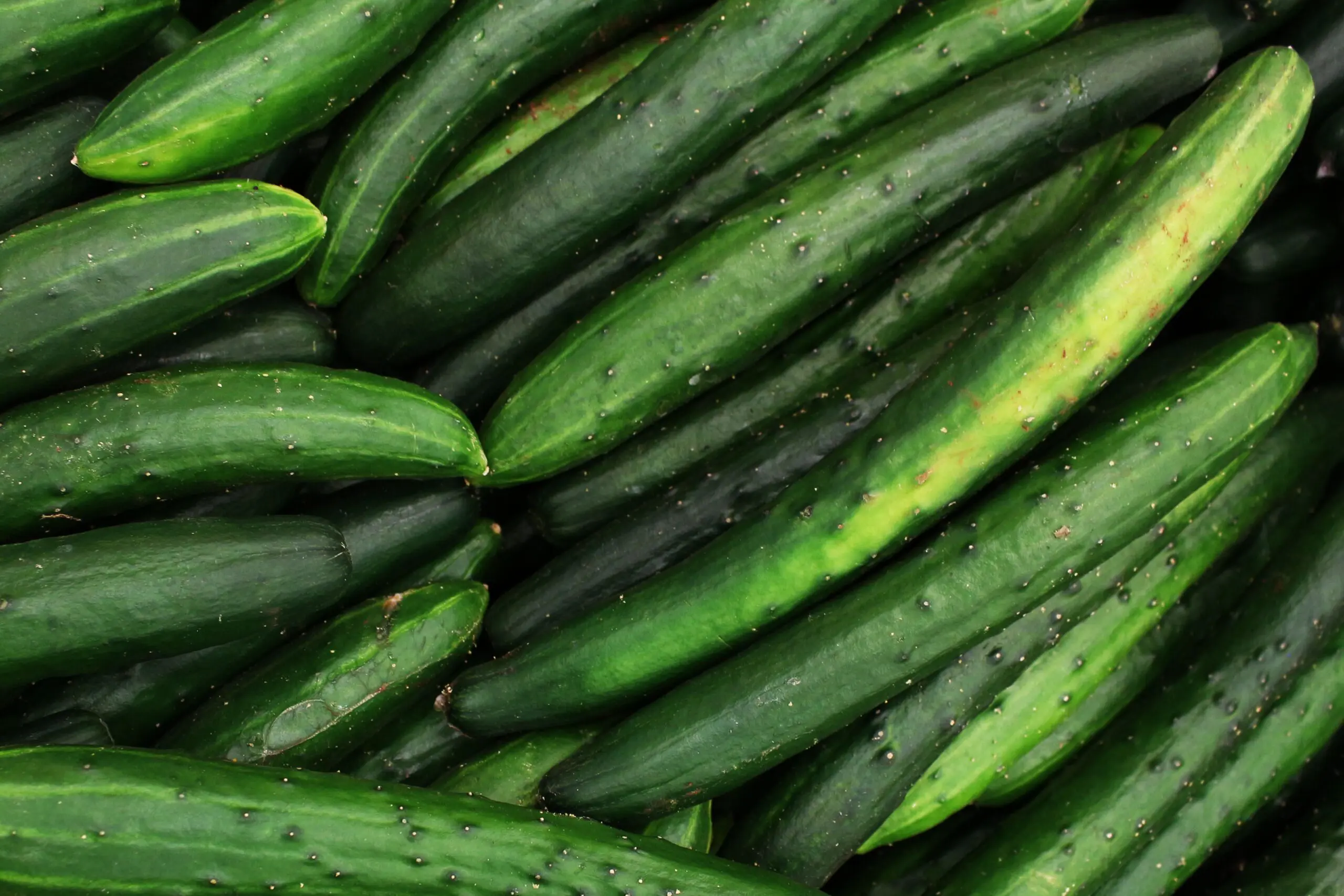
Cucumbers are a crop that needs regular feeding. It often happens that at the beginning of the season the fruits are abundant and correspond to the specific varietal characteristics, and in the midst of it unpleasant surprises happen. Fruiting quickly decreases and instead of perfect cucumbers, those with irregular and bizarre shapes appear.
This usually starts to happen in July (maybe even earlier), when cucumbers consume a large part of the nutrients in the soil. The leaves also often change their color and shape – they lighten and bend down.
Cucumbers are a real express among vegetables. From color to a cucumber ready for harvesting, only a few days pass, and if the plants experience any stress during this period, the fruits immediately begin to deform.
This situation can be corrected quickly, but we must learn to correctly read the signals that cucumbers give by changing their shape.
Potassium deficiency
If cucumbers begin to narrow towards the stem and swell towards the tip, becoming pear-shaped (or light bulb-shaped), the plants are sounding the alarm about an acute potassium deficiency. It is a basic building block responsible for the proper distribution of moisture in plants and the development of fruits.
Introducing potassium sulfate will quickly solve the problem. Foliar feeding gives results within just 1-2 days, and root feeding – longer-term. 1 tablespoon of potassium sulfate is needed for 10 liters of water and is watered evenly on moist soil. Potassium will restore the correct cylindrical shape of cucumbers and make them more crispy.
Nitrogen deficiency
Here the picture is diametrically opposite – cucumbers are swollen towards the stem, while the tip is sharp, pale and often curved into a hook. This is a strong signal of nitrogen deficiency.
It is the fear of nitrates that makes us completely exclude nitrogen from the cucumber menu, but this is a fatal mistake. They are a crop that needs this element until the end of the season, as new leaves constantly grow and replace the old ones.
To correct the situation, minimal doses of nitrogen are used – 1 teaspoon of urea per 10 liters of water will quickly and gently restore the cylindrical shape of cucumbers. This feeding can also be done with an infusion of weeds or vermicompost.
Phosphorus deficiency
This problem occurs when the soil is alkaline. This prevents the absorption of phosphorus, even when it is available.
A significant part of the buds fall off, and the rest are very small, deformed and have a bitter aftertaste. The leaves are bright green and bordered with a brown border.
The lack of trace elements, although cucumbers need small amounts, affects their development and fruiting. To avoid this, it is necessary to regularly add organic matter to the soil and use complex fertilizers for feeding.
During drought, cucumbers thin out in the middle, bend, remain significantly smaller and bitter, and a large part of the shoots fall off. The leaves turn yellow and dry out.
Illustrative photo: pexels-daniel-dan-47825192-7543157