When a country decides to dig a tunnel through a mountain to get ships to the sea faster, it’s no longer just an infrastructure project. It’s a sign that a multi-billion dollar industry is behind it.
That’s exactly what’s happening in Norway. The country is starting construction on the world’s first ship tunnel through the Stad Peninsula – a facility that will allow cargo ships to avoid some of the most dangerous waters in the North Sea. Among the biggest winners will be the salmon industry – Norway’s most valuable food export and one of the most important commodities on the world market.
But behind this tunnel lies a much bigger story – a real battle over a fish that has become a strategic resource in recent decades.
How salmon became “pink gold”
Just half a century ago, salmon was a relatively rare and expensive fish, available mainly to wealthy Europeans.
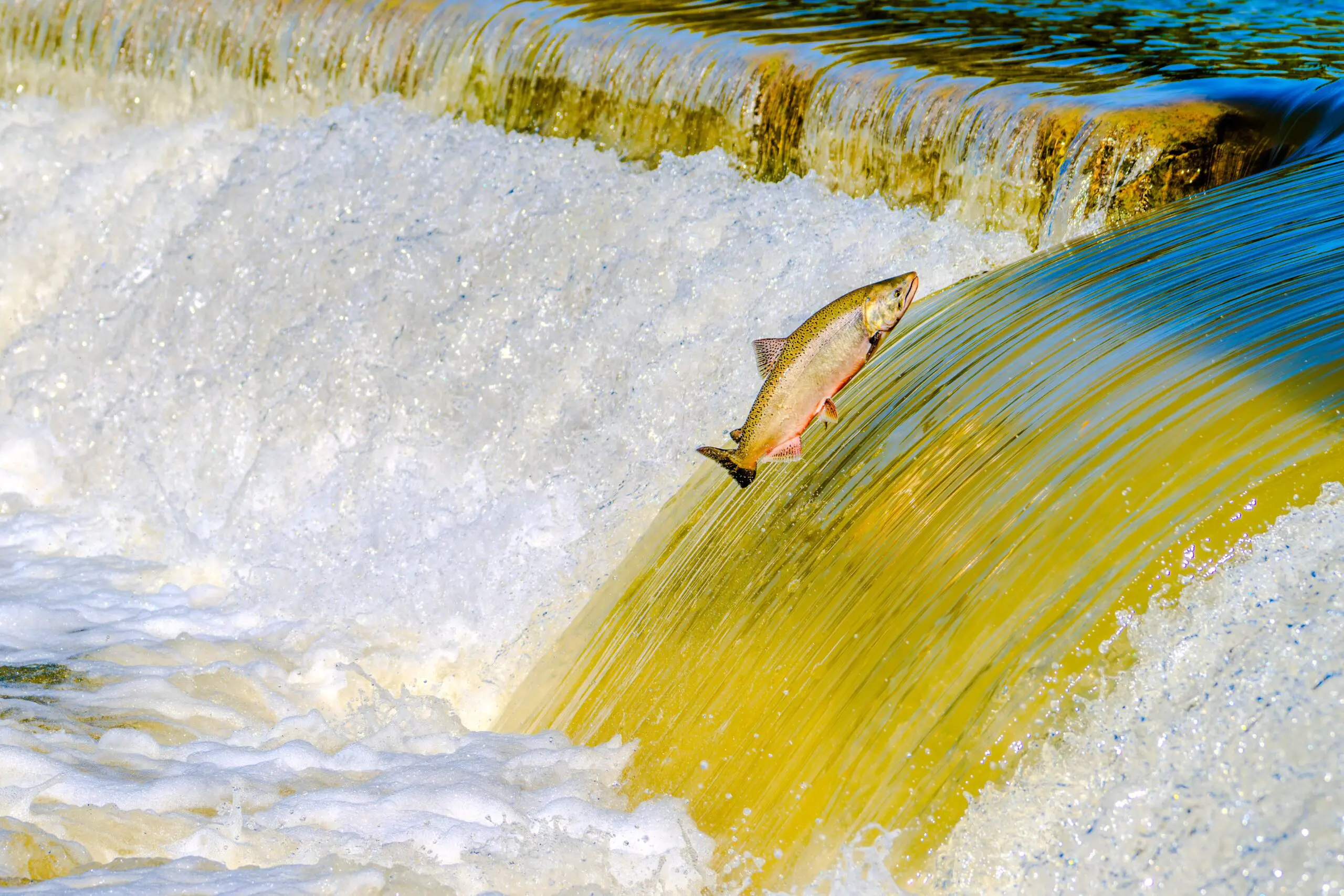
Today, it is one of the most traded foods in the world. Thanks to the development of aquaculture, the production of Atlantic salmon has increased many times over and has changed the way the world eats.
Norway has benefited the most from this revolution.
Today, the country produces more than half of all Atlantic salmon in the world. Exports bring in tens of billions of euros a year and are the second most valuable export sector after oil and natural gas. Norwegian salmon reaches more than 150 countries – from Japan and South Korea to the United States and the European Union.
The big battle is no longer between fishermen
The global salmon market no longer resembles traditional fishing.
It is a high-tech industry, in which giant companies participate with automated farms, artificial intelligence, underwater robots and continuous biological monitoring.
Any change in sea temperature, any disease or disruption in logistics can cause prices to jump around the world.
Climate is changing the rules
Recent years have put the industry to the test.
Warming oceans are increasing the risk of sea lice infestations, parasites that attack salmon and can destroy entire farms.
More frequent heat waves are reducing the oxygen content in the water, which increases fish mortality.
Scientists warn that if climate change continues at the current rate, some traditional salmon farming areas will become significantly less suitable in the coming decades.
Why prices are constantly rising
Demand for salmon is growing faster than production.
More and more consumers are choosing it as a healthy alternative to red meat, and Asian markets are increasing consumption every year.
At the same time, production has been difficult to expand. Norway is restricting new farm licenses to protect the environment, and strict environmental requirements make expanding production slow and expensive.
The result is a market in which even small shocks lead to significant price fluctuations.
Market tremors
The Atlantic salmon market is already feeling the strain.
By the end of June 2026, Norwegian salmon was trading at around NOK 74 per kilogram – an increase of over 13 percent in just one month. This is a clear signal that demand is outstripping production, and any climatic or logistical shock turns into a global price shock.
Analysts expect the trend to continue next year, when the price could exceed NOK 100 per kilogram. Thus, the “pink gold” is not just getting more expensive, it is establishing itself as one of the most volatile and strategic resources of the global food industry.
Norway is building the future
That is precisely why Oslo is investing billions in infrastructure.
The new ship tunnel through the Stad Peninsula will not only transport salmon, but this industry will be among its largest users. Faster and safer transport means fewer delays, lower costs and more secure deliveries to European markets.
For a product with a short shelf life, every minute saved counts.
The new competitors
For a long time, Norway seemed to be the unattainable leader. Today, however, competition is intensifying.
Chile is now the second largest producer of Atlantic salmon, and Scotland, the Faroe Islands, Iceland and Canada are constantly increasing their capacity.
At the same time, scientists are working on a new generation of land-based farms, where salmon will be grown in huge recirculating ponds far from the ocean. If the technology becomes economically viable, it could change the entire global market.
The salmon market will remain under pressure in the coming years. Global demand continues to grow, while production expansion is limited by climate change, environmental regulations and high investment. This means that salmon is likely to maintain its status as one of the most valuable foods in international trade.
That is why Norway is no longer investing only in farms. It is investing in tunnels, ports and logistics corridors. Because in the new economy, the battle is not only who produces the most, but also who delivers the fastest. And in the “pink gold” every minute gained is worth millions.
Illustrative photo: pexels-hberganza-34079758