
Brussels seeks another year of legal certainty for displaced Ukrainians, while tying some new arrivals to Ukraine’s wartime exit rules
The European Commission has proposed extending temporary protection for people fleeing Ukraine until 4 March 2028, giving millions of displaced people another year of residence, work and welfare rights in the EU. The move offers reassurance to families already rebuilding lives across Europe, but it also marks a more complicated phase in the bloc’s response: protection is being prolonged, while future rules are being shaped by Ukraine’s long war, labour needs, military obligations and the question of when return can be safe and voluntary.
The proposal, announced in Brussels on Friday, would prolong the EU’s temporary protection system by one year beyond its current expiry date of March 2027. The European Commission said the measure was intended to provide “legal certainty, stability and predictability” while Russia’s war continues to make conditions in Ukraine volatile.
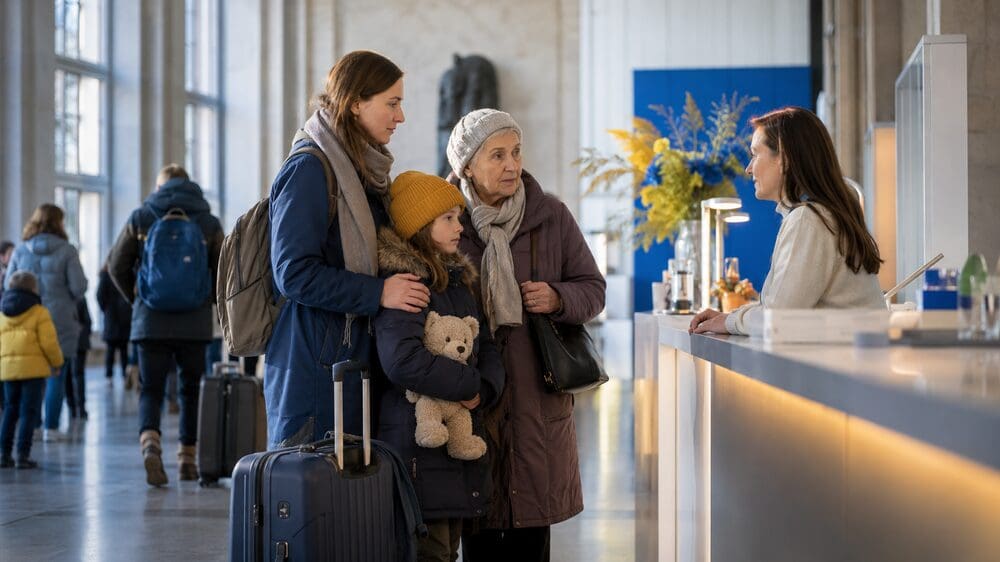
Temporary protection was activated in March 2022, days after Russia’s full-scale invasion, and became one of the EU’s largest collective protection measures. It allows eligible people fleeing Ukraine to live, work, study and access essential services in member states without going through ordinary asylum procedures.
A lifeline for millions
The scale remains substantial. According to Eurostat’s latest monthly data, 4.37 million non-EU citizens who fled Ukraine were under temporary protection in the EU at the end of April 2026. Ukrainian citizens made up almost all of that group, with adult women accounting for 43.4%, adult men 26.7%, and minors nearly one third.
Those figures show why the extension is not merely administrative. For families, it affects school enrolment, rental contracts, medical treatment, employment, language learning and the ability to plan beyond the next renewal deadline. For host countries, it shapes public services, labour markets, local integration programmes and housing pressure.
The Commission’s proposal also comes after EU member states previously agreed to extend protection until March 2027, a decision covered by The European Times as a rare point of unity in Europe’s migration debate. Friday’s proposal suggests that unity still holds in principle, but it now sits alongside harder questions about long-term status and Ukraine’s wartime capacity.
A narrower rule for some new arrivals
The most sensitive part of the proposal concerns newly arriving people who are not authorised by Ukrainian authorities to leave Ukraine because of military obligations. The Commission said temporary protection should not, as a rule, be granted to that category.
That language reflects a shift from the emergency logic of 2022, when the priority was rapid shelter for people escaping a sudden invasion. Four years later, the EU is trying to balance protection with Ukraine’s need to defend itself, while avoiding abrupt changes that could destabilise families already in the bloc.
The distinction will require careful implementation. Member states will need clear procedures, consistent safeguards and reliable information from Ukrainian authorities. Any uncertainty could place border officials, asylum services and displaced people in legally difficult positions, particularly where family unity, medical vulnerability or other protection needs are involved.
Beyond temporary status
The Commission also urged member states to prepare for a coordinated transition out of temporary protection. That means building pathways into longer-term legal residence for those who qualify, while supporting sustainable return and reintegration in Ukraine when conditions allow.
Brussels said it will work with interested member states and Ukrainian authorities on a voluntary return and recovery pilot programme, focused on practical support such as jobs, housing and education. The emphasis on voluntary return is important. For many Ukrainians, return remains a hope rather than an immediate option, especially if homes, schools, hospitals or workplaces have been damaged or if security remains uncertain.
The proposal now goes to the Council, where member states must decide whether to adopt it. Given the number of people affected, the decision will be watched closely not only in Brussels and Kyiv, but also in cities and towns across Europe where Ukrainian families have become part of everyday community life.
The EU’s challenge is to keep protection credible without pretending that temporary measures can carry a protracted displacement crisis forever. Extending the scheme buys time. What Europe does with that time will determine whether displaced Ukrainians are offered a stable future, a dignified return, or another year of uncertainty under a different name.