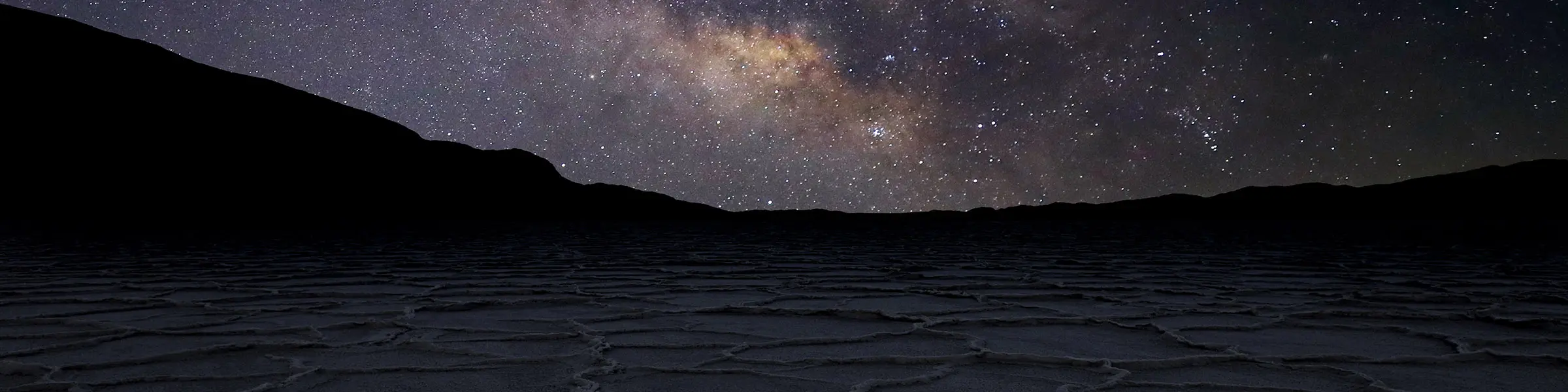
If you have ever seen the Milky Way in the night sky, you probably noticed that it looks cloudy. That is because towards the centre of our galaxy, and of most galaxies, there are vast amounts of dust that make it hard to see what is going on.
That means a big swathe of the universe is hidden to us, with about half of the light coming from galaxies buried in this dust. The best way to see inside these obscured regions is to use a gigantic submillimetre-wave telescope that detects radiation between radio waves and infrared.
“Without submillimetre, we’re getting a very biased picture of what’s out there,” said Claudia Cicone, an astrophysicist at the University of Oslo in Norway. “We are missing the regions of space that are most obscured by dust.”
In recent decades, telescopes like the Atacama Large Millimeter/submillimeter Array (ALMA) in Chile have allowed us to probe some of these regions.
Now astronomers want to go further with a new European-led project called the Atacama Large Aperture Submillimeter Telescope (AtLAST), a 50‑metre telescope far larger than any submillimetre telescope built before.
Early design work is being carried out in an EU‑funded project called AtLAST2, which is running until 2028. Researchers from Europe and around the globe – Chile, South Africa, Canada, Taiwan, Thailand, New Zealand, Japan and the USA – are refining the concept by prototyping key technologies and planning how to run the facility as sustainably as possible.
The aim is to bring that cloudy, hidden universe into focus. “With previous submillimetre facilities, we’re observing the tip of the iceberg,” said Cicone, one of the leads on the telescope. Astronomers can today see only a fraction of the cold gas and dust that shape galaxies.
“
We are missing the regions of space that are most obscured by dust.
“With AtLAST, we will answer the question of where all the gas and dust in the universe is.”
AtLAST is designed to slot into a new generation of giant observatories set to reshape astronomy in the 2040s, following Europe’s Extremely Large Telescope, which is nearing completion in Chile.
Without a large, single-dish submillimetre telescope like this, astronomers say there will be a major gap in our ability to map cold gas and dust across the sky and to link what these other facilities see at different wavelengths.
Wide-angle view
ALMA’s 66 antennas in the Atacama Desert act like a microscope, giving focused views of dusty regions where stars and planets form. AtLAST, by comparison, would be a wide-angle camera, able to take a census of dusty locations across the universe.
“ALMA can only see an area thousands of times smaller than the Moon’s surface on the sky in any given observation,” said Tony Mroczkowski, an astronomer at the Institute of Space Sciences in Spain and another of AtLAST’s leads.
“ALMA is powerful, but you can’t map the sky with a microscope. In comparison, AtLAST will image an area up to 16 Moons in size with every observation, so we can map the hell out of the universe,” he joked.
To map the sky at that scale, the telescope would “need to move fast to map back and forth”, said Mroczkowski. “With a huge field of view, we would create a pretty large map of the sky quickly.”
The AtLAST2 team is using this design phase to prototype crucial parts of the telescope, from its optics and control systems to its data handling.
Built to last
The primary 50‑metre dish of AtLAST would be designed with aluminium panels in the mirror and a massive steel backing structure. In total, it would weigh about 4 400 tonnes, and would include a 12‑metre secondary mirror – itself larger than most telescopes – to help deliver its wide field of view.
It would be located near ALMA in the Atacama Desert, where the thin and dry atmosphere at over 5 km above sea level allows a pristine view of the universe.
“The telescope would be entirely powered by renewable energies, using a novel, tailored hybrid energy regeneration,” said Cicone. As the telescope slows after moving, its kinetic energy can be recovered as electric charge, like in a hybrid car.
To run a power‑hungry, 50‑metre‑class observatory at a remote, high‑altitude site without fossil fuels, the project is testing combinations of solar power, energy storage in batteries and metal hydride, as well as recovery of braking energy.
The researchers also plan to use near-zero carbon power to produce the steel and aluminium. The hope is that AtLAST2 will set a pattern for how large observatories can do ambitious science without jeopardising Europe’s climate targets.
Multiple countries would also be involved in the project, including Japan, which had previously considered building its own 50‑metre submillimetre dish, the Large Submillimeter Telescope (LST).
“We realised that we should join forces,” said Cicone.
The AtLAST2 project aims to turn that closer cooperation into a concrete, shared facility, bringing together European expertise and partners around the world.
Hidden galaxies
AtLAST’s survey could reveal cold gas and dust that fuels star formation, dusty galaxies that were previously obscured, and even unseen components of the Sun’s atmosphere. “We can study the solar atmosphere and the variability of solar flares as has never been done before,” said Cicone.
For galaxies, AtLAST would peer into particularly dusty regions of the universe where galaxies are currently obscured. Astronomers can detect light from these regions, but individual galaxies blur together, making it impossible to tell how many there are.
“You don’t know if the light is coming from one galaxy, 10 galaxies, or 1 000 galaxies,” said Cicone, referring to what is known as the confusion limit. AtLAST will recover these missing galaxies, she said, with the potential to find up to 50 million in 1 000 hours of observations.
“
With AtLAST’s huge field of view, we would create large maps of the submillimeter sky extremely quickly.
Doing this will help astronomers understand how the universe has evolved over cosmic time, helping to pin down the accelerated expansion of the universe due to dark energy, and the nature of dark matter – the unseen stuff whose gravity shapes galaxies.
It could also reveal much of the universe’s missing matter, both the hot and the cold gas that should exist around galaxies but has proven hard to find, using traditional visible-band wavelengths.
By spotting molecules that might be the building blocks of life, AtLAST could help astronomers answer how life emerges in the universe, and how it develops and evolves, said Mroczkowski.
Peering into molecular clouds and debris discs – the regions of gas and dust around young stars – it would also give us greater insight into how stars and planets form.
Perhaps the greatest science would come from the unknown – unexpected discoveries such as new transient, short-lived events that only appear at sub‑millimetre wavelengths, and that only AtLAST’s large field of view can reveal. There may be plenty of time to find those mysteries, with AtLAST designed to operate for 50 years.
The goal is to make it “not just a throwaway, disposable telescope,” Mroczkowski said, but rather one with a long life and upgradeable instrumentation that can benefit future generations of astronomers.
Research in this article was funded by the EU’s Horizon Programme. The views of the interviewees don’t necessarily reflect those of the European Commission. If you liked this article, please consider sharing it on social media.