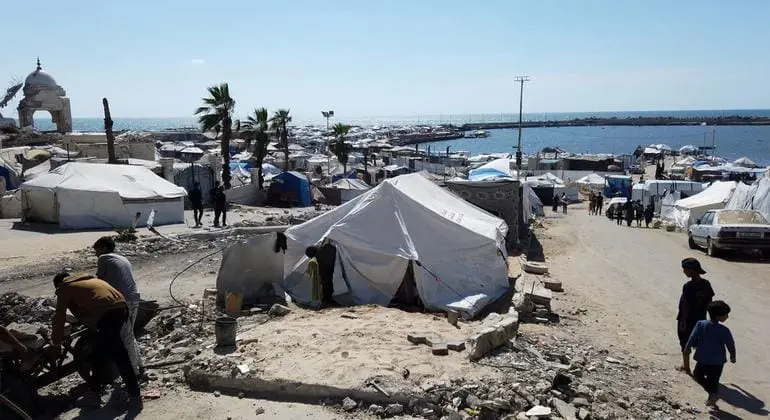
Zeenat and her spouse, Moamen Abu Asr, reside with their children in a fragile canvas tent, part of the thousands that now stretch along the coastline of Gaza. Once a destination for relaxation and enjoyment, the beach has transformed into a final sanctuary for Palestinians who have been forcibly displaced due to continuous Israeli airstrikes and military operations. As evacuation orders confine people to increasingly smaller areas, the coastal strip near Gaza’s port has evolved into a temporary settlement. The tattered tents and crowded living situations illustrate the severity of a humanitarian crisis that has reached alarming levels after more than 600 days of conflict between Israeli military forces and Hamas. The seaport, formerly a hub for Gaza’s fishing industry, now resembles a barren wasteland. All fishing boats have been destroyed, replaced instead by a sprawling camp lacking in basic survival essentials.
Moamen Abu Asr is seen repairing a water tank outside his tent.
A family stripped of everything
Moamen and his family have been residing in the camp for roughly two months, managing to survive in a tent assembled from salvaged mats and broken utensils scavenged from nearby debris. Sitting outside with his children, he scrolls through photographs on his phone—fragments of their former life in Shujaiya, located east of Gaza City, where residents faced sudden evacuation orders. “There have been times when we’ve faced displacement every couple of months,” he shared with UN News. “Each day brings suffering for us. We arrived at Gaza port with no food, no water—without even our iron tent.” He lamented, “There are no basic necessities for us.” To provide for his family, Moamen repairs small water tanks for five shekels, approximately $1.43, barely sufficient in an area where prices have surged. “A kilogram of flour costs a hundred shekels [around $28.60],” he detailed. “Our situation is extremely difficult, and we feel lost. By God, this is not living. We would prefer to die.”
Flies buzz around one of the sleeping children in the Abu Asr family’s tent in Gaza.
‘We survive on water’
The humanitarian crisis has intensified since March, when Israeli authorities enforced a total blockade on aid. Although this blockade has recently been somewhat relaxed, the minimal flow of supplies fails to meet the vast needs of the population. Desperate civilians, facing starvation and fear, have resorted to looting any aid that arrives. Inside their tent, Zeenat cleans a few cooking utensils—her only finds from the communal makeshift kitchen. Most days, there is little food to prepare. “Yesterday, I wept a great deal over my son,” she recounted. “He told me, ‘Mum, I want to eat.’ I felt powerless, unsure of what to do. The charity kitchen didn’t provide food. We now survive on fresh water; I advise my children to drink it to help ease their hunger. Today, thankfully, we received a plate of food and managed to eat.”
Zeenat Abu Asr describes the challenges her family is enduring in Gaza.
‘Our patience has run out’
The living conditions within the tent are appalling. Flies swarm incessantly, and hungry stray dogs roam nearby. “Yesterday, a dog entered the tent and tugged on a tarpaulin while my son was sleeping. I feared it was pulling my baby. I screamed, and my husband forced the dog out,” she recounted. “We don’t know where to turn or what to do. They have uprooted us. Our spirits are crushed. We can no longer endure. Our patience has worn thin.” The tents scattered along Gaza’s coastline serve as a stark reminder of the escalating humanitarian crisis. The cries of those suffering from hunger overshadow any glimmer of hope. There is no shelter left—only the sea remains.
Zeenat’s closing plea encapsulates the depth of their despair: “Let the war conclude. Grant us a reprieve. Otherwise, let all nations unite and drop a nuclear bomb on us to end our suffering because we are exhausted from this existence. Enough is enough.”