


A case of abusive detention on the basis of presumption of guilt. Human Rights Without Frontiers urges Seoul for his release.
For one month, Chairman Lee (Lee Man Hee, born in 1931), founder and spiritual leader of the Shincheonji Church, has been held in pretrial detention since his arrest on 24 June 2026, making him arguably the oldest prisoner in the world, despite not having been found guilty of any crime.
This is not happening in a totalitarian or dictatorial country, but it is happening as we speak in a democratic country: South Korea.
Why was he put in prison? He has not killed anybody, he has not used any form of violence or incited to violence, he has not been involved in drug trafficking or money laundering, he has not been suspected of sexual abuse or rape, he has not personally enriched himself in a fraudulent manner, he is not being investigated about tax evasion…
Exactly a month ago now, a Seoul court issued an arrest warrant at the end of a court hearing, and he was taken into custody on the same day on allegations related to influencing political party membership and elections. Concretely, he is accused of directing his followers to sign up as members of the conservative People Power Party, allegedly violating hereby the Political Parties Act.
The alleged crime is a supposed violation of the principle of separation of religion and state and he was detained over concerns that he could possibly destroy evidence or escape. At his age? Chairman Lee denies any wrongdoing and his lawyers have appealed the court decision putting him in pretrial detention.

Judicial harassment and media campaign against Chairman Lee. What is behind?
In the last few years, there were already two main attempts to legally ‘decapitate’ the Shincheonji Church of its leader, but every time the Supreme Court of the country declared Chairman Lee fully innocent of the fabricated charges.
It started when COVID started in 2019, when the Shincheonji Church was accused of having hosted a meeting that allegedly introduced the pandemic into the country. A huge media campaign in South Korea targeted and vilified Shincheonji for months and years.
This further intensified already severe and deeply rooted misconceptions about Shincheonji, particularly prevalent in South Korea. This in turn resulted in numerous instances of discrimination against individuals identified as members of a “cult”, including physical assaults, public ridicules, and dismissal from employment.
On 11 August 2022, the Korean Supreme Court dismissed a separate lawsuit based on alleged deceptive evangelism. It ruled that the missionary activities of Shincheonji were not illegal, hereby overturning a lower court’s decision.
On 12 August 2022, the Supreme Court of Korea declared that Shincheonji was not guilty of the widely publicized charge of violation of health regulations on COVID-19. This important court decision in South Korea restoring the truth remained, however unreported and unnoticed outside the country.
In Europe, media outlets and journalists continue to repeat unfounded accusations while largely ignoring the two Supreme Court decisions that cleared Chairman Lee. Whether this stems from laziness, ignorance, or a preference for sensationalism is difficult to determine. Whatever the reason, it has contributed to persistent but unfounded suspicions about the Shincheonji Churches in Europe, damaging their reputation despite their lack of involvement in the events in South Korea. In some cases, this has also negatively affected their relationships with public institutions and banks. (*)
The media reporting in Europe has sometimes also had a negative impact on the family relationships of certain converts to the Shincheonji Church, at times causing disruptions that have lasted for extended periods.
The question that remains is what forces drive harassment of this church in South Korea, and the detention of its 95-year-old leader? There are at least two concurring factors that explain it: the controversial practices of a number of Presbyterian pastors and the political party currently in power.
The conflict between radical Presbyterian pastors and the Shincheonji Church
Korean Presbyterianism originated in Korea in the early 1880s following the evangelisation efforts of Scottish Presbyterian missionaries.
In the 20th century, under Japanese colonial rule (1910-1945), the Church went through its greatest crisis in its history. Until the end of the 1930s, the Church was deeply divided on issues such as the loyalty to the Japanese emperor, the participation in imperial ceremonies and the worship at Shinto shrines. Many pastors who refused to “collaborate,” were imprisoned, tortured and killed in prison. Others accepted, under coercion, to participate in shrine ceremonies because they wanted to avoid the closure of their places of worship, the imprisonment of their pastors and the destruction of their church institutions.
Presbyterian pastors are nowadays again divided but on different lines: to what extent can they theologically accept religious diversity? The theology of Shincheonji is a challenge to them.
There is a competition and even a conflict between Presbyterianism and the Shincheonji Church.
Shincheonji Church is a Christian new religious movement which was founded in South Korea in 1984 by Chairman LEE (born in 1931) and is still led by him as of July 2026. In early 2026, their membership could be estimated at over 500,000 with another 200,000 students studying their Bible course, according to their own statistics.
This expansion could not remain unnoticed from Presbyterian churches, particularly because in the past most new congregation members of Shincheonji were coming from among their ranks. This triggered vigorous anti-Shincheonji campaigns from the religious establishment, especially in a number of Presbyterian congregations.
Pastors of anti‑heretical counselling centres, largely affiliated with Presbyterian churches, have encouraged and participated in coercive de‑conversion of Shincheonji members, a practice aimed at compelling individuals to recant the faith they freely embraced.
According to Shincheonji’s own statistics for 2003–2019, around 1,500 congregation members report having “survived” coercive changes of religion, including family abduction, confinement, and “deprogramming” carried out by some Presbyterian pastors and other anti‑Shincheonji activists.
These practices have caused severe psychological and physical hardship and have been linked by NGOs and observers to at least two tragic deaths of female Shincheonji members in 2007 and 2018, highlighting the grave human rights concerns raised by deprogramming. The victims of coercive de‑conversion were adults who had freely chosen to follow the teachings of the Shincheonji Church but either resisted this ‘re‑education’ or managed to escape it.
Human Rights Without Frontiers investigated the issue in South Korea itself in 2020 and published a 66-page report titled “Coercive Change of Religion in South Korea” based on numerous interviews of victims of that practice that was illegal but that was never prosecuted and remained unpunished.
The Minister of Justice violating his duty of restraint
The second factor explaining the prosecution of Chairman Lee is political.
South Korea’s Minister of Justice, Jeong Seong-ho, recently wrote in Facebook: “Lee Man-hee, Chairman of Shincheonji, who is accused of forcibly registering more than 50,000 believers as members of a specific political party, was indicted and detained. The allegation is that through mass party enrollment during major political events such as presidential primary elections, local elections, and party leadership elections, he distorted the political will of political parties and citizens and violated the constitutional principle of separation of religion and state.”
Moreover, in addition to openly politicizing the issue, the minister also declared on Facebook that Chairman Lee was “a false prophet.” With this value judgment, he publicly took sides in a theological debate and against a specific church, interfered in the internal matters of a religion and violated the constitutional principle of separation between state and religion.
And the Minister concluded his Facebook post with a biblical quotation: “Beware of false prophets, who come to you in sheep’s clothing but inwardly are ravenous wolves.” He gives his reader a reference to the Gospel of Matthew (7:15). Willy, is it not true that by making these statements, he, himself, traspasses the separation of religion and state boundary that is observed in South Korea?
Also noteworthy is that in South Korea, a draft law is pending that would authorize swift dissolution of religions whose leaders have been sentenced or that “interfere in politics.” This is clearly specifically targeting the Shincheonji Church.
Last but not least, it must be said that Minister Jeong Seong-ho is known as a pious Presbyterian.
A European fact-finding mission of several religious freedom experts is being set up in Brussels to investigate the situation of freedom of religion or belief in South Korea and should be in Seoul in early August.
(*) See the articles published in 2026 by Human Rights Without Frontiers about the Shincheonji Church in the United Kingdom: Separating the wheat from the chaff about their evangelism, Legal status, church development and founders and State of play of the interaction with the European culture.
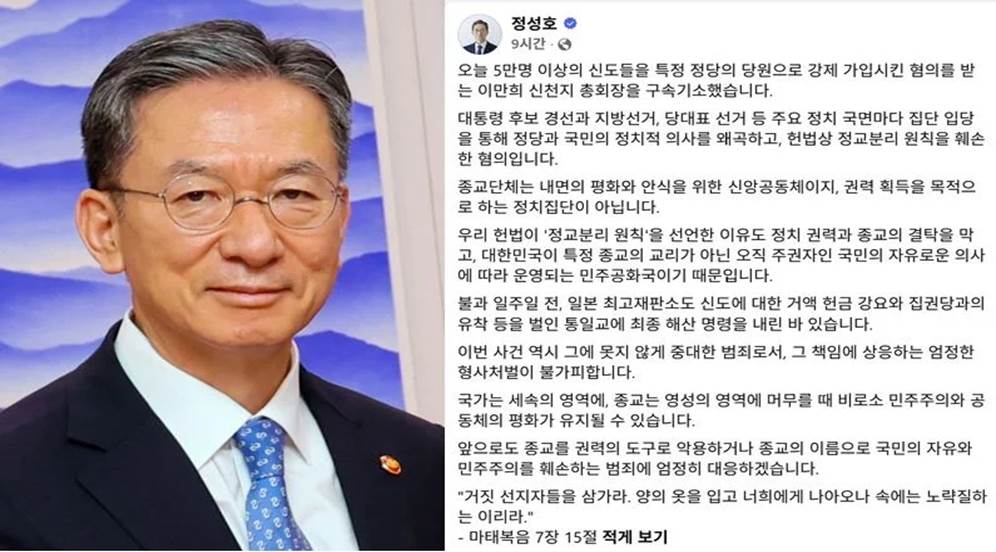
Minister Jeong Seong-ho and his extraordinary Facebook post.Credit: Bitter Winter