
Certified viewers, indirect projection and careful timing can protect eyesight during total, partial and annular eclipses
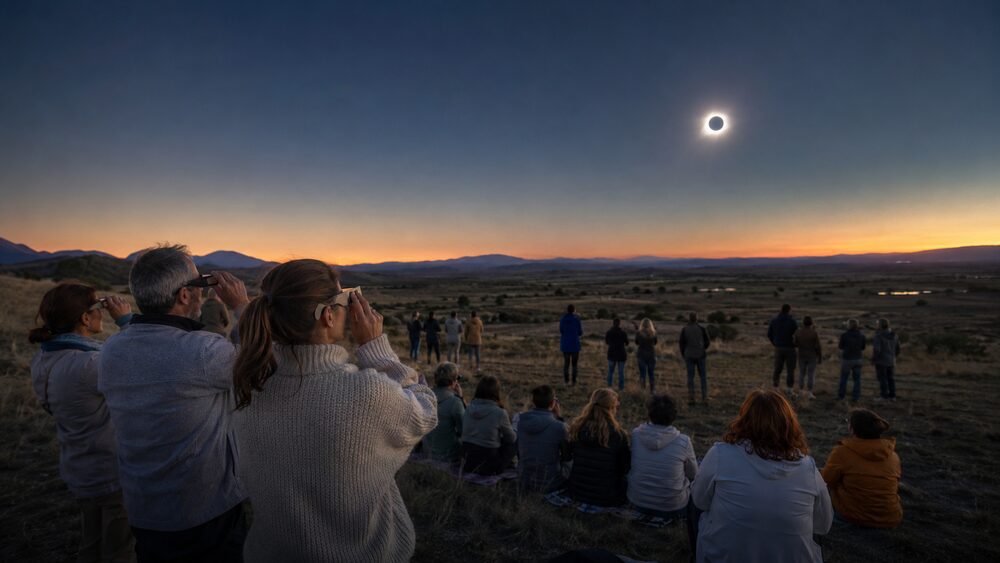
A solar eclipse can be observed safely, but ordinary sunglasses, improvised filters and cloud cover do not protect the eyes. During every partial or annular phase, viewers need certified solar eclipse glasses or a safe indirect viewing method. Unprotected viewing is permissible only during the brief total phase of a total eclipse, when the Moon completely covers the Sun.
Why an eclipsed Sun can still damage eyesight
An eclipse makes the Sun appear less bright, encouraging people to look for longer than they normally would. However, the uncovered part of the Sun remains intense enough to injure the retina, the light-sensitive tissue at the back of the eye.
Even when 99% of the Sun is hidden, the remaining crescent can cause serious and potentially permanent damage. Clouds, mist, smoke or a low position near the horizon do not make direct viewing safe.
Retinal injury may occur without pain. The eye has no immediate warning mechanism that reliably tells a person when damage is taking place, so an observer may believe nothing harmful has happened until changes in vision appear later.
How to identify safe eclipse glasses
Solar viewers intended for direct observation should comply with the EN ISO 12312-2:2015 standard. This is different from ISO 12312-1, which applies to ordinary sunglasses and does not provide sufficient protection for looking at the Sun.
The Instituto de Astrofísica de Canarias eclipse guidance advises European consumers to check for several features:
- A clear EN ISO 12312-2:2015 marking on the viewer, packaging or instructions.
- A visible and legible CE conformity mark on products sold in the European Union.
- The manufacturer’s name, instructions for use and appropriate warnings.
- Filters without scratches, holes, tears, creases, lighter patches or other damage.
- Purchase through a reputable supplier, observatory, planetarium or recognised astronomy organisation.
A printed certification claim is not, by itself, proof that an unknown product has been properly assessed. If the origin or condition of a viewer is doubtful, the safer choice is not to use it and to observe through an indirect projection method instead.
Ordinary sunglasses are unsuitable, regardless of their darkness or price. Smoked glass, exposed photographic film, CDs, X-ray film, tinted plastic and homemade combinations of filters are also unsafe.
Using solar viewers correctly
Inspect eclipse glasses before every use. Put them on before turning towards the Sun. When finished, turn away from the Sun before removing them.
People who normally wear prescription glasses can place eclipse viewers over them. The solar viewer must remain securely positioned so that direct sunlight cannot enter around its edges.
Observation should be brief, with regular pauses. Children and people requiring assistance should be supervised closely. Adults should demonstrate the procedure before the eclipse begins, when excitement and changing light can make instructions harder to follow.
Damaged viewers should be discarded. Tape or glue should not be treated as a reliable repair for a torn or punctured solar filter.
Total, partial and annular eclipses require different precautions
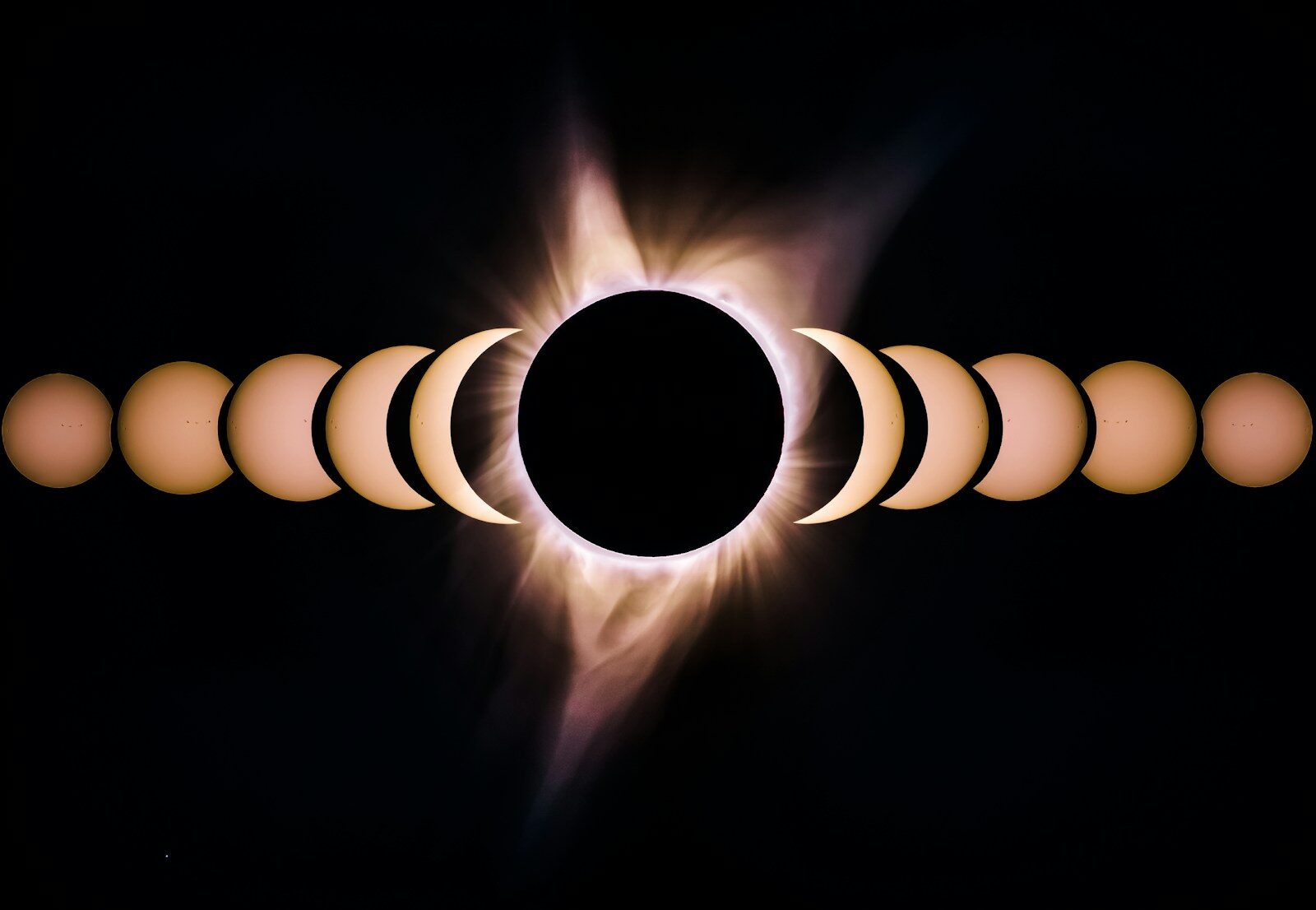
During a partial eclipse, part of the Sun remains visible at all times. Certified protection is therefore required throughout the event. This applies even when only a very thin crescent remains.
An annular eclipse produces the familiar “ring of fire” because the Moon appears too small to cover the Sun completely. The bright ring is direct sunlight, so eclipse glasses must remain in place during annularity as well as during the surrounding partial phases.
A total eclipse is the only exception. Observers located inside the path of totality may remove their viewers after the Sun has become completely covered. Anyone outside that narrow path will experience only a partial eclipse and must remain protected.
Viewers must be replaced as soon as the first bright point of the Sun returns. This appearance, sometimes called the diamond-ring effect, marks the end of safe unfiltered observation. Anyone uncertain whether totality has begun or ended should keep the glasses on.
Cameras, binoculars and telescopes need separate filters
Eclipse glasses are designed for unmagnified viewing. They must not be used as a filter while looking through binoculars, a telescope or a camera viewfinder.
Optical instruments concentrate sunlight and heat. This can damage the instrument, destroy an incorrectly positioned filter and cause immediate eye injury. A solar filter designed specifically for the equipment must be securely fitted over the front aperture, before sunlight enters the optics.
Filters that attach behind the eyepiece are unsafe because concentrated light reaches them first. Anyone unfamiliar with solar observation should seek assistance from an observatory, astronomy association or experienced operator rather than improvising an optical arrangement.
Cameras and smartphones also require care. Pointing a lens at the Sun for an extended period may damage the sensor, particularly when magnifying lenses are used. A suitable front-mounted solar filter and the equipment manufacturer’s instructions should guide any attempt to photograph the partial phases.
Indirect projection offers a simple alternative
People without certified glasses can follow an eclipse without looking towards the Sun. A pinhole projector uses a small opening in an opaque card to cast an image of the Sun onto a second surface.
The observer should stand with their back to the Sun, allowing sunlight to pass through the hole onto paper, card or another light-coloured surface. The projected image will change as the Moon moves across the Sun. No one should look through the pinhole.
A kitchen colander can produce many small projected crescents. Gaps between tree leaves create the same effect naturally, covering the ground with changing images of the eclipsed Sun.
Projection is particularly suitable for schools, families and public events because several people can watch the same image without sharing glasses. It can also make the eclipse more accessible to people who are uncomfortable wearing viewers or cannot position them reliably.
Possible signs of solar retinopathy
Solar retinopathy is retinal injury caused by looking directly at the Sun. Symptoms may not appear immediately and can develop hours or days after exposure.
Possible warning signs include blurred vision, visual distortion or a dark or missing area near the centre of the visual field. Reading and recognising fine detail may become difficult. Symptoms can affect one or both eyes.
Anyone who notices a change in vision after viewing the Sun should seek prompt medical or eye-care assessment. The absence of pain does not mean that no injury has occurred.
Planning a safe viewing location
Official astronomical sources should be used to confirm whether an eclipse will be total, partial or annular at a particular location. The distinction determines whether there will be any period when glasses can be removed.
Observers should also consider the Sun’s height, the direction of the horizon, weather, heat, transport and crowd conditions. A famous location is not necessarily the best one. A nearby open space with an unobstructed view and manageable access may offer a safer experience.
Public observation sites can provide trained staff, reliable timing announcements and equipment adapted for group use. Organisers should make instructions available in accessible formats and in languages understood by residents and visitors.
Clear public guidance is part of the wider relationship between science and society. As The European Times has reported in its examination of scientific trust in Europe, public confidence depends on institutions explaining evidence, uncertainty and risk honestly rather than relying on authority alone.
Europe’s coming solar eclipses
Europe is entering an unusual sequence of major solar events. The European Space Agency’s eclipse calendar identifies three particularly important dates:
- 12 August 2026: a total eclipse crossing Greenland, Iceland, Spain and northeastern Portugal, with a partial eclipse across much of Europe.
- 2 August 2027: a total eclipse visible from southern Spain, North Africa and parts of the Middle East.
- 26 January 2028: an annular eclipse crossing Portugal and Spain, with partial phases visible elsewhere.
The same safety principle applies to all three events: protect the eyes whenever any part of the Sun’s bright surface remains visible. Good preparation does not diminish the experience. It allows people to concentrate on the changing light, temperature, shadows and sky without exposing their eyesight to an avoidable risk.