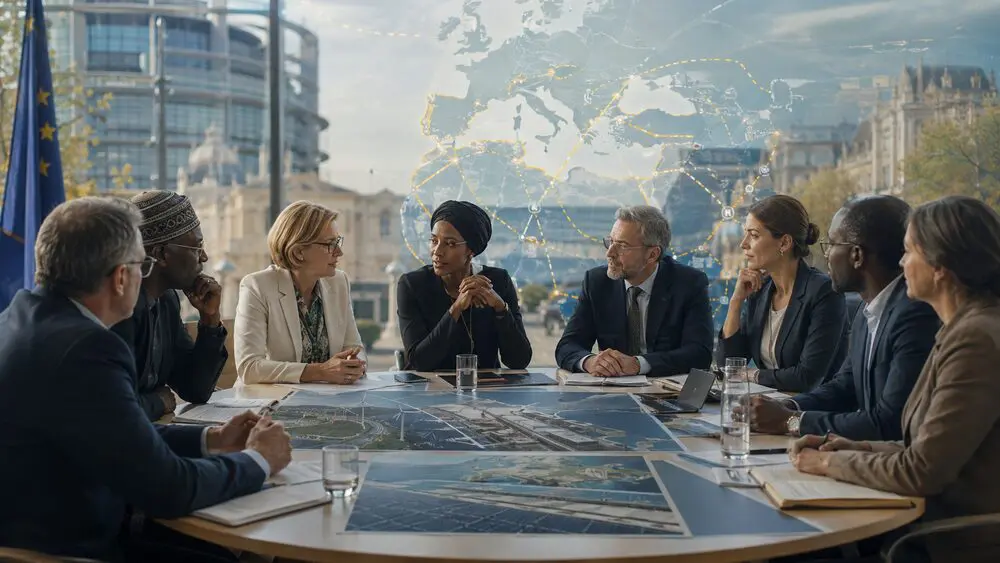
Member states back the bloc’s global investment strategy, but call for clearer project choices, stronger reporting and closer local consultation.
The Council of the EU has reaffirmed Global Gateway as a central part of Europe’s external policy, using new conclusions adopted on Monday to press for sharper governance, more transparent project selection and stronger evidence that the strategy benefits partner countries as well as European interests.
EU member states adopted conclusions on Global Gateway on 15 June, presenting the initiative as a worldwide investment and partnership strategy at a time of growing economic fragmentation, geopolitical rivalry and pressure on democratic governance.
The decision does not create a new programme. Instead, it seeks to tighten the political direction of an existing EU offer that combines development cooperation, trade policy, investment tools and private capital in areas such as digital connectivity, energy, transport, health, education and research.
A strategy under closer scrutiny
Global Gateway was launched as Europe’s answer to the global infrastructure gap and, indirectly, to rival investment models that have expanded China’s influence in Africa, Asia, Latin America and the EU’s neighbourhood. The EU says the strategy is rooted in transparency, good governance, environmental and social sustainability, human rights and the rule of law.
Monday’s conclusions show that member states also see weaknesses in delivery. The Council called for improved governance, stronger coordination between the Commission, member states and EU delegations, more regular reporting and clearer monitoring of results and impact.
That language matters because Global Gateway has often been criticised for being easier to market than to measure. Independent analysts at the European Centre for Development Policy Management have pointed to concerns over transparency, partner-country scepticism and the tension between development goals and Europe’s own competitiveness agenda.
The Council appears to acknowledge that problem, saying projects should be aligned with partner countries’ priorities and developed in consultation with local authorities, civil society and the private sector. For rights groups and development organisations, that consultation will be one of the clearest measures of whether the strategy can move beyond geopolitical branding.
Europe’s interests are now explicit
The conclusions also make clear that Global Gateway is not only a development instrument. The Council says the strategy should support the EU’s resilience, competitiveness, economic security, strategic autonomy and more diversified supply chains.
That dual purpose is likely to shape debate over future projects. Investments in ports, green energy, digital infrastructure or critical raw materials can help partner countries build long-term capacity. They can also serve European commercial and security interests, especially as Brussels seeks more reliable supply chains and a stronger position in global technology and clean industry.
The European Times has previously reported on EU efforts to support raw materials projects outside the EU, a field where development, industrial policy and geopolitical competition increasingly overlap.
The challenge for Brussels is to avoid presenting strategic self-interest as partnership unless local communities can see tangible benefits, safeguards and accountability. Infrastructure projects can affect land rights, labour standards, debt exposure, public services and environmental protection. Those consequences rarely fit neatly into diplomatic communiqués.
The credibility test ahead
Global Gateway’s supporters argue that the EU can offer a higher-standard model of connectivity than rivals, combining investment with rule-based cooperation and sustainability safeguards. But credibility will depend on whether those standards are visible in project selection, financing, implementation and public reporting.
Monday’s conclusions therefore place Global Gateway in a more demanding phase. The EU is no longer only trying to explain what the strategy is. It is being pushed to show who chooses projects, who benefits, how risks are shared and whether affected communities have a meaningful voice.
In a crowded global investment landscape, Europe’s offer will be judged not only by the volume of money mobilised, but by whether it can make partnership feel real outside Brussels.
![[Press Release] Andy Reid Honors America’s 250th Anniversary on ‘Music and the Spoken Word’](https://i2.wp.com/newsroom.churchofjesuschrist.org/media/640x480/20260705_094808_NilssonLES_0604.jpg?resize=1,1&ssl=1 "[Press Release] Andy Reid Honors America’s 250th Anniversary on ‘Music and the Spoken Word’")

![[Press Release] President Uchtdorf Welcomes the President of Switzerland to Church Headquarters](https://i1.wp.com/newsroom.churchofjesuschrist.org/media/640x480/20260630_143920_CPowell_CEP_9840.jpg?resize=1,1&ssl=1 "[Press Release] President Uchtdorf Welcomes the President of Switzerland to Church Headquarters")