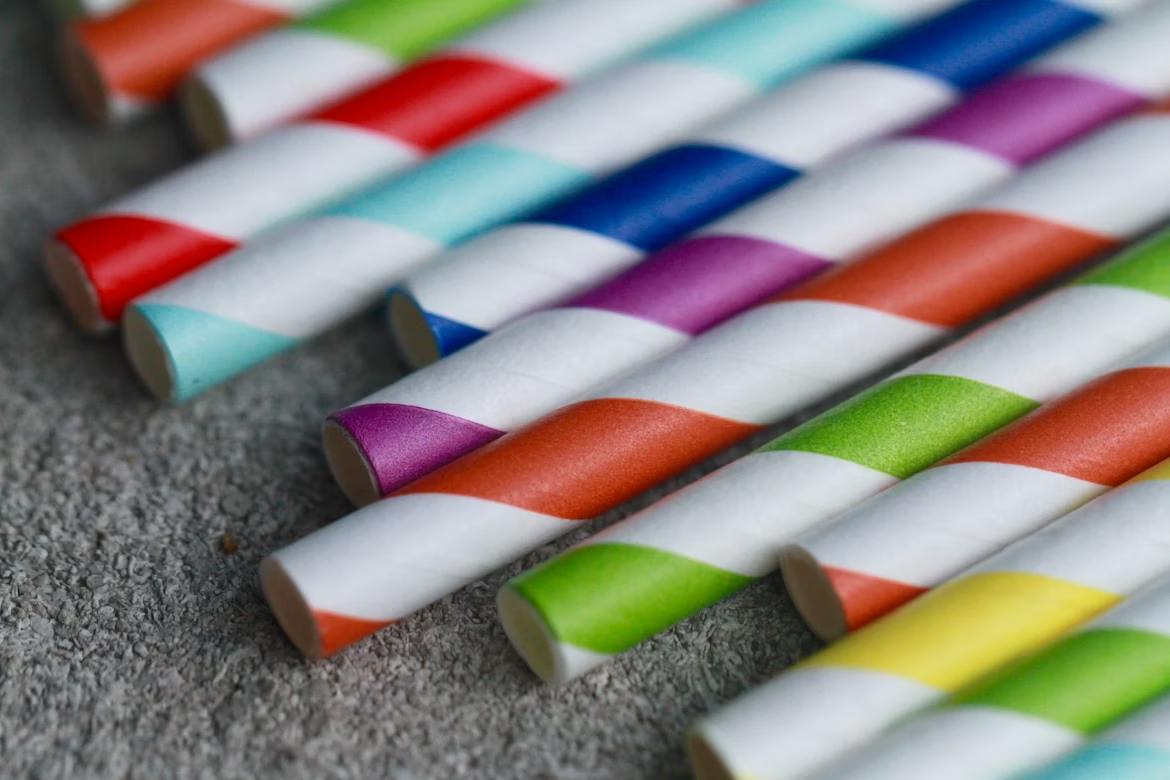
For the past couple of years, paper straws and reusable cups, among other sustainable things, have become the norm when it comes to addressing climate issues. European Parliament’s Single-Use Plastic Directive from 2019 marked the beginning of an EU approach to climate mitigation. In particular, 10 specific products most frequently found on European beaches, such as plastic straws, cups, bags, packages, cutlery, plates, and others, were targeted as main pollutants. As of 2021, the Directive has been implemented into national laws and the aims were simple – no plastic products in places where their alternatives are easily accessible. All of this in an attempt to lower the impact of these products on the environment, while at the same time promoting a transition to a circular economy. What is a circular economy? Simply put, it is an economic system in which the ‘three Rs’ (reuse, reduce, recycle) are at play; an economic system which focuses on preserving the value of products for as long as possible, recycling of waste as much as possible so that waste is reduced as much as possible and some value is put back into the markets without additional output. Is this enough, though? Yes and no. Who is it enough for, and who is it not, and what to do in that case? All essential questions which require our attention.
A European transition to a circular economy is indeed a path towards environmental sustainability, but has two main issues on a global scale. Firstly, it happens mainly from above, it is mainly a top-down approach. While the European institutions do have the power to make changes using legislative acts, they tend to change behaviour, not mindsets. Perhaps a change of behaviour among the European society, such as the halt of using plastic cups and straws, might lead to a long-standing mindset change simply because of the inconvenience in using plastic materials because of their absence on the market. On a deeper level, this might also lead to a shift in ideals, should European consumers of paper straws realise the negative effects of plastic ones on the environment. Such a top-down approach in a democratic society, however, tends to be very slow and necessitates a lot of preparation for a smooth and just transition. And since this statement could be understood in various ways, allow me to explain so that I do not be misunderstood.
Democratic processes and just transitions are slow processes. They are not wrong. They are not bad. They are slow. This is not bad either, when it comes to some issues. When it comes to the environment, however, we do not have much time to spare. We need to act upon the environmental crises as soon as possible, both top-down and bottom-up. Decisions and practices should come from both states and institutions, and the people. On top of contributing to EU-backed regulations on climate mitigation, we should also be actively participating in devising sustainability on a lower, non-institutional level. We should act personally, on a daily basis, by introducing sustainable practices in our own lives. Only then can we contribute to the development of a just sustainable approach which does not blindly rely on technological developments and does not sacrifice the environment.
The second issue with the European transition to a circular economy, or put in short – paper straws and cups – is that it happens only in Europe. Europe, however, or whatever and whomever else, does not exist in a vacuum. We all live on one planet. This same planet, which some are somehow trying to save, and others are relentlessly exploiting. While Europe is trying to at least reduce the use of plastic, others have done the opposite. In early 2025, the second Trump administration launched a strategy to eliminate paper straws for alleged health-related reasons (and because they ‘do not work’). Such an act very well resonates with the way the US under Trump approaches the environmental crisis. Or the lack thereof. If I were to put such approaches on the ‘growth spectrum in the environment-economy nexus’ (see previous articles of the series), it would be borderline climate denialism, or at best what I call hardcore neoliberalism. If we could put it in their words, the environmental crisis is either a hoax, or is just nothing to worry about, as we could adapt to all the changes necessary due to high technology.
While some decide not to use paper straws and cups, others simply cannot afford to do that. The world is an unequal place, especially from an economic perspective. To give this simple example again, while some people in the Global North switch to using electric cars in order to reduce their carbon emissions, others, in the Global South, have to mine for the lithium in the batteries of these same cars for less than 2 dollars a day. It is logical that the person with the electric car lives in a society in which paper straws and cups could easily be used as an alternative to plastic ones. Yet, similar transitions would be very difficult, if possible at all, in other places. Therefore, despite the fact that Europe is a hub for just and sustainable climate mitigation, it is not the world. To put it radically, it is not Europe’s problem. But it is the world’s problem as a whole. Again, we live on the same planet. We are part of the same natural environment – the one we exploit and are trying to save at the same time.
What we need to do, then, is simple – everything, everywhere, all at once! In other words, we need to do as much as possible, at all times, in order to contribute to solving the climate crisis. Not only in Europe, but in the while world. Sustainability might take different forms, which serve the purposes of the ones applying it. It could be devised from indigenous knowledge, or backed by top-notch scientific theories. Here, then, growth agnosticism and degrowth, and their practical suggestions, come useful.
The practical approach of growth agnosticism is doughnut economics, and the first step towards applying it is getting to know the needs of the economy in question. In other words, the approach is sensible to specific local needs and offers solutions to specific problems. Let us say we apply the doughnut model to a local economy – a town. The first step would then be to position the current economy of the town on a doughnut model and see what should be targeted first. Which parts of that economy are the ones that critically threaten either the social foundation or the environment? Once done, a reconsideration of the needs of the local society with regards to their economy is necessary. After this, specific plans of action could be made in order to reduce the damage of the targeted economic activities on both the social foundation, and the environment. And here we go – this could all happen on top of already existing sustainability approaches, such as paper straws and cups. It does not have to be top-down. It could very much come from people who are concerned about environmental issues.
Degrowth practices could also happen on top of everything else. Indeed, they do happen and have happened for way longer than we might think. Yet, we have not called them degrowth, but a way of life. An example of that is what proponents of the idea call community-supported agriculture. Or community gardens. Such gardens, in different forms, have existed and still exist in many places of the world. Mainly in rural areas, where the environment is hospitable, but very much existing as a way of life. Community-run projects for production of various foods might easily be seen as ideal ways to produce biological fruits and vegetables, reconnect with nature and teach next generations essential skills when it comes to that. On top of that, this could as well be a good recreational activity and even exercise at times.
Another community-based approach, which could easily happen on top of everything else, is repair workshops. Skill-enhancing community workshops in which people share knowledge about basic and more specific repair, for example, could easily reduce unnecessary consumption. Let us remember the question ‘why do I need the newest smartphone if my old one is working fine?’ and paraphrase it a bit – ‘why buy a new toaster if I can easily fix this one?’. If it is a matter of basic repair, and one knows how to do it, consumption of basic everyday products could drastically be reduced and this would bring us one step closer to reducing our footprint on the environment.
We can clearly see that there is so much more that we could do than just use paper straws and cups because of EU regulation. It is our planet we need to save, and it is the whole world that needs to work on that. Europe alone is doing great when it comes to finding solutions to environmental issues, but it is all of us that need to contribute to addressing environmental issues. Both top-down and bottom-up approaches are necessary. Regulations work, so does local action. All of this for global impact. The future of the natural environment is in our hands and every little act makes a difference.