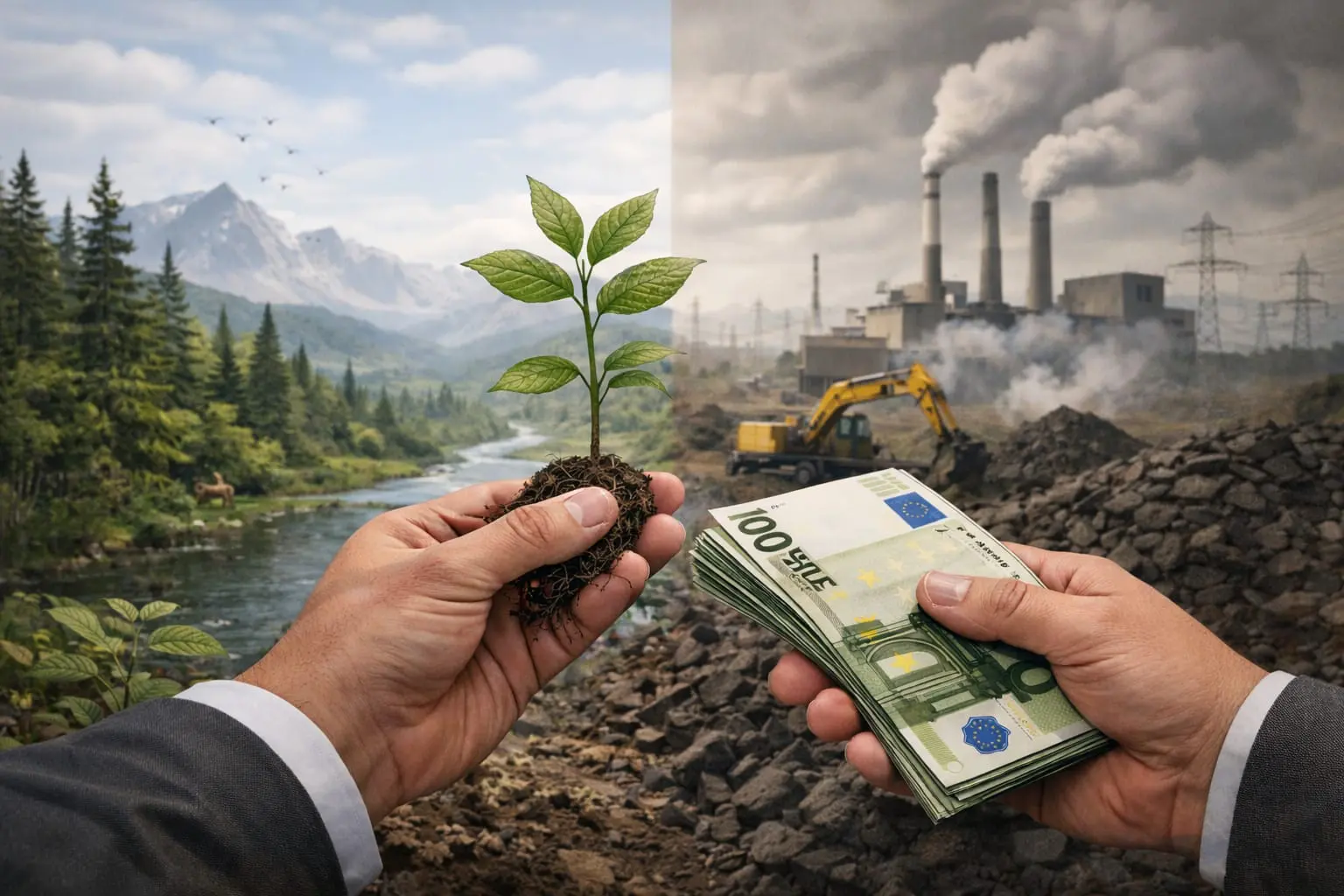
Rare would it be if one were to say that they had not heard of the ever growing topics around the so-called green transition, Green New Deal, and the likes. Such discussions are everywhere and it seems like sustainability has become a must (at least in Europe). European Union regulations regarding the ban of plastic straws and cups are but one example of what seems to be sustainability in practice. And it all seems right – a straightforward project focused on renewable energy, reusable products and reduceable waste in an attempt to live more sustainably. Addressing such issues that combine economic and environmental approaches requires for them to be viewed as a nexus – a relationship of constant interdependence and influence. This nexus lies at the centre of this discussion. A more critical look into all of these practices with a focus on the development of the idea of sustainability allows us to dissect it from a critical perspective. What do we need to sustain and since when? Who or what is in the centre of the green transition? Why do we call it green?
Let us for a moment take a big step back and think about the natural environment. From the point of view of us, humans, it could be considered something out there – trees, mountains, rivers, oceans. All things natural – not created by humans. The natural environment, then, is there – exists and has existed without the need of human activity. A deeper look into this, a more spiritual one even, would suggest that humans are part of the natural environment. And this would not be wrong. Like all other living natural things, humans could be considered like any other species (with some exceptions when it comes to natural intelligence and intellect. Regardless of whether we consider the natural environment to be out there or we consider ourselves parts of it, we could without doubt say that we depend on it. This dependence is an example of a connection of mutual influence which is even more important than the question whether we are part of the environment or not.
Historically speaking, ever since the dawn of humanity, humans have found a way to make use of (exploit) the environment for their own sustainment. And up until the beginning of European colonialism and the Industrial Revolution, this exploitation has been relatively harmless for the natural environment. To clarify, environmental exploitation for the purpose of human sustainment has happen in such significance and time-frames that the environment has been able to sustain itself, reproduce itself, with no significant harm caused by human activity. From this logic we could conclude the following – human activity for humanity’s sustainment until the development of European colonialism and more specifically the Industrial Revolution has done no significant harm to the natural environment. What happens after that, however, changes the purpose of environmental exploitation by human activity.
With the advent of European colonialism, roughly in the beginning of the fifteenth century, a massive expansion of environmental exploitation took place. New places were ‘found’ and were made use of, specifically in terms of raw materials and resources. This gave the beginning of a process of extraction which, simply put, took a resource away from one place and delivered it to be uses and exploited in another. This break of the natural metabolism signified a shift from previous environmental exploitation. To compare, previous exploitation which sustained humanity happened neither on such a scale, nor transferred resources from one part of the world to another.
Another shift behind the purpose of this exploitative human activity was seen with the advent of the Industrial Revolution, which made it possible for humanity to see an unseen by then rate of development. This, however, was followed by more extraction, especially by colonial powers, thus actively under-developing their colonies. Resources used in the Global North were extracted from the Global South, thus further deepening the metabolic issues. Such a speed of development, despite seen as a positive historical event in terms of human prosperity in the long-term, led to an ever increased energy production and consumption. This third type of environment-exploiting human activity could then be said to have given the beginning of environment-related economic activity.
What makes this activity different from the other two is that it is completely disembedded from the idea of humanity sustainment. Instead, its focus is on the sustainment of the newly-emerged economic system of market capitalism. This system’s logic of constant expansion is in play here – the system needs to continue growing in order to continue functioning and to benefit the ones who are part of it. We observe, therefore, from a historical perspective, that human activity connected to exploiting the environment has always existed, but has also drastically changed in the last five centuries. From a type of activity that has been necessary for the sustainment of humanity and has rarely done significant damage to the natural environment, through nature’s metabolic shift of resource extraction from one place to another, and lately – a complete shift of both the reasons behind environmental exploitation and its consequences.
This latest period of development, in which human activity has been largely economic and its purpose has become the sustainment of the economic system that constantly needs to grow, and not the sustainment of humanity, as it has been before the advent of colonialism, lies at the heart of the environment-economy nexus. A more detailed understanding of its essence is needed, however, in order to jump into discussing current solution-based approaches, such as the trigger word sustainability. I delve into that in the next article.
Note: The author of “Series – Hidden from the Economy”, Dimitar Borumov, is a political economist with interests and specialisms in various political economy topics, based in The Hague. He holds a BA degree in International Studies with a specialisation in Politics and Economics of the Middle East, and a Master’s degree in International Relations – Global Political Economy, both of which from Leiden University, the Netherlands. During his academic journey, Borumov focused on exploring three main topics from both a global and a local perspective – economies in transition, the political economy of care and social reproduction, and critiques of modern capitalism and the environment-economy nexus. Currently, he is a formal and informal educator on environmental awareness and the relationship between the ecology and economy. He holds a position of a Bulgarian History, Geography and Economy teacher at ‘St. Cyrill and Methodius’ Bulgarian School in The Hague, and is part of the United Religions Initiative as a youth leader of ‘BRIDGES – Eastern European Forum for Dialogue.’ On global issues Dimitar says ‘In order to address a problem as good as possible, we need to understand the roots of it; only then can we devise sustainable solutions.’ Contact email: borumovd@gmail.com