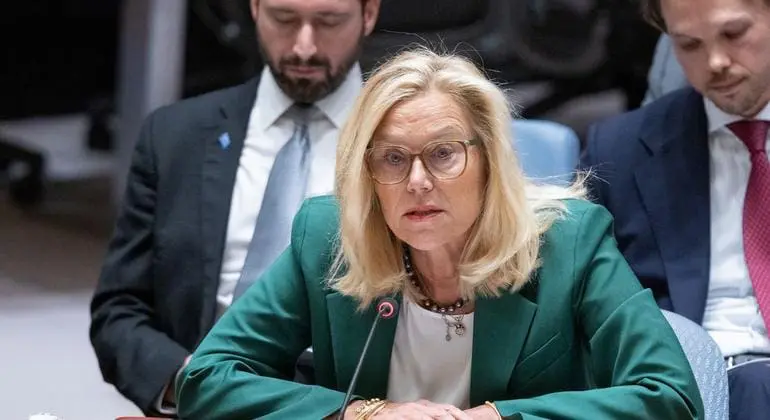
Sigrid Kaag briefed ambassadors on the progress made regarding resolution 2720, which was passed last December and established her role in response to the violent Hamas-led attacks on Israel on October 7 and the ensuing conflict in Gaza. Her responsibilities include the creation of a United Nations mechanism aimed at expediting humanitarian relief deliveries to the region, a task overseen by the UN Office for Project Services (UNOPS).
Establishment of Supply Routes
Kaag noted that “the 2720 Team” has consistently worked on access challenges, tackling barriers and suggesting solutions to facilitate assistance from various aid organizations, including the UN Relief and Works Agency for Palestine Refugees in the Near East (UNRWA), which she described as the “backbone” of humanitarian efforts in Gaza. She reminded attendees that 11 months ago, the area was almost entirely isolated, with all but one access point closed. Despite the complicated circumstances, her team has been able to negotiate and enhance supply lines and routes to ensure aid is provided in a sustained and transparent manner. These routes facilitate the movement of supplies from Egypt, Jordan, Cyprus, the West Bank, and Israel.
Humanitarian Aid Goals Not Met
Kaag expressed concern that the current systems do not compensate for the necessary political will needed to assist civilians in Gaza effectively. “Successful humanitarian operations depend on the appropriate quality, quantity, and variety of goods to meet the daily needs of people in Gaza. This objective is not being achieved,” she stated. Ongoing violence, disorder, and the looting of supplies significantly hinder UN efforts to distribute assistance. Humanitarian workers also face denials, delays, safety issues, and poor logistical support.
Lives at Risk
She emphasized, “This situation continues to impede relief efforts, even with recent approvals for trucks, satellite phones, and other essential equipment,” and reaffirmed that discussions on these matters are ongoing. Kaag stressed, “Commitments and intentions must be translated into concrete actions on the ground,” cautioning that “any delay in implementation directly impacts human lives.”
Areas for Action
Her mission remains focused on improving access to a wide range of humanitarian and commercial goods, pointing out critical areas that need attention. “There has been some progress in specific areas, such as waste and sewage management. However, this does not address the full scope of needs. There is an urgent requirement for cash, prepositioned fuel, and hygiene supplies,” she noted. Furthermore, she pointed out that the range of humanitarian items permitted entry into Gaza remains too limited, and there is an urgent need for additional security communications and tracking equipment.
Implementing Agreed Protocols
Kaag reported that a new Joint Coordination Board is now operational, but highlighted that “recent security incidents, including attacks on humanitarian convoys, are unacceptable and indicate that established protocols still require thorough and timely implementation.” She also praised the recent medical evacuation of 251 patients and their families to the United Arab Emirates, marking the largest such operation from Gaza to date. Nevertheless, over 14,000 patients are still in need of specialized medical care outside of Gaza, highlighting the necessity for further action.
Recovery Cannot Be Delayed
Stressing that “humanitarian assistance is merely a temporary measure to mitigate suffering,” Kaag maintained that a comprehensive, just, and enduring peace can only be achieved through a two-State solution involving Israelis and Palestinians. “In this context, the recovery and reconstruction of Gaza must not be postponed,” she asserted, underlining the need for education, healthcare, and housing, as well as establishing governance and security measures. “The UN’s stance is unequivocal,” she added. “The Palestinian Authority must resume its full responsibilities in Gaza. Prime Minister (Mohammed) Mustafa’s cabinet has crafted comprehensive plans to restore local governance, security, and reestablish the rule of law.” She noted that international planning efforts by the UN, the European Union, the World Bank, and others are ongoing to support the Palestinian Authority, with her mission developing financing options for consideration by the international community.
Mechanism Operational
Meanwhile, Jorge Moreira da Silva, Executive Director of UNOPS, affirmed the organization’s commitment to supporting Kaag’s mandate. He reported that the UN mechanism has been maintaining a database of humanitarian aid shipments into Gaza since May, which is publicly accessible. To date, 229 consignments have sought clearance, with 175 approved, 101 delivered, 17 pending, and 37 rejected. This totals over 20,000 metric tons of humanitarian supplies delivered, including food, shelter items, water and sanitation (WASH) supplies, and medical aid.
Jordan Aid Corridor
The consignments were primarily delivered via the Jordan corridor, the established route from Jordan to Gaza that has been formalized to provide much-needed consistency and address the backlog caused by previous multiple inspection and transloading points, he explained. Health-related shipments delivered through this route now only pass through one inspection point in Jordan and one transloading point in Gaza, a reduction from the previous three inspection points and four transloading points. A smaller portion of shipments has also been sent through the Cyprus corridor, which serves as an important supplementary route for delivering humanitarian aid to Gaza, complementing existing land and sea corridors without replacing them.
Building Confidence and Ensuring Transparency
In response to donor requests, Moreira da Silva stated that UNOPS is prepared to tackle current logistical challenges for the Cyprus corridor by providing a comprehensive solution that ensures coordinated, efficient, and transparent aid delivery. To support the regularization of corridors under the UN mechanism, UNOPS has dispatched 14 international monitors to Cyprus and Jordan to verify the humanitarian nature of each consignment, facilitate shipment approvals, and track the entire journey from origin to final delivery in Gaza. “This mechanism fosters confidence and transparency, ensuring that what is sent to Gaza reaches its intended destination,” he remarked. For consignments that are rejected, the UN mechanism requires justification.
Allowing More Aid
Moreira da Silva emphasized that UNOPS, alongside Kaag’s office, continues to advocate for the entry of more items and consignments into Gaza. “Eleven of our international monitors are also prepared to be deployed inside Gaza to enhance this crucial verification and tracking mechanism, which will support our collective efforts to increase the humanitarian aid reaching civilians in Gaza,” he stated.
Vital Lifeline from Egypt
He also highlighted the Egypt corridor, which has been a “vital lifeline” for delivering aid to Gaza since the outbreak of conflict. UNOPS is collaborating closely with Egyptian authorities to fully integrate this route into the mechanism, with a team set to be in Cairo this week to finalize the process. “Once this is complete, the 2720 mechanism will provide a comprehensive real-time overview of all humanitarian cargo entering Gaza from every supply route, allowing for better prioritization, tracking, and monitoring of relief efforts up to the point of delivery,” he explained.
Supporting All Routes
Moreira da Silva informed the Council that UNOPS is committed to ensuring the full operational capacity of each corridor. The office is procuring 280 trucks for the Jordan route and constructing 10 additional warehouse spaces for the Jordan Hashemite Charity Organization. Additionally, two truck holding areas are being established at the King Hussein Bridge border crossing and inspection site. UNOPS is also securing 38 trucks for humanitarian use within Gaza to facilitate the delivery of aid arriving via the various corridors. “We have obtained the necessary armored vehicles, communications, and security equipment to enable the operational capacity of the mechanism’s international monitors inside Gaza, without placing additional strain on the already limited resources of the humanitarian community,” he stated. The UNOPS chief expressed gratitude to Member States for their financial backing of the UN mechanism, underscoring that the effective delivery of aid at the required scale will depend on political will, security guarantees, and an enabling environment.