

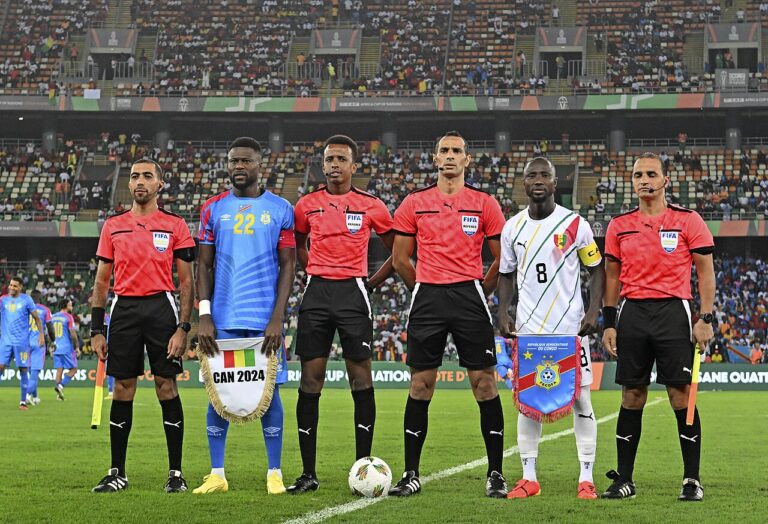
Somali referee’s Super Cup appointment puts sporting access and equal treatment in focus
Somali referee Omar Abdulkadir Artan will take charge of the UEFA Super Cup between Paris Saint-Germain and Aston Villa in Salzburg on Wednesday evening, two months after he was prevented from officiating at the World Cup because the United States denied him entry. The assignment recognises an accomplished official, but it also exposes a basic weakness in global sport: selection for an international tournament does not guarantee that a host country will allow a qualified participant to do his job.
By Daniel Mercer, Sports Correspondent
Artan will lead the officiating team at Stadion Salzburg as the Champions League and Europa League winners contest the first major trophy of the new European club season. For the 34-year-old, the fixture is more than a prestigious appointment. It is his return to a global stage after an opportunity of historic importance to Somalia was taken away at the border.
He had been chosen among the match officials for the 2026 World Cup and was in line to become the first Somali referee to work at the tournament. US authorities refused him admission after he arrived at Miami International Airport in June. FIFA subsequently confirmed that he could neither train nor officiate at the competition.
American officials cited vetting concerns and alleged an association with suspected members of terrorist organisations. No supporting evidence has been made public, and Artan has not been charged with an offence. Somalia’s government backed his integrity and asked for an explanation. That distinction matters: a security allegation is not a proven finding, especially when it ends a professional opportunity without a transparent route to challenge the decision.
A career earned on the pitch
Artan’s record makes clear that his Salzburg role is not a ceremonial gesture. He has been on FIFA’s international list since 2018, officiated the second leg of the 2025/26 CAF Champions League final and was named CAF Men’s Referee of the Year for 2025.
UEFA said the appointment followed discussions with the Confederation of African Football and formed part of cooperation between the two bodies on refereeing. Its official announcement described Artan as an experienced elite official and presented the decision as an expression of unity, equality and non-discrimination.
The match also reflects the increasingly international character of officiating teams. Artan will be assisted by Liban Abdoulrazack Ahmed of Djibouti and Stephen Eleazar Onyango Yiembe of Kenya, while Italian, Spanish and Slovenian officials complete the video and fourth-official roles. That mix is an ordinary feature of modern football, yet in this case it carries unusual weight: professional evaluation has crossed borders even where immigration policy did not.
Recognition is not redress
UEFA deserves credit for turning institutional cooperation into a meaningful appointment. The governing body has given Artan responsibility for a fixture involving two of Europe’s strongest clubs, rather than offering only a public statement of sympathy.
Still, the Super Cup cannot replace the World Cup. The competitions differ in scale, meaning and career value. Artan lost the chance to represent Somalia at football’s largest event, and a later appointment on another continent does not answer the unresolved questions around his exclusion.
The episode should therefore prompt more than applause. International federations award hosting rights years in advance and depend on governments for visas, border admission and security. Those agreements need credible safeguards for players, officials, media workers and supporters whose nationality may expose them to travel restrictions. They also need an escalation process that begins well before arrival, along with clear procedures when a participant with tournament accreditation is refused entry.
FIFA’s information for World Cup travellers stated that priority visa appointments did not guarantee admission because applicants remained subject to screening. That is a legal reality, but it leaves a governance problem unanswered. A competition presented as global can be diminished when an official selected on merit is unable to participate and the reasons cannot be independently assessed.
Football’s promises require practical guarantees
Sporting bodies often speak about equality in broad terms. Artan’s experience shows that those commitments are judged at practical points: visa desks, airport interview rooms, accreditation systems and appeal procedures. The principles discussed in The European Times’ earlier examination of human rights in football governance become meaningful only when institutions can protect fair participation in real cases.
Independent reporting has established that Artan held FIFA accreditation, was questioned after arriving in Miami and was then sent back, while the precise evidentiary basis for the decision remained undisclosed. A BBC account of the exclusion also noted that Somalia was among the countries covered by US travel restrictions.
There is a temptation to frame Wednesday night as a neat story of adversity overcome. It is not quite that. Artan’s appointment is a deserved professional milestone and an important moment for Somali and African refereeing. It is also a reminder that individual resilience should not be required to compensate for institutional failure.
When Artan blows the whistle in Salzburg, the central sporting questions will concern PSG, Aston Villa and the decisions made during the match. That is as it should be. Yet the circumstances that brought the referee to this particular stage should remain in view. A genuinely international game must do more than invite the world; it must build conditions in which qualified people from across that world can take part on equal and transparent terms.