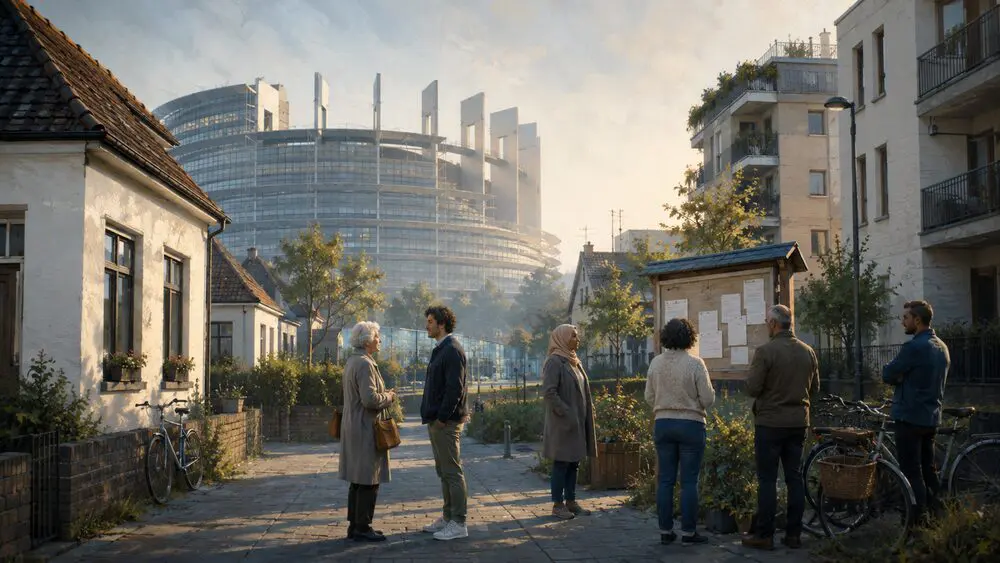
MEPs extend the EU housing committee’s mandate as affordability pressures move deeper into European social policy
The European Parliament has extended the mandate of its Special Committee on the Housing Crisis until January 2027, keeping housing affordability, energy costs and construction barriers on the EU agenda beyond the committee’s initial work. The decision gives MEPs more time to press the European Commission and member states on one of Europe’s most visible social pressures: the growing difficulty of finding decent, sustainable and affordable homes.
The extension, approved in Strasbourg this week, is not a housing law in itself. It is an institutional signal. Parliament wants its housing committee to continue monitoring how the Commission responds to earlier recommendations, map existing EU and national policies, and identify where European legislation may help or hinder access to housing.
The committee’s own page now lists a press release on the extended mandate, saying the body will continue its work until January 2027. Agence Europe reported that MEPs renewed the mandate by a show of hands on Tuesday, with a revised task list covering social, sustainable and affordable housing in cities, islands, coastal areas and rural communities.
A Social Crisis With EU Consequences
Housing remains mainly a national, regional and local responsibility. Governments set planning rules, taxation, tenancy law and most social housing policy. But the crisis has become too large to leave entirely outside EU politics.
High rents, mortgage pressure, tourist short-term letting, rising building costs, energy-inefficient homes and local shortages are affecting workers, students, pensioners and families across the bloc. In some cities, the issue has become a test of whether the European project still improves daily life. Free movement matters less to people who can cross borders for work but cannot afford to live near that work.
The committee’s renewed mandate appears designed to bridge that gap between legal limits and political urgency. According to Parliament’s public material, the committee has examined housing affordability in times of high energy costs, criminal activity in real estate markets, construction materials, youth housing and the role of public banks and the European Investment Bank.
That range matters because the housing crisis is not one problem. It is a tangle of supply, income, speculation, regulation, energy poverty and public investment. Treating it only as a market failure risks missing its deeper social impact. Treating it only as a welfare issue risks ignoring the financial and construction systems that shape who gets housed and where.
From Hearings to Pressure
Parliament set up the housing committee in December 2024 to investigate the roots of the crisis and propose practical responses. The European Parliament’s research service has noted that MEPs have already called for EU funds to be more closely aligned with social priorities, including homelessness, social housing and affordable rental schemes.
The renewed mandate now gives the committee time to follow through after Parliament’s March 2026 resolution on decent, sustainable and affordable housing. Its work will also intersect with a housing simplification procedure expected from the Commission in 2027, a phrase likely to attract close scrutiny from both housing advocates and market actors.
Simplification can mean faster building, easier renovation and fewer administrative barriers. It can also become a route to weakening safeguards if it is not handled carefully. The committee’s public-interest value will depend on whether it can keep affordability, accessibility and tenant protection at the centre of the debate while still addressing the real obstacles that slow down housing delivery.
The decision also lands as climate adaptation makes housing policy more urgent. Recent European heatwaves have shown that homes are not only financial assets or private shelters. They are part of public health infrastructure. As The European Times reported in June, extreme heat has turned housing, work and urban planning into rights questions for vulnerable households.
The Test Ahead
The extension gives MEPs more time, but not unlimited power. Parliament can investigate, recommend, scrutinise and shape legislation where EU competences exist. It cannot build homes on its own. The harder work will still fall to governments, municipalities, public lenders, construction sectors and landlords.
Still, the renewed committee keeps a politically important question alive: whether Europe can treat housing as a foundation of dignity rather than a secondary economic outcome. For millions of Europeans, affordability is no longer an abstract policy term. It is the difference between stability and insecurity, independence and dependence, belonging and exclusion.
If the committee uses its extra months well, it could help turn a fragmented debate into a clearer European agenda. If it fails, the housing crisis will continue to be felt most sharply by those with the least room to absorb it.