She was loyal to the Church of England and when in 1677 her father gave her to the young ruler of the then Netherlands.
Queen Anne managed to unite Great Britain.
After the disgraceful overthrow of James II and his exile to France for his attempt to reintroduce Catholicism in England instead of the English version of Protestantism, there was no vacuum in power in London. According to historians, a number of nobles from the ruling elite feared such a development of the situation, but Parliament suddenly turned out to be very resolute and quickly found a way out of the unpleasant situation that had arisen.
But it did not accept James II’s son with the same name, who was also baptized as a Catholic at the insistence of his mother – the Italian princess Maria Beatrice of Modena, as his heir, and ascended to the throne the daughter from the first marriage of the exiled ruler – Mary. She was faithful to the Church of England, and when in 1677 her father gave her to the young ruler of the then Netherlands – William, Princess Mary did not change her faith, on the contrary – she tempered it in the Protestant state.
And her husband was a very interesting person – due to the fact that the possessions he inherited were both Dutch, as well as German and French, and a small part of the Netherlands was even under the scepter of the Spanish king, he spoke six languages without fail – his native Dutch, German, French, English, Spanish and Latin. Frail, weak, pale, suffering from asthma and with a small hump, he had clear blue eyes and was so graceful and subtle that the English princess truly loved him. Tall, beautiful and erudite, Mary had a strong positive influence on him, and the marriage, which at first was purely political, gradually became filled with love, although he remained childless.
And when Parliament in London invited her to become queen of the throne vacated by her exiled father, the proclaimed ruler Mary II agreed, but on one condition – to be a sovereign on equal terms with her spouse. The puppy was accepted and then she and William together discouraged the efforts of her reborn brother James to wear the crown, thus becoming full-fledged sovereigns of England, Ireland and Scotland. Well, although they were in love and tried constantly to have their dream heir born, who despite Mary II’s pregnancies did not survive due to the queen’s genetic disease, William still took a mistress. Her name was Elizabeth Villiers and when in 1677 James II married Mary in Holland, the beauty became her lady-in-waiting. Three years later, however, her husband took a liking to Elizabeth, and she became his mistress, a relationship that was more or less blessed by Mary before and after she became queen in 1788. But on her deathbed, which she found herself on after contracting smallpox in 1795 and barely 32 years old, the queen asked her partner to break up with Elizabeth once and for all, apparently fearing that she would bear him a child and that he would inherit the crown that had already been destined for her sister Anne. William complied with his wife’s request, but in order to keep his beloved close to him, he married her to the nobleman-warlord George Hamilton, making him an earl, and the family remained with the widowed king until his death in 1702. Then Mary II’s sister, Anne, ascended the throne of England, Scotland, and Ireland, and she would go down in history as the first queen of Great Britain, that is, of the United Kingdom. Well, she managed to unite England and Scotland, which until then had been ruled by the sovereign in London, but remained separate countries, and in order to avoid quarrels – she christened the “assembly” Great Britain. And it is no coincidence that Queen Anne was recreated in bronze in the huge statue in front of the cathedral of the English capital – “St. Paul”, in front of which thousands of Londoners and their guests pass every day – there is great filial gratitude for the great deed, so to speak.
But she will also remain in history as the first ruler of the great country, who, as we say today, was bisexual. No, she did not refuse caresses to her husband – the Danish Prince George, but it seems that she was also fond of same-sex love, since historians attribute two dizzying favorites to her. The otherwise beloved ruler, even by today’s inhabitants of the Island, also holds a sad record – she was barren 17 times, but it seems that she was struck like her sister Mary by the same hereditary defect of the reproductive system, the vast majority of her children were stillborn. And her only surviving son William, although in excellent health, died before the eyes of his tearful mother from scarlet fever, smallpox or meningitis. In general, the doctors of the time were never able to establish the exact cause of the boy’s death, which put an end once and for all to the great English dynasty of the Stuarts.
And as far as Queen Anne’s big “dress thrills”, for historians the first one is undoubtedly the stronger, more lasting and more scorching – the one with Sarah Jenkins, better known by the surname Churchill, that is, that of her legal husband. It is about a friendship between two beautiful ladies, which at the time everyone in London knew about and discussed its bedspread dimensions in hushed tones. Fifteen-year-old Sarah met the young Princess Anne, who had barely turned ten, in 1675, when she was introduced to the court as a companion to her father James’s second wife – the Italian Maria di Modena. They liked each other, became friends, were constantly together, with the older Sarah seemingly teaching the younger girl with blue blood games and mischief, and their friendship deepened over time. But they seem to have become “intimate” around 1680, when Anna came of age, and Sarah had already married the court and social lion of London – John Churchill. He is the great-great-uncle of the notorious Prime Minister of the United Kingdom – Winston Churchill, who wanted to turn Sofia into a potato field with English bombs at the end of World War II. Be that as it may, when Anna married the Danish Prince George and he diligently set about the task of keeping her constantly unoccupied in order to provide an heir to the crown, her relationship with Sarah became even stronger and clear in all its nuances as daylight.
Otherwise, neither King Charles II nor the princess’s brother and father, who succeeded him in 1685 – James II – opposed this healthy female friendship, but Anna’s sister – Maria – did not look kindly on the thrill. And when she took the throne of her exiled parent, she began to openly expel both Sarah and her husband John Churchill, as well as her younger sister, from the court. Although the new monarchs (well, we’ve already mentioned it – Mary ruled as an equal with her Dutch husband William) – honored Sarah’s husband with the title of “Duke of Marlborough”, the family lost a lot of privileges and was gradually isolated from the London elite. And because of Mrs. Churchill’s influence on the princess and, along with her, on a number of statesmen of all ranks, the queen insisted that her sister abandon her friend. But Anne did not want to fulfill Mary II’s request, and this refusal became the cause of an irreparable rift in the relationship between the two sisters. For example, the queen decided to expel Anne from her apartments in Whitehall Palace, but even before she ordered her to do so, the princess left her apartment and went to live almost illegally with friends. She continued to resist her husband’s demands to send Sarah away, even after the discovery of a document signed by the Duke of Marlborough, declaring full support for the exiled Catholic King James II and his followers. Even John Churchill was arrested and imprisoned in the Tower of London, and Sarah was virtually isolated from the world, but this fact seemed to further temper her friendship with Princess Anne. King William III was more tolerant of the “warm relationship” between the two women when he was widowed in 1692 after the premature death of Mary II, but the friendship truly blossomed after the death of Anne’s brother-in-law and her claim to the crown. Well, Sarah becomes a shadow of the queen, even her “second self”, especially since the Duke of Marlborough John Churchill is sent to fight for the honor of the crown somewhere in Spain, then in Spain, etc. She is the queen’s secretary, advisor, confessor, quiet harbor, the second most influential person in the state, and it is no coincidence that at court they begin to call her “the other queen”. But gradually Sarah begins to interfere annoyingly in the governance of the country, uses more and more her power over the queen, intercedes for her protégés to be appointed to sweet positions, appoints military leaders, manages everything – from finances to who is allowed to be admitted to the royal person. The “companion” is known for her directness towards the queen and never resorts to flattery, but little by little she not only begins to roughly use her power over the adoring queen, but even often insults her in public.
However, Anne expects kindness and understanding from her closest friend, but Sarah is not inclined to accept such behavior – she increasingly shows domineering and strives for complete obsession with the queen. And somehow naturally comes the moment of a serious political rift, when Sarah insists that her son-in-law – the third Earl of Sunderland Charles Spencer become a member of the Privy Council of Her Majesty the Queen. Anne refuses and then Sarah begins to gossip, sends her “friend” compromising materials about her very close associates, disparages them at court, even slanders the ruler about her unfortunate pregnancies. And in 1704, or after almost thirty years of devoted friendship, Anne declares to her close courtier – Lord Godolphin, that for the sake of the state she and Sarah can no longer be friends.
Four years later, in 1708, Anne’s husband, Prince George of Denmark, dies, and Sarah arrives uninvited at the Queen’s Kensington Palace to pay her respects and console her former friend. And then the intrusive guest learns that her position as First Lady of the Court has been taken by Baroness Abigail Masham, a fact that deeply hurts her and she insults Anne cruelly – a fact that finally breaks their relationship. And Sarah is furious, because it was she who, a few years earlier, introduced her impoverished cousin Abigail Hill to the court with the intention of finding her a suitable position.
The girl was the eldest daughter of Sarah’s aunt, who first employed her in her own household and, as a reward for her good work, arranged for her appointment as a lady-in-waiting to Queen Anne in early 1704. Abigail was charming, discreet and shrewd, Sarah was domineering, intrusive and irritatingly direct, and a strong female friendship quickly developed between the new companion and the queen. Moreover, Abigail not only happily bestowed on Anne the kindness and attention that the queen had always expected from Sarah but had not received, but also never pestered her with political scheming and petitions for all sorts of appointments. Anne responded warmly to Abigail’s flattery and charm, and in order to always be by her side, in 1707 the queen married her in a secret wedding to the aide-de-camp and first valet of her husband George – Baron Samuel Misham.
Sarah, however, suspects nothing of Anne’s friendship with Abigail, hopes that their old love with the queen has not taken hold and expects to be invited to court again. And so she is surprised at the funeral of the prince consort, and when she learns that her cousin often meets privately with the queen – she explodes with anger. Queen Anne’s health worsens in 1713 – she already suffers from gout, when she also falls ill with erysipelas or, as the disease is known in our latitudes, red wind. This is an acute bacterial infection of the upper layer of the skin and lymphatic vessels, the queen is constantly at a high temperature of 39-40 degrees, she shakes, her headaches are unbearable, she lies down for weeks and dies on August 1, 1714, at the age of 49. With her, the direct line of the Stuart dynasty is interrupted and rulers with predominantly German blood come to the Island. Queen Anne was buried in Westminster Abbey, her body so swollen by the disease that it had to be laid in a wide, almost square coffin.
Her final resting place was in the chapel of her ancestor Henry VII, and a simple stone tablet marks the spot where she rested with her husband, Prince George of Denmark. It is said that at the funeral in Westminster Abbey, Sarah and Abigail, cousins who had been reconciled by the death of their mutual friend, were side by side.
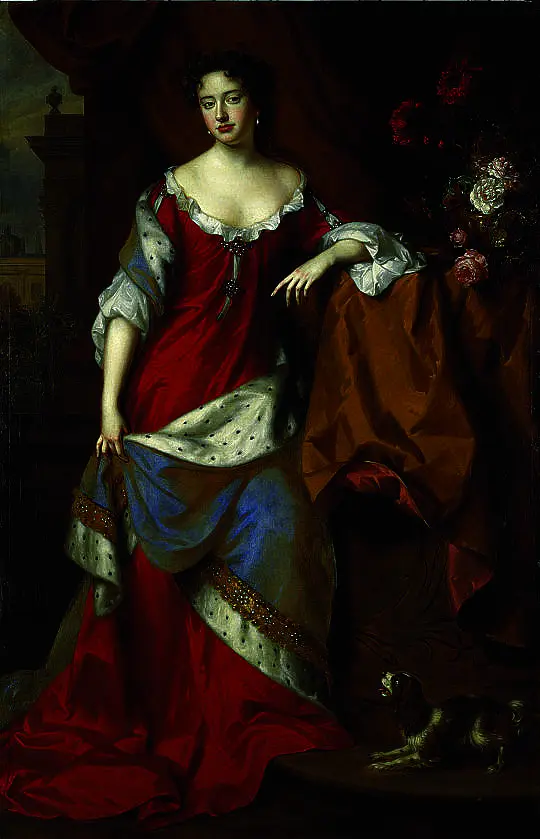
Illustration: Anne, the first Queen of the United Kingdom