

More than 95 per cent of the children in EU countries attend early childhood education, leaving very few of them without schooling, because of different reasons (European Commission 2025). Globally, more than 67.5 million children are left without primary education, approximately half of which in Sub-Saharan Africa. While Europe enjoys great primary schooling, things in Sub-Saharan Africa are more complicated. Access to education is hence unequal in these two parts of the world. Like many other things, this disparity is usually explained by conventional economics as an underdevelopment. What is often not mentioned, however, is how this underdevelopment ‘appeared’ and came into place.
In conventional economics the term underdevelopment is one of three terms that classify the general economic development of a country. According to the classification, countries could be developed, developing, underdeveloped. While this looks like an okay distinction, it overlooks key historical and politico-economic importances which are beyond simple economic metrics.
For starters, it is underdeveloped itself that is the most problematic term. Semantically speaking, underdeveloped means not normally or adequately developed. In economics, then, this would translate into not having developed in the way it should have. Not to go into great detail about how problematic this statement is, let me just say that the belief for universal economic development has proven wrong in the past years. Despite the many attempts for helping a country develop following the path of another country that is already developed (many examples come from US-led development programmes in Latin America and the MENA region in the second part of the 20th century), this has usually ended in either a patron-client relationship which still exists today, or unsuccessful for the receiving country economic reforms which have led to more economic disruption than before. Development, then, is also problematic in a way.
Yet, this is the more recent hidden meaning of development and underdevelopment. If we think more critically for a moment and go back in time now, another meaning of underdeveloped uncovers. Let us go back to the 15th century world. Imagine the continents (the same as they are now) and their (lack of) connectedness. Little to no travel, no communication. To each their own. In Europe there was one way of life (varying depending on the different parts of Europe), in North America another, in South America yet another, and so on. While some have been building ships to travel around the world, others have been living in peace with the environment. Both ways of life fine for the ones living them. No right or wrong. No ‘backward’ or ‘forward’ living.
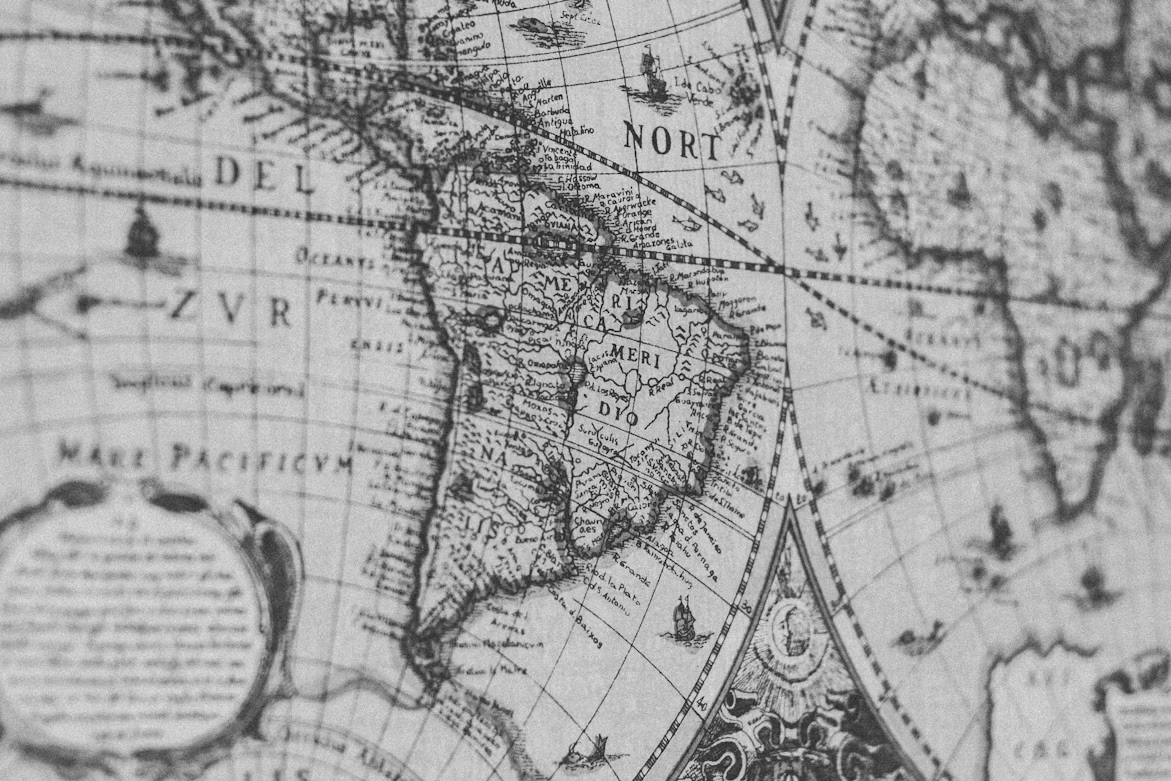
Europeans (starting with the Portuguese in the early 1400s) began ‘exploring’ the rest of the world thanks to their maritime technology. Arriving to different parts of the world, European colonialists brought with themselves technology not familiar to the new places they visited, such as modern for that period guns and other weapons. The locals (indigenous), in turn, faced the invaders with their defence methods, incomparable to what the colonialists had. Imagine (roughly speaking) an offender equipped with a sword (and perhaps a primitive gun) against a defender equipped with spears and stones. It is no surprise who would easily win such a fight. With great superiority over the indigenous of the newly ‘found’ territories, European colonialists easily exerted superiority and ‘claimed’ the ‘new’ land together with its indigenous peoples.
These continued developments – first in Latin America, then Asia, Africa and the Middle East, gave the beginning of many relationships of unequal exchange. No, exchange is a very light word to use here. Extraction, exploitation, enslavement, and underdevelopment are more suitable ones. Considering the ‘new’ land theirs, European colonialists started extracting value from it and returning it back to the metropole (the colonial state, i.e. Portugal, the Netherlands, Britain), this way piling up resources from the colonised places into the imperial power, leaving very little for the locals.
Now this is active underdevelopment – literally under-developing a place – doing the exact opposite of development. Think of it in that way – a colonial power, say – the Portuguese, have already exerted their superiority over the indigenous in, say, Brazil. This creates a hierarchy, where the Portuguese control not only the people in Brazil, but also their land, resources, and even labour. Having disrupted the indigenous way of life, the colonisers take the ‘new’ land as a free piece of earth, which can be extracted from, exploited, and its people could be enslaved and subordinated to the ones with the more powerful weapons (the colonisers). So it happened. Not only in Latin America. Other regions too. Regions which are now called underdeveloped or barely developing.
This is only the genesis story of modern politico-economic hierarchies. What remains to happen in the centuries to follow are years of oppression, attempts for revolution, freedom, neo-imperialism and -colonialism and, finally today – relationships and developments in which the remnants of colonialism still play a great role. Nowadays’ lack of development and inter-country inequalities are the result of a long time of unequal relationships between colonisers and colonised, oppressors and oppressed, Global North and Global South. That is why knowing the history behind a current problem before addressing it is very important. In the article to follow I shall discuss the later historical developments which followed after colonialism spread around the world and dive even deeper into the question ‘how did the world become so unequal?’.


