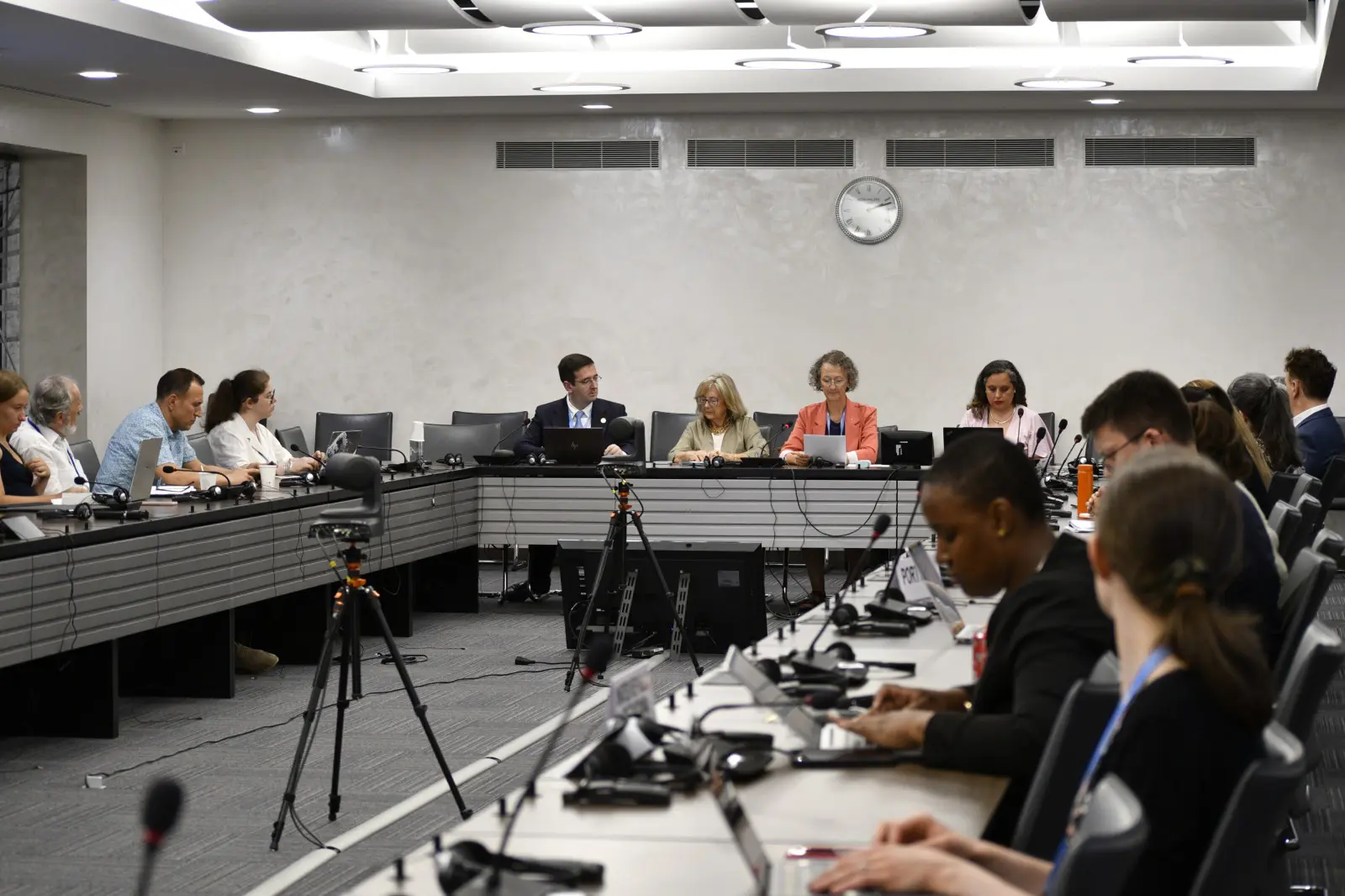
Speakers urged governments and employers to protect freedom of religion or belief in hiring, workplace rules and public procurement.
A side event at the United Nations in Geneva placed employment at the centre of the freedom of religion or belief debate. Speakers from the World Evangelical Alliance, the International Panel of Parliamentarians for Freedom of Religion or Belief, Fundación Mejora, the Church of Scientology and civil society examined how religious identity can affect access to work, dress codes, public-sector neutrality, reasonable accommodation and public procurement. The discussion moved from France, Belgium, Switzerland and Québec to Spain and Germany, where “faith-breaker clauses” targeting Scientology were presented as a warning about how state policies can travel from public contracts into the lives of individual workers.
A right that follows people into the workplace
At the Concordia 1 Room of the Palais des Nations in Geneva on 1 July 2026, a side event organised by Fundación para la Mejora de la Vida, la Cultura y la Sociedad — Fundación Mejora — examined a question that is often treated as secondary in religious freedom debates: what happens when belief meets employment?
The event, held under the title Freedom of Religion in the Context of Employment, brought together legal experts, freedom of religion or belief advocates and civil society representatives. According to the organisers, around 40 people attended, including members of the NGO Committee on Freedom of Religion or Belief and representatives from diplomatic missions.
Opening the meeting, Iván Arjona-Pelado, President of Fundación Mejora (as well as from the Church of Scientology in Europe, and the UN Geneva NGO Committee on FoRB), framed the issue as one that concerns individuals before institutions. Freedom of religion or belief, he said, “intersects with other rights” and “specifically, with employment”. He added that the UN has repeatedly made clear that the right belongs not primarily to religious institutions but to citizens.
“When discrimination happens during employment, it is actually the citizens based on their religion or on other factors that are the ones discriminated,” Arjona-Pelado told participants. “And this comes from policies, from culture, from habits, and from history.”
That opening set the tone for a discussion that moved beyond abstract principles. The speakers focused on the ordinary spaces where discrimination can become real: a job interview, a uniform rule, a public-sector neutrality policy, a staff schedule, a tender document or a grant application.
Janet Epp Buckingham: laïcité and the narrowing of public space
Prof. Dr. Janet Epp Buckingham, who represents the World Evangelical Alliance at the UN Geneva, began by challenging the assumption that workplace discrimination is less urgent than imprisonment or physical violence. “Sometimes we think that perhaps issues of employment and freedom of religion or belief are not as important as people who are being imprisoned and people who are facing violence,” she said. “But the reality is that this is a very important topic, because most of us spend a great deal of time at work.”
For Buckingham, the workplace is not a neutral abstraction. It is where many people spend most of their waking life, build social networks and sustain their families. “It is important that we be able to do our work without facing discrimination or hostility because of our faith,” she said.
She referred to the idea, promoted by religious freedom advocates in business, that employees should be able to “bring your whole self to work”. That, she argued, requires more than private tolerance. It requires employers to accommodate religious practices and to support employees who have and express faith in appropriate ways at work.
Yet Buckingham’s central focus was not private-sector inclusion but government restrictions, especially those rooted in laïcité. She described the French concept as a form of “closed secularism” in which the state seeks to privatise religion. “You may practice your faith in your home and in a place of worship,” she explained, “but outside that, there may be restrictions.”
Her presentation traced laïcité from its French revolutionary and republican roots to modern policies affecting religious dress. She cited restrictions on Muslim women wearing the hijab or niqab, Jewish men wearing the kippah, Sikhs wearing turbans or kirpans, and employees whose religious expression becomes visible in public-facing roles.
In France, she noted, the debate has long centred on state neutrality and public cohesion, including the 2004 prohibition of conspicuous religious symbols in public schools and the 2010 ban on face coverings in public. But Buckingham also pointed to the 2018 decisions of the UN Human Rights Committee, which found that France violated the rights of two women fined for wearing the niqab in public.
She then widened the lens to Belgium, Geneva and Québec. In Belgium, she said, public employers may prohibit religious symbols at work when the rule is part of a broader policy of neutrality. In Geneva, she highlighted the canton’s 2019 laïcité law and the June 2026 vote approving a constitutional amendment banning elected politicians from wearing visible religious symbols while carrying out official duties. In Québec, she referred to a tightening secularism framework that has expanded restrictions on religious symbols and changed accommodation standards.
Buckingham warned that when the state restricts religious dress in public employment, the effect can spread. “While much of my remarks focus on public-sector employment, it sets a public tone in the country,” she said. “If the government restricts the wearing of religious dress, private employers are encouraged to do the same.”
Her conclusion was stark: such policies create “an unwelcoming environment” for people whose religion requires visible dress or symbols. The message, she said, is “not to bring your whole self to work.”
Fernanda San Martín Carrasco: law protects belief at every stage of work
Fernanda San Martín Carrasco, Director of the International Panel of Parliamentarians for Freedom of Religion or Belief (IPPFoRB), placed the issue within European and international law. She underlined that freedom of religion or belief is not confined to the home or worship space. It includes public manifestation, and that includes the workplace.
“International human rights law protects individuals’ freedoms to have or not to have a religion or belief and to express, manifest and practice this religion or belief alone or in community with others, in private as well as in public,” she said. “And as public, this includes the workplace.”
San Martín Carrasco stressed that employees must not be judged through assumptions about their religion. “All employees have the right not to be discriminated against on the grounds of religion or belief,” she said. “An employer cannot treat an individual employee differently from others based on their religion or belief or the employer’s assumptions about an employee’s convictions.”
She added that a worker’s religion should not be used as a proxy for competence. “Employers should not consider an employee’s religion or belief as an indicator of their ability to perform specific tasks or fulfil responsibilities as an employee,” she said. “An employee’s convictions should not serve to impact positively or negatively their employment, promotion or dismissal.”
Her intervention focused strongly on recruitment and access to employment. The EU Employment Equality Directive, Directive 2000/78/EC, prohibits direct and indirect discrimination in employment on several grounds, including religion or belief. San Martín Carrasco noted that this applies across the employment cycle: recruitment, hiring, dismissal, promotion, pay, working conditions and vocational training.
Recruitment, she argued, deserves special attention because it shapes access to the labour market itself. “When a group of a society is denied access to equal opportunities of work, it increases the economic and social gap and impacts economic growth,” she said.
She reviewed key European cases, including Eweida and Others v. the United Kingdom, where the European Court of Human Rights confirmed that Article 9 of the European Convention on Human Rights extends into the workplace. She also discussed the Court of Justice of the European Union’s Achbita v. G4S Secure Solutions, concerning a Muslim employee dismissed after insisting on wearing a headscarf, and Vera Egenberger v. Evangelisches Werk für Diakonie und Entwicklung, concerning religious requirements in hiring by a Protestant organisation.
From those cases, San Martín Carrasco drew a core principle: employers may not refuse to hire, dismiss, demote or alter employment conditions because of religion or belief unless they can show that religion is a “genuine, legitimate and justified occupational requirement” for the specific role.
She then turned to reasonable accommodation. “Across human rights systems, reasonable accommodation is a positive obligation requiring employers to modify rules or practices so individuals can exercise their right to freedom of religion or belief,” she said.
Examples include religious dress or grooming, flexible scheduling, adjusted hiring procedures, exemptions from uniform rules, prayer space and dietary accommodation during recruitment or onboarding. San Martín Carrasco also cited comparative law beyond Europe, including the United States Supreme Court’s EEOC v. Abercrombie & Fitch Stores, where a Muslim applicant wearing a hijab was rejected under a corporate appearance policy.
Her final focus was gender. Religious restrictions, she warned, can limit women’s access to work and deepen economic inequality. “Women experience freedom of religion or belief violations in a very different and often harder manner,” she said, pointing to multiple discrimination based on sex, religion and belief.
She also noted that women can face barriers from several directions: employers, co-workers, state policy and sometimes religious communities themselves. Patriarchal norms and gender stereotypes, she said, may influence “the credibility given to women’s voice, arguments and efforts at the workplace”.
Isabel Ayuso Puente: Spain’s legal balance and the need for education
Dr. Isabel Ayuso Puente, Secretary General of Fundación Mejora and a lawyer specialized in criminal law, with long experience in freedom of religion cases in Spain, presented Spain as a case study in balancing religious freedom with workplace organisation.
“It is an honour for me to speak at this very significant venue to address one of the challenges of modern labour law in a globalised world: the exercise of religious freedom within the employment relationship,” she said.
Ayuso Puente outlined Spain’s constitutional framework. Article 16 of the Spanish Constitution protects religious freedom and worship, while Article 14 prohibits discrimination, including on religious grounds. Spain’s 1980 Organic Law on Religious Freedom further states that religious beliefs may not be grounds for inequality or discrimination before the law.
She quoted the law’s central principle: “Religious grounds may not be invoked to prevent anyone from engaging in any work or activity or from holding public office or performing public functions.”
At the same time, Ayuso Puente argued that religious freedom in the employment relationship must be applied through proportionality and good faith. “When a citizen signs an employment contract, they do not leave their fundamental rights at the company’s doorstep,” she said. “But the employment contract also creates obligations.”
She posed the practical dilemma clearly: “Does the employer have the obligation to adapt the company to the beliefs of its workforce? Or must the employee conform entirely to the demands of production?”
Spanish case law, she explained, requires companies to seek reasonable accommodation where possible. But that duty is not unlimited. Respect for religious beliefs, she said, “neither permits nor requires unilateral change to the terms of the employment contract”. Employers are not obliged to adopt measures that would cause serious financial harm or unfairness toward other workers.
Ayuso Puente referred to a 1985 Constitutional Court case involving a worker who converted to the Seventh-day Adventist Church and requested a shift change to avoid work from Friday sunset to Saturday sunset. When the company denied the request for organisational reasons and the employee did not report to work, she was dismissed. The Court held that religious freedom protects worship but does not automatically grant the right to change an already agreed work schedule unilaterally.
She also discussed religious symbols and clothing, including the Islamic headscarf, kippah and Sikh turban. In her reading, Spanish doctrine aligns with EU law: employers may restrict visible religious symbols only under strict conditions, such as a genuine neutrality policy applied equally to the workforce, or legitimate safety concerns.
Ayuso Puente’s strongest warning concerned informal discrimination. Beyond law and case law, she said, another reality persists “particularly in small and medium-sized businesses, but also in the public sector”: a lack of trust toward people who do not practise the predominant religion in a given area.
“This discrimination is based purely and simply on ignorance,” she said. “The unknown is rejected. It is not written down, it is not discussed, but it exists.”
Her answer was education. Human resources staff, labour unions, social partners and public servants need to understand religious diversity “not as a danger, but as a source of richness”.
She closed with practical proposals: internal reasonable-accommodation protocols, flexible time banks for religious holidays and “neutral yet respectful dress codes”. Such measures, she said, “prevent litigation, improve the work environment and ensure the company’s productivity.”
Germany and Scientology: when procurement becomes employment
Arjona-Pelado then presented Germany as a case study involving one religious community: Scientology. He began with a simple question: “What should a person have to prove in order to have a job?”
His answer distinguished legitimate professional requirements from religious screening. A person may reasonably be asked to prove competence, integrity, professional capacity, respect for the law, child protection standards, confidentiality and non-discrimination. “But no person should be asked to prove religious distance from a named belief community,” he said.
Arjona-Pelado focused on German Schutzerklärungen, which he translated as protective declarations and described as “faith-breaker clauses”. These declarations, he said, have been used in relation to Scientology and L. Ron Hubbard’s teachings. In his view, they operate differently from ordinary professional rules.
“A neutral safeguard in any job would regulate the conduct of the employee,” he said. “Do not coerce, do not discriminate, do not misuse public funds, do not breach professional obligations, do not break the law.”
A faith-breaker clause, he argued, does something else: it names one belief community and requires a person or organisation to declare distance from it. According to Arjona-Pelado, sample language in such declarations also requires the signer to extend the same obligation to employees and subcontractors.
“The phrase employees and subcontractors is decisive,” he said. “It is where procurement becomes employment.”
He described a chain effect: a public authority imposes the condition on a contractor; the contractor passes it to subcontractors; employers then pass it to employees or applicants. “At the end of that chain stands a person who may be asked to deny, disclose or distance himself or herself from a belief in order to work,” he said.
In one of the event’s most pointed lines, Arjona-Pelado said: “That is not neutrality. It is exclusion written into administrative language.”
According to research he said he personally conducted using EU public tender data, at least 3,959 German public contracts published between 2014 and 2 June 2026 required applicants to sign declarations concerning Scientology or L. Ron Hubbard methods. He said the problem continued after the 2022 Federal Administrative Court ruling against such declarations in a Munich grant case for an eBike, with Bavarian tender figures rising from 432 in 2022 to 621 two years later.
The 2022 ruling concerned a Munich environmental grant for the purchase of a pedelec, or electric-assist bicycle. The applicant had refused to sign a declaration “in relation to the teachings of L. Ron Hubbard / Scientology”. Germany’s Federal Administrative Court held that the city could not make the grant conditional on such a declaration.
Arjona-Pelado told the story in human terms. A woman who played violin with a local orchestra applied for a €500 subsidy after purchasing the bicycle. She qualified, he said, but was then asked to sign a Scientology-related declaration. “This document was asking this violinist woman to resign from Scientology if she wanted to have the €500 for her environmentally friendly ebike,” he said. “Of course, this was brought to court, and she won.”
For Arjona-Pelado, the court victory did not resolve the wider problem. “Why does every Scientologist have to go to court each time for something that the law and the constitution does not allow you to do anymore?” he asked.
He also linked the discussion to Germany’s 2026 decision to end Scientology as a separate federal field of observation by the Federal Office for the Protection of the Constitution. German media reported that the agency ended systematic federal surveillance as a distinct category after 30 years of wasted tax payers money, in which they found nothing illegal nor unconstitutional with Scientology or Scientologists. Arjona-Pelado argued that the long-running observation had helped justify discriminatory clauses and should now prompt reconsideration.
Denial at the hiring stage can shape whole careers
The Geneva side event showed that workplace religious freedom is not a narrow issue about symbols or scheduling. It is about who can enter the labour market, who must hide identity to be considered employable, and whether state neutrality protects citizens equally or pressures them into silence.
Several themes emerged.
First, freedom of religion or belief protects people, not abstractions. Arjona-Pelado’s opening point — that citizens are the rights-holders — shaped the discussion. A policy that appears administrative can still burden a worker, contractor, applicant or student seeking a first job.
Second, neutrality can serve inclusion or exclusion. Buckingham’s presentation showed how laïcité, originally developed as a way to prevent religious domination of the state, can become restrictive when applied to individual expression in modern pluralistic societies. The question is not whether states may be neutral, but whether neutrality becomes a demand that visible believers disappear from public life.
Third, recruitment matters. San Martín Carrasco repeatedly returned to access to employment. Denial at the hiring stage can shape whole careers, widen inequality and exclude minorities before workplace rights can even be invoked.
Fourth, reasonable accommodation remains one of the most practical tools available. Ayuso Puente’s Spanish case study showed that accommodation does not mean abolishing workplace organisation. It means applying good faith, proportionality and practical flexibility before conflict becomes litigation.
Finally, procurement deserves closer scrutiny. The German Scientology case raised a question that goes beyond one country or one religion: can public authorities require belief-related declarations from contractors in ways that indirectly affect employees? If such conditions move down the supply chain, they can convert public contracting into religious screening.
For human rights advocates, the event’s message was clear: employment is not peripheral to freedom of religion or belief. It is one of the places where the right is most frequently challenged in daily life — quietly, repeatedly and often without headlines.
As Ayuso Puente put it, much of the problem begins with ignorance. “The unknown is rejected,” she said. The Geneva discussion suggested that the answer is not only litigation, but education, policy reform and a clearer commitment that no one should have to choose between conscience and work.
References:
- European Union, Council Directive 2000/78/EC establishing a general framework for equal treatment in employment and occupation.
- European Court of Human Rights, Eweida and Others v. the United Kingdom.
- Court of Justice of the European Union, Achbita v. G4S Secure Solutions, Case C-157/15.
- Court of Justice of the European Union, Vera Egenberger v. Evangelisches Werk für Diakonie und Entwicklung, Case C-414/16.
- OHCHR, Freedom of religion or belief must also be protected in the workplace, UN rights expert says, 2014.
- United Nations General Assembly, Interim report of the Special Rapporteur on freedom of religion or belief, Heiner Bielefeldt, A/69/261, 2014.
- OHCHR, France: banning the niqab violated two Muslim women’s freedom of religion, UN experts say, 2018.
- SWI swissinfo.ch, Geneva bans elected representatives from wearing religious symbols in parliament, 2026.
- German Federal Administrative Court, Judgment of 6 April 2022, BVerwG 8 C 9.21, concerning Munich’s Scientology-related declaration and a pedelec grant.
- Zeit Online, reporting on the 2026 end of Scientology as a separate federal observation category.



![[Press Release] President Uchtdorf Welcomes the President of Switzerland to Church Headquarters](https://i1.wp.com/newsroom.churchofjesuschrist.org/media/640x480/20260630_143920_CPowell_CEP_9840.jpg?resize=1,1&ssl=1 "[Press Release] President Uchtdorf Welcomes the President of Switzerland to Church Headquarters")