

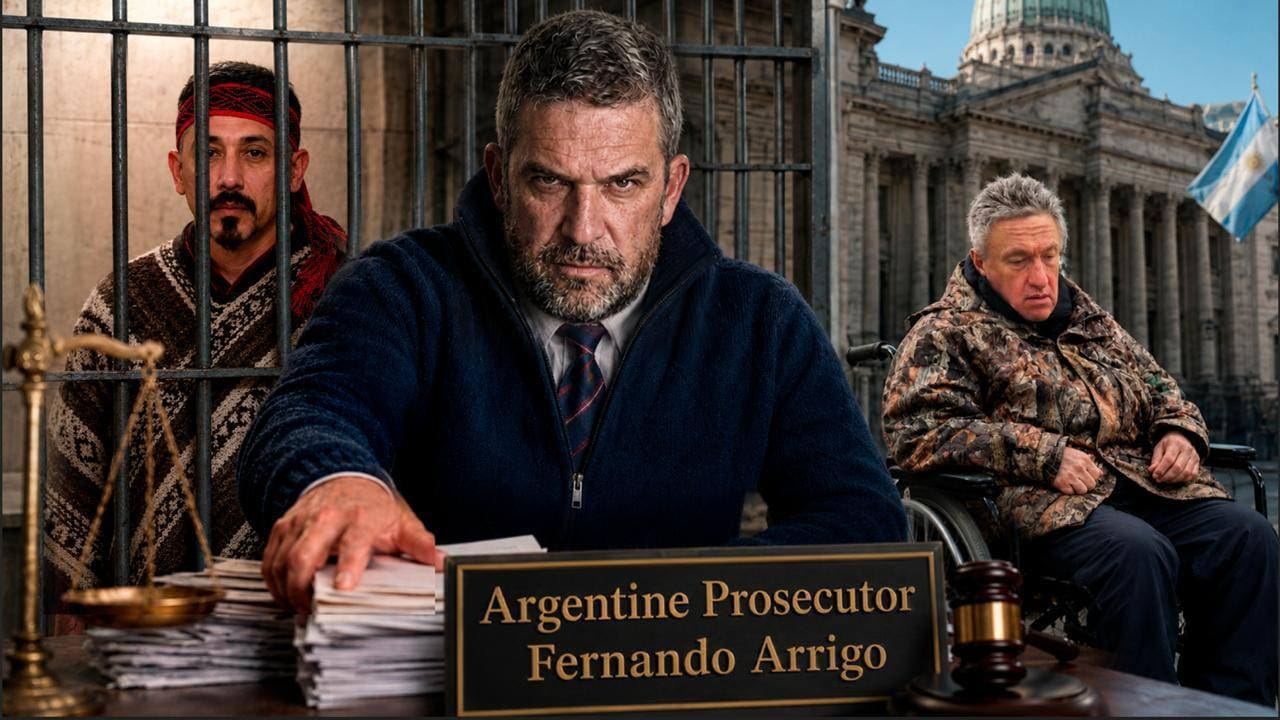
A deepening emergency for Facundo Jones Huala and Konstantin Rudnev as new medical evidence exposes the consequences of prosecutorial pressure
The European Times has covered the case of Russian spiritual teacher and dissident Konstantin Rudnev, whom a team of Argentinian prosecutors coordinated by Fernando Arrigo insists in sending back to jail from house arrest. I noted that Arrigo’s team displays a similar obsession with harsh measures of detention, disregarding the patient’s health situation, in the case of Mapuche rebel leader Facundo Jones Huala.
The situation documented in the earlier article has now entered a darker phase. On June 22, at around three in the afternoon, Jones Huala was taken urgently to the Santa Teresita Hospital in Rawson in a state of profound physical collapse. He had completed fifty‑five days of hunger strike and six days of dry strike. Those close to him describe a man whose strength has been exhausted. The transfer was the foreseeable result of a protest that has pushed the human body to its limits, and it took place in the same climate of prosecutorial pressure that has marked his case from the beginning.
Shortly after the transfer, supporters of the Mapuche leader issued a public statement reporting that inmates in Pavilion 5 of Rawson Jail’s Unit 6 had declared a hunger strike in solidarity with him. They explained that this action was taken as a gesture of support and as a protest against the unhealthy conditions of the prison infirmary where he had been held. They stated that he had been taken to the Santa Teresita Hospital, given intravenous fluids and tests, and then returned to the prison the same afternoon, where he remained without communication until the following day. They reported that he had lost significant weight after more than fifty‑six days of hunger strike and that a heart problem had been detected, raising fears of a possible infarction. They held penitentiary and judicial authorities responsible for any irreversible consequences to his health or life, and they called for immediate medical attention appropriate to his condition.
These developments have intensified concern about the prosecutorial approach adopted by Arrigo’s team. His name appears repeatedly in decisions that heighten tension rather than reduce it. The insistence on measures that disregard medical warnings has become a defining feature of his cases, and the demand for his dismissal grows stronger as the consequences become more visible.
Konstantin Rudnev’s health has also reached a dangerous stage. His defense has submitted a new medical report by Professor Luis Sarotto and Dr. Mariano Duarte describing a clinical situation of exceptional complexity. The report lists chronic conditions including a previous myocardial infarction with cardioesclerosis, grade 3 hypertension with very high cardiovascular risk, respiratory disease under investigation such as possible pulmonary fibrosis or COPD with exertional desaturation, severe obesity with diffuse hepatic steatosis, bilateral carpal tunnel syndrome with severe median nerve involvement, and degenerative spinal disease affecting both dorsal and cervical regions.
The report notes that Rudnev recently underwent urgent surgery for a right inguinoscrotal hernia complicated by ileus. His recovery is threatened by chronic cough from emphysema, which repeatedly increases intra‑abdominal pressure and endangers the surgical mesh, the stability of the wound, and the risk of recurrence. It explains that obesity and suspected Cushing’s syndrome impair healing, weaken the skin, and reduce immune response. It highlights neurological and mechanical limitations caused by severe cervical spinal stenosis, chronic pain, and restricted mobility, all of which increase the risk of thromboembolism. It describes hypertension, tachycardia, respiratory compromise, and oxygen saturation that drops with minimal movement. It documents neurological signs of active cervical myelopathy with motor weakness, gait disturbance, and urgency or incontinence. It warns that minor trauma could trigger acute neurological decline.
The cardiovascular section describes a very high‑risk profile with hypertensive heart disease, left ventricular hypertrophy, diastolic dysfunction, and metabolic disturbances possibly linked to Cushing’s syndrome and sleep apnea. The recommendations include endocrine testing, metabolic evaluation, 24‑hour blood pressure monitoring, polysomnography, and continued high‑complexity home hospitalization. The report concludes that discharge or conventional outpatient care is contraindicated because of imminent life‑threatening risk. Only strict medical, nursing, and respiratory supervision can prevent irreversible complications.
Speaking to The European Times, Rudnev expressed deep concern for Jones Huala. He said: “I am deeply outraged by what has happened to Jones Huala. Despite his critical medical condition, he was sent back to prison when what he clearly needs is hospitalization, constant medical supervision, intravenous treatment, nutritional support, and every possible measure to preserve his life.”
He continued: “How could medical professionals, whose duty is to protect human life and health, allow this to happen? They should have objected. They should have insisted that he remain under proper medical care. They should not have allowed prison authorities, prosecutors, or any other officials to remove him from a setting where he could receive the treatment necessary for his survival.”
Rudnev added: “Instead, he was returned to a prison medical facility reportedly characterized by extremely poor conditions. The situation has become so alarming that an entire prison pavilion has reportedly begun a hunger strike in solidarity with him. This demonstrates the level of concern among those who witness his condition firsthand.”
He emphasized the human dimension of the crisis: “What is happening is not merely a legal issue. It is a humanitarian issue. A man who appears to be fighting for his life is being placed in circumstances that may further endanger his health and survival. Watching this unfold creates confusion, compassion, and a profound desire to help.”
He also described his own experience at the Santa Teresita Hospital, which he does not regard as an independent medical environment. He told The European Times that although it was formally presented as an outside civilian hospital, the doctors did not act as independent medical professionals. He recalled being repeatedly told that he was completely healthy, while his symptoms were dismissed and not properly documented. He maintains that this experience was later misrepresented in court as a refusal of treatment or as care provided by independent physicians. In his view, the medical personnel were functioning within the prison system rather than exercising independent clinical judgment.
The concerns he raises resonate with the situation of Jones Huala. He believes that some medical professionals dealing with incarcerated individuals may be influenced by institutional expectations rather than guided solely by their duty to protect health and preserve life. He emphasized that medical care should remain independent, impartial, and focused exclusively on the well‑being of the patient, regardless of legal status or place of detention.
The events of June 22, the medical documentation, and the testimonies now available converge into a single conclusion. The approach adopted by Arrigo and his team places human life in immediate danger. The demand for accountability has become urgent.