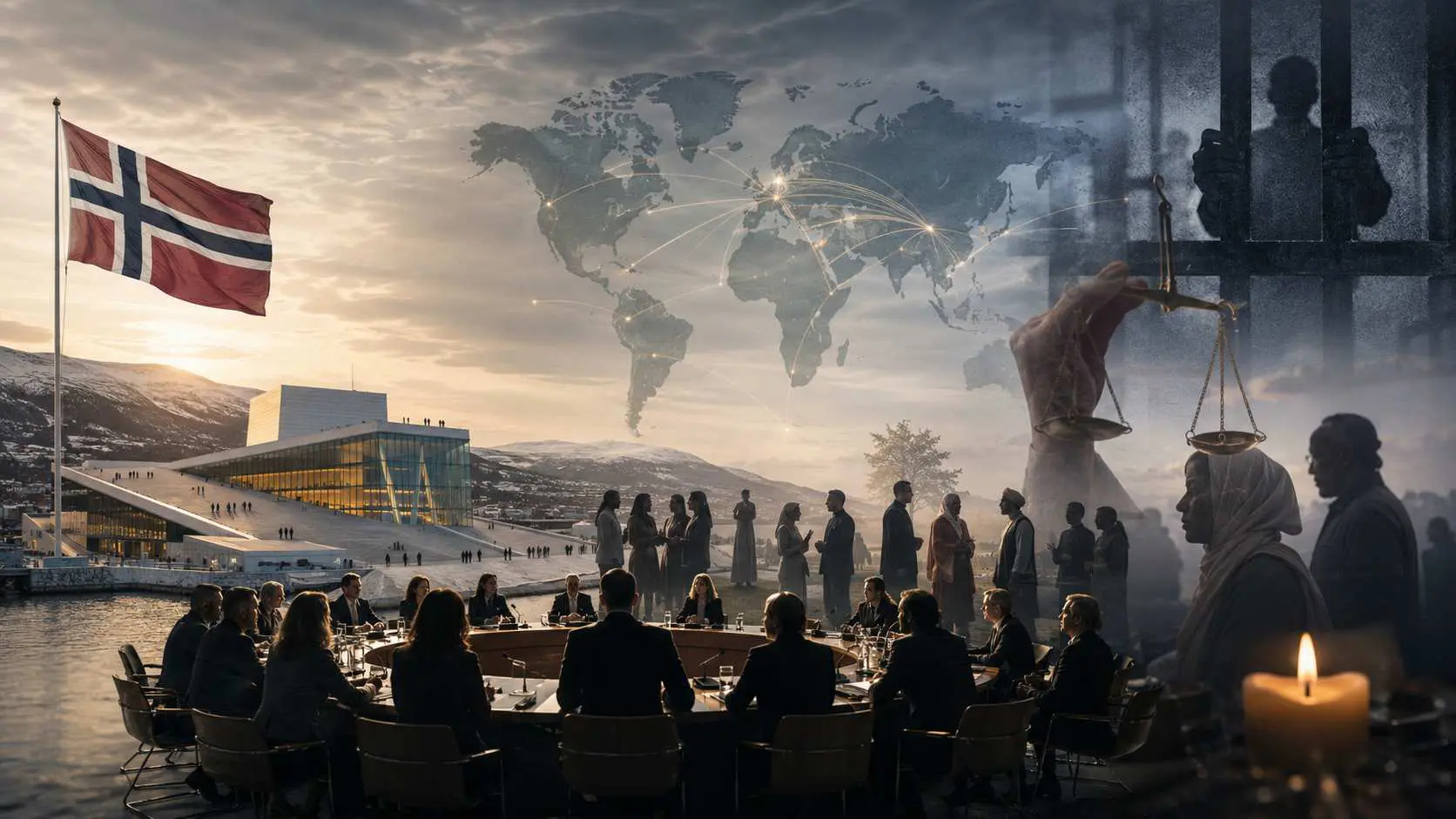
Norway has made freedom of religion or belief a sustained part of its international development and human-rights policy. Its approach is not framed as the promotion of religion, but as the protection of a universal right: the right to believe, not to believe, change one’s belief, worship, dissent, organise, and live free from coercion or discrimination.
At a time when freedom of religion or belief is under pressure in many parts of the world, Norway has emerged as one of Europe’s clearest and most consistent public voices on the issue. Its policy is rooted in the universal human-rights framework of Article 18 of the Universal Declaration of Human Rights and Article 18 of the International Covenant on Civil and Political Rights, and is implemented through diplomacy, development cooperation, civil-society partnerships and multilateral engagement.
The Norwegian Ministry of Foreign Affairs states that its international work to protect and promote freedom of religion or belief is based on a human-rights approach, with particular attention to religious and belief minorities. This means that Norway does not treat FoRB as a narrow religious concern. It links it to freedom of expression, freedom of association, privacy, gender equality, minority rights and democratic resilience.
A foreign-policy priority, not a symbolic slogan
Norway’s policy stands out because it has moved beyond statements of concern. The country has developed official guidelines on freedom of religion or belief for its Foreign Service, Norad and other actors working in the field. These guidelines make clear that FoRB is for everyone: believers, non-believers, converts, dissenters, majority communities and minorities within majority traditions.
This universal framing matters. It prevents FoRB from being reduced to a geopolitical tool or a selective defence of one community over another. It also reflects a serious understanding of modern persecution, where restrictions often affect people at the intersection of belief, gender, ethnicity, expression, association and civic participation.
Norway’s policy also avoids a common mistake: presenting freedom of religion or belief as if it were in conflict with other rights. The revised guidelines explicitly highlight the relationship between FoRB, gender equality and freedom of expression. This is a crucial point. A credible FoRB policy must protect women and girls from abuses justified in the name of religion, while also protecting religious women, minorities and dissenters from coercion, violence and exclusion.
Working through parliaments and civil society
A significant part of Norway’s contribution is channelled through civil society, international organisations and specialised networks. One important example is the International Panel of Parliamentarians for Freedom of Religion or Belief, known as IPPFoRB, with the global Secretariat based in Oslo, is the unique non-partisan global network of parliamentarians dedicated to freedom of religion or belief.
IPPFoRB reports that its network includes more than 400 current and former parliamentarians from around 95 countries. Its work includes capacity-building, legislative engagement, parliamentary diplomacy, advocacy, peer exchange and regional cooperation. The network is centred on the Oslo Charter, signed in 2014 by parliamentarians at the Nobel Peace Center in Oslo.
The parliamentary model is important because it moves FoRB from abstract commitment to practical institutional change. Laws on registration, education, security, equality, public funding, hate speech, anti-extremism and association can either protect pluralism or quietly restrict it. Training parliamentarians and supporting cross-party dialogue can help ensure that religious and belief minorities are not left at the mercy of political moods, administrative bias or majoritarian pressure.
The Norwegian Ministry of Foreign Affairs along with the Stortinget (Norwegian Parliament) supports IPPFoRB allocating funding in a multiyear cycle project. That kind of predictable support is unusual in the human-rights field, where many defenders depend on short-term, fragile or politically exposed funding.
The European Times has previously examined IPPFoRB’s work and the wider political challenges facing freedom of religion or belief. Norway’s support for such networks shows how a medium-sized European state can have influence beyond its size by strengthening institutions, legislators and human-rights defenders rather than relying only on public declarations.
FoRB as conflict prevention and social cohesion
Norway’s approach also links freedom of religion or belief to conflict prevention and peacebuilding. This is not because religion should be politicised, but because religious identity is often instrumentalised in conflict, authoritarian mobilisation and social fragmentation.
In fragile contexts, attacks on religious or belief minorities can serve as early warnings of wider democratic breakdown. Registration restrictions, blasphemy accusations, mob violence, discriminatory security policies and propaganda against minority groups rarely remain isolated. They often accompany broader attacks on independent media, civil society, women’s rights, opposition parties and the rule of law.
By treating FoRB as part of democracy and human rights, Norway helps move the issue away from culture-war language. The aim is not to privilege religion. The aim is to protect persons and communities from coercion, exclusion and violence because of what they believe, do not believe, or are perceived to believe.
Women, minorities and civic space
One of the most sensitive aspects of Norway’s policy is its attention to the intersection between freedom of religion or belief and women’s rights. This is essential. In many countries, women and girls face double pressure: discrimination from state or social authorities because of their religious identity, and restrictions within their own communities justified through religious or cultural arguments.
A serious FoRB policy must therefore reject both forms of coercion. It must defend the right of religious women to dress, worship, organise and speak according to conscience, while also defending the right of women and girls to education, health, equality, freedom from violence and freedom from forced belief or practice.
Norway also connects FoRB with civic space. This includes cases where minority religious or belief-based organisations face arbitrary registration barriers, harassment, surveillance, public stigmatisation or criminalisation. Support for documentation, monitoring, advocacy and strategic litigation can be decisive in such contexts, especially when local defenders face retaliation.
Multilateral leadership in a difficult global moment
Norway’s role is also visible multilaterally. It engages through the United Nations, the Human Rights Council, diplomatic missions and international networks. The Article 18 Alliance lists Norway among its members, alongside countries committed to advancing freedom of religion or belief internationally.
This matters in the current global context. Freedom House reported in 2026 that global freedom declined for the 20th consecutive year in 2025. Such democratic backsliding affects FoRB directly. When courts weaken, media are intimidated and civil society is restricted, minorities are usually among the first to feel the consequences.
For decades, the United States was widely seen as the dominant international voice on religious freedom. That role remains institutionally important, but global leadership now depends increasingly on coalitions of credible states that can speak consistently, fund responsibly and work through multilateral channels. In that landscape, Norway has become one of the clearest European models.
A standard that must also be applied at home
Norway’s international leadership is strongest when it is matched by consistency at home. No country is beyond scrutiny, and domestic policy on religious and belief communities should always be assessed against the same universal principles promoted abroad. That is not a weakness of Norway’s approach. It is the test of its seriousness.
The value of Norway’s model lies precisely in its insistence that FoRB is not a favour granted to approved communities. It is a right attached to every human being. It protects the majority and the minority, the believer and the non-believer, the dissenter and the convert, the religious community and the individual who leaves it.
A small country with a strategic human-rights voice
Norway’s policy demonstrates that international leadership on freedom of religion or belief does not require military weight or geopolitical dominance. It requires clarity, consistency, partnerships and funding that allows civil society and institutions to work over time.
In a world where religion is again instrumentalised to exclude, persecute or silence, Norway’s development cooperation policy stands for a simple but powerful idea: freedom of religion or belief is not a cultural concession. It is a universal human right and a prerequisite for peace.
Alongside other Nordic and European partners, Norway offers a model of principled engagement in an area that is often politically sensitive and easily misunderstood. Its message is dignified but firm: no society can claim to defend human rights while leaving people unsafe because of their conscience, belief, unbelief or religious identity.