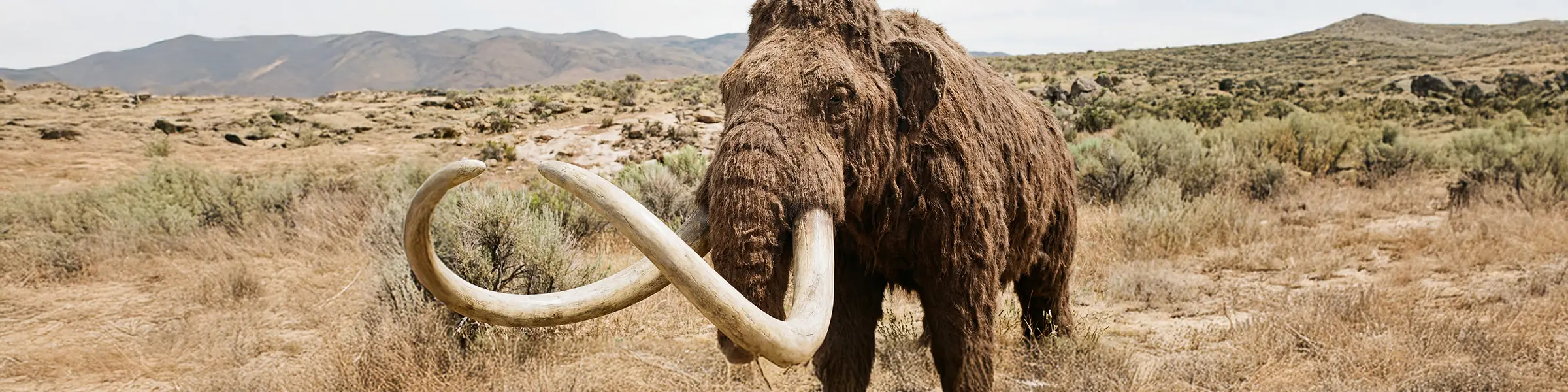
Shortly before the peak of the last Ice Age, herds of woolly mammoths roamed across Central Europe, following seasonal routes through a vast, frigid landscape of grassland and tundra. Across the region, archaeologists have uncovered striking accumulations of mammoth bones, sometimes numbering in the thousands.
These sites have puzzled researchers since the 19th century. Were these vast bone beds the result of hunting, natural deaths, or both? And what do they reveal about the people who lived alongside these giant animals?
An EU-funded European research team is taking a fresh look at three of the most important sites: Kraków Spadzista in Poland, Dolní Věstonice in Czechia and Langmannersdorf in Austria. Their work is part of a five-year initiative called MAMBA, funded by the European Research Council, which will run until June 2027.
Leading the work is Dr Jarosław Wilczyński, an archaeologist and associate professor at the Institute of Systematics and Evolution of Animals at the Polish Academy of Sciences in Kraków.
He coordinates an international team working to piece together what these bone deposits can tell us about life between 35 000 and 25 000 years ago.
Reading the bones
To answer these questions, the team combines traditional archaeology with a wide range of scientific techniques. Excavations are paired with laboratory analysis drawing on expertise in genetics, isotope chemistry, geoarchaeology and palaeoclimatology.
“We are bringing together fieldwork and laboratory work,” Wilczyński said. “We collect new material, but we also re-examine museum collections using methods that were not available before.”
“
We collect new material, but we also re-examine museum collections using methods that were not available before.
By studying stable isotopes in bones, scientists can tell what mammoths ate, where they lived and even the season they died. Ancient DNA (aDNA) extracted from mammoth remains is helping researchers build a picture of these extinct mammoth populations – how large they were, how they were related and how they changed over time.
To go further, the team is also using strontium and oxygen isotope analysis, led by Alex Pryor at the University of Exeter. The ratios of these isotopes in teeth and bones act like natural geographic markers, allowing researchers to trace where individual mammoths lived and moved during their lifetimes.
High-precision radiocarbon dating is refining the timeline of each site, while a better understanding of past environments is helping to reveal the landscapes and climates of the period.
Wilczyński and his team are also careful to balance analysis with conservation. “Excavation and analytical techniques have improved over the years,” he said. “We can preserve samples more carefully and, where possible, excavate new material rather than risk damage to historical collections.”
Tracing ancient DNA
The aDNA work of the MAMBA team is led by David Díez del Molino, a researcher at the Centre for Palaeogenetics in Stockholm, a joint institute of Stockholm University and the Swedish Museum of Natural History.
He specialises in analysing aDNA, and uses aDNA and computational methods to study the evolution of extinct species and past ecosystems. MAMBA’s work posed certain challenges for the preservation of samples.
“Most of the aDNA we study comes from well-preserved mammoth samples from permafrost deposits. But all mammoth material from MAMBA comes from non-permafrost contexts, which is much more challenging,” Díez del Molino said.
By developing improved DNA extraction methods tailored to degraded samples, the team is unlocking genetic information from specimens long thought unsuitable for analysis, opening up museum collections to a new kind of research.
“We are hoping to have analysed more than 400 samples by the end of the project,” said Díez del Molino. “Given our success rate, we are potentially unlocking thousands of historically overlooked specimens for DNA research.”
What the hunters knew
The emerging picture challenges earlier assumptions about human behaviour.
Rather than opportunistic scavengers, the people who lived alongside mammoths appear to have been skilled and organised hunters. They were capable of planning and coordinating complex hunting activities and of processing large kills such as mammoths and other animals.
“They understood the animals and their environment very well,” said Dr Dorothée Drucker, a research fellow at the Senckenberg Centre for Human Evolution and Palaeoenvironment at the University of Tübingen in Germany. Drucker is an expert in ancient diets and ecosystems.
“
The woolly mammoth is an iconic species which played a major ecological role.
Ice Age hunters appear to have had a detailed understanding of mammoth migration routes, seasonal movements and gathering areas. They likely used this knowledge to position themselves strategically, increasing their chances of success.
Such activities would have required cooperation, communication and social organisation. The accumulations of bones we find today are, in a sense, the material trace of that expertise.
The woolly mammoth was not just a source of meat. It was a keystone species in its environment, shaping the landscape around it.
“The woolly mammoth is an iconic species which played a major ecological role: a big animal that crushed trees and bushes, changed its environment, fertilised the soil with its dung,” said Drucker.
For humans, it provided a wide range of resources, including meat, fat, ivory and bone for tools and ornaments.
Lessons from a changing world
The period between 35 000 and 25 000 years ago during the late Ice Age (known to archaeologists as the Upper Palaeolithic) was one of rapid environmental change. As the climate cooled and ice sheets expanded, ecosystems shifted across Europe, affecting both animal populations and human communities.
“What we see is that humans were highly adaptable,” Drucker said. “They were able to respond to changing conditions and still exploit available resources.”
At the same time, researchers are investigating how human activity may have affected the depletion of the mammoth population.
“Mammoths show unusually high levels of an isotopic marker called nitrogen-15, which is linked to diet,” Drucker explained. “Humans who ate a lot of mammoth meat also show high levels of this marker. That suggests mammoths were an important food source.”
Researchers are now using these isotopic signals, alongside genetic data, to explore how strongly human hunting may have contributed to the decline of mammoth populations, in combination with climate change.
The decline and eventual extinction of mammoths was likely the result of multiple interacting pressures, including climate change, habitat shifts and human activity. Untangling these factors remains a key challenge.
The findings from these sites offer insights that go beyond archaeology. By reconstructing how early humans adapted to extreme and rapidly changing conditions, researchers are gaining a clearer understanding of human resilience over time – how societies respond to environmental stress, organise themselves and survive.
What is becoming increasingly clear, however, is that Ice Age humans were not passive observers of their environment. They actively shaped it and were shaped by it in return.
The mammoths are long gone. But in the bones they left behind, the people who lived alongside them are beginning to speak.
Research in this article was funded by the European Research Council (ERC). The views of the interviewees don’t necessarily reflect those of the European Commission. If you liked this article, please consider sharing it on social media.