

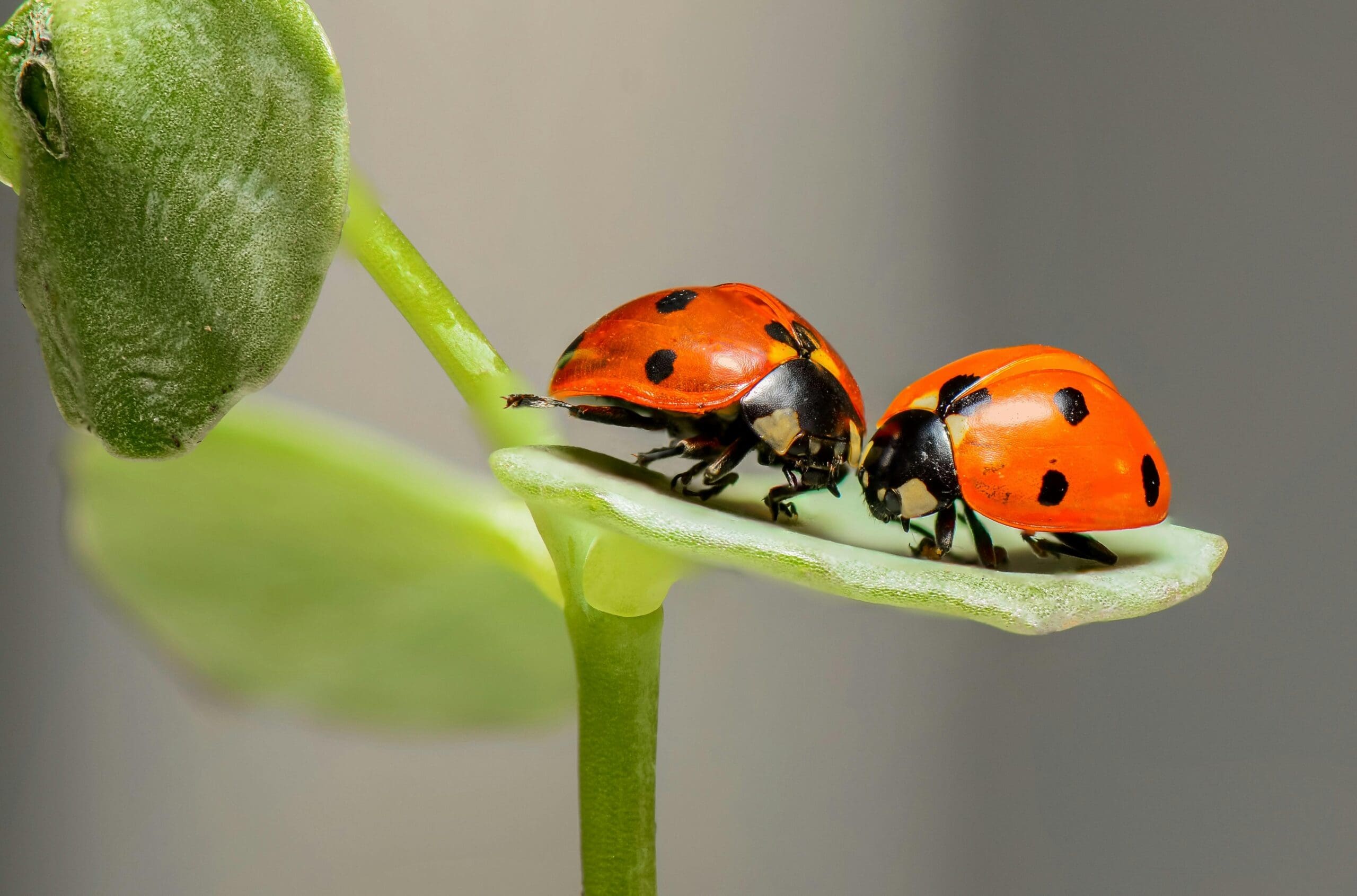
There are about 5,000 different species of ladybugs in the world. They differ mainly in their colors and spots – there are 2-spotted, 10-spotted, 14-spotted and even 24-spotted. The most popular and common are those with a shiny, red body with seven black spots.
The number, shape and arrangement of the spots are determined by the type of ladybug and are formed while the insect is still emerging from its pupa. There are species that are yellow with black spots, and those that are black with red spots.
Their sizes vary from four to ten millimeters. They have an elongated, oval or round body with a strongly convex back. The surface of some species of these insects is covered with thin hairs. The body consists of a small head, thorax, abdomen and wings with elytra. In addition, each individual has three pairs of legs.
Representatives of almost all species are considered predators. The basis of their diet is mites and aphids. But they do not neglect the larvae of other insects, butterfly eggs and small caterpillars. In nature, there are also species that feed exclusively on plants, flowers, leaves, pollen and even mushroom mycelium.
Ladybugs are also cannibals. If food is scarce, they resort to cannibalism – a hungry ladybug, without hesitation, would eat its own kind in order to survive.
Ladybugs have good protection against most of their enemies. Their red-black color warns predators that they will regret it if they try them. When a bird or other animal tries to attack it, the ladybug releases droplets of poisonous blood from the joints of its legs. It contains cantharidin.
This poisonous, unpleasant-smelling yellow liquid discourages birds and other potential enemies. The attacker tastes the bitter blood and spits out the ladybug. Predators learn to interpret the red-and-black color of the wings as a message to stay away.
The highest speed that a ladybug can reach is 24 kilometers per hour. The number of times its wings flap can reach an enviable 85 per second. It can fly 120 kilometers without stopping at the speed of a galloping horse.
The red bug can stay in the air for two hours and reach a fairly high altitude of 1,200 meters.
The way in which a ladybug retracts its wings after a flight is also interesting. This beetle carefully folds its delicate wings under its red-and-black elytra (elytra) when it lands. The insect makes a complex series of movements, resembling folding origami, to hide its wings.
Its wings are both strong enough to support flight, and yet so flexible. The shape of the veins on its wings allows it to roll up like a roller, making them stiff but foldable.
All ladybugs lead a solitary lifestyle. They only come together during hibernation or during the mating season. This process begins in early March, and sometimes the pairing of the insects lasts up to 9 hours in a row.
There can be a maximum of 5-6 generations of ladybugs in a year, with the average time from egg to adult ladybug taking only about 3-4 weeks. Females lay between 50 and 300 eggs. The small eggs are yellow and oval in shape and are usually found in groups of 10-50.
Ladybugs lay eggs on the underside of plant leaves, where aphids usually gather so that the small larvae can feed. The larvae, which vary in shape and color, emerge within a few days after the eggs are laid.
They grow extremely quickly and shed their skin several times. Then they attach themselves to a leaf with a tail-like structure and turn into pupae. Within a week or two, the pupae turn into ladybugs.
Ladybugs are most active from spring to autumn. When the weather gets cold, they find a warm, secluded place where they wait for the weather to warm up again.
Representatives of some species meet the winter in countries with a more favorable climate, while others remain to wait out the cold, merging into numerous groups consisting of several million. Such places are most often in hollows in trees, under stones and even in people’s houses.
In 1999, the American space agency NASA sent 4 ladybugs and aphids into space to test their behavior in airless space. The ladybugs that were on board were named after the four members of the Beatles – John, Paul, Ringo and George. All of them survived the space flight, even feeding on aphids in the microgravity environment that was unusual for them.
Illustrative Photo by Pixabay: https://www.pexels.com/photo/2-lady-bug-on-green-leaf-144243/