

The main directions of interpretation of the image of the Ark of the Covenant in the Christian Church are determined by the significance of this central sacred relic in the Old Testament history of the people of Israel. Here, this image is metaphorically revealed within the framework of such important concepts in Christian theology as sanctity, mediation between God and man, and the symbol of the Christian’s innermost spiritual life. The description of the structure of the Ark of the Covenant presented in the Book of Exodus (Exodus 25:10-16) received the most extensive interpretations from ancient Christian authors. In interpreting these verses, most exegetes of the ancient Church relied on the Septuagint text, according to which the Lord commands the people through Moses to make “the ark of the testimony of incorruptible wood” (ἐκ ξύλων ἀσήπτων – Ex 25:10; in the Hebrew text of this verse, as in the Synodal translation: “of shittim wood”).
Probably the earliest Christological interpretation of these verses belongs to Hieromartyr Hippolytus of Rome, who says that the Ark of the Covenant, being made of incorruptible wood, was a prototype of Christ, thus denoting “the immortality of His incorruptible body” (Hipp. De resurrectione ad Mammaeam imperatricem // Quelques nouveaux fragments des Pères anténicéens et nicéens / Ed. M. Richard. 1963. (Symbolae Osloenses; Vol. 38). Pp. 79-80; cf.: Idem. Fragmenta in Psalmos. 19. 2 // Hippolytus’s kleinere exegetische und homiletische Schriften / Ed. H. Achelis. Lpz., 1897. Pp. 130, 146-147, 153. (GCS; 1.2)). Other authors develop this interpretation: the structure of the K. z. covertly points to the incorruptibility of the Savior’s body (cf. Acts 13:37) (Cyr. Alex. De adorat. // PG. 68. Col. 597) and speaks of “… the mystery of the Flesh of Emmanuel, which is not subject to corruption and is not damaged by sin” (Ephraem Syr. In Exod. 37). Accordingly, the Book of the Law, placed inside the Covenant, symbolizes God the Word united with the flesh (cf. John 1:14 and Rom. 8:3) (Cyr. Alex. In John 6:68; Idem. De adorat. // PG. 68. Col. 617). Pure gold, with which the walls and materials inside and outside the Ark of the Covenant were decorated, is a symbol of the Divinity and points to the “brightness and incorruptibility of the pure body of the Savior” (Idem. De adorat. // PG. 68. Col. 597): as the Ark of the Covenant was decorated with gold, His divine body was “…adorned within by the Word, and outside by the Spirit” (Iren. Fragm. Gr. 8. 1-4; John. Damascus. Contr. Jacob. 89. 6). St. Gregory the Great sees in the structure of the Ark a reference to the Church of Christ, which is surrounded by four Gospels, just as the Ark of the Covenant is framed on all sides by four rings. The wooden poles inserted into these rings symbolize the reliable teachers of the Church, and carrying the Ark of the Covenant on the poles speaks of their preaching the teachings of the Church to all the unbelievers (Greg. Magn. Reg. pastor. 2.11). At the same time, the golden rings represent all those who surround Christ and participate in His glory, i.e., the disciples who serve Him in love (Cyr. Alex. De adorat. // PG 68. Col. 597). According to the Venerable Bede, the Ark of the Covenant symbolizes Christ and, above all, His human nature, while the vessel with manna kept in it symbolizes His divine nature (Beda. Homiliarum euangelii. 2. 25 // CCSL. Vol. 122. P. 376). The cover of the Ark of the Covenant (Ex. 26:34) also points to Christ, “who became the propitiation for our sins, sealed and confirmed everything that was in the Old Testament” (Theoph. Bulg. Exp. ad Hebr. 9:5). The numerological interpretation of the dimensions of the Ark is very rare in church tradition: Hippolytus of Rome has an interpretation according to which the sum of its dimensions by length, width, and height (2.5 + 1.5 + 1.5) is 5.5 cubits, which “must indicate the 5,500 years when the Savior, coming from the Virgin, brought into this world His own body, that is, the ark, adorned inside with the Word, and outside with the Holy Spirit” (Hipp. In Dan. IV 24:3-5).
The Christological direction in exegesis is followed by comparisons of what happens to the Ark of the Covenant with the sufferings of the Savior in earthly life: the image of the Ark of the Covenant placed on earth is sometimes correlated with the words of the Apostle Paul: “…the Only Begotten was in humility and humility like us (Phil. 2:7) (Cyr. Alex. De adorat. // PG. 68. Col. 617). K. z. was dishonored in captivity by foreigners, just as “God the Word, being impassible, suffered dishonor in the nature he assumed when he was crucified” (Ephraem Syr. Sermo adversus haereticos, in quo tum ex margaritae tum ex aliorum claris argumentis ostenditur credendum esse sanctam deiparam praeter naturae leges dominum ac deum nostrum pro mundi salute et concepisse et peperisse // Sancti patris nostri Ephraem Syri Opera omnia / Ed. K. G. Phrantzoles. Thessal., 1988, 1995r. Vol. 6. P. 170).
This line of interpretation is continued by K. z. as a symbol of the Blessed Virgin and Mother of God Mary, through whom the incarnation of God the Word took place (John. Damascus. Contr. imag. calumn. I 12. 47). St. Cyril of Alexandria asserts that in His incarnation God the Word dwelt “as if in an ark, in a temple received from the Virgin” (Cyr. Alex. De adorat. // PG. 68. Col. 597, 661). Accordingly, the Most Holy Theotokos is called in the works of ancient exegetes the “sacred ark” (Ephraem Syr. Precat. ad dei matrem. 4), the “true ark” (Ibid. 9), the “ark of holiness” (Greg. Thaum. In Annunt. // PG. 10. Col. 1153) or the “intelligent ark of glory” (νοερὰ τῆς δόξης κιβωτέ) (John. Chrysost. In Christi natalem diem [Spuria] // PG. 61. Col. 737). Just as the Ark of the Covenant shone with gold, the Virgin Mary, adorned with unearthly gold, “shone within and without with the splendor of virginity” (Maxim. Taurin. Serm. 42. 92). This Mariological understanding of the Covenant is widely expanded in Orthodox Christianity. services where the Most Holy Theotokos is glorified as: “the Ark gilded by the Spirit” (see, for example: the 12th ikos of the Akathist to the Theotokos – the Lenten Triodion. Part 1. Sheet 329 rev.), “the Ark bearing manna” (the Theotokion of the 5th song of the canon for the 5th week after Pascha by Joseph the Beautiful, 4th tone – the Pentecostarion Triodion. Sheet 137), “the Ark of life” (the Theotokion of the 4th song of the tripod of the 8th tone at matins on Thursday of the 5th week of Great Lent – the Lenten Triodion. Part 1. Sheet 301), “the immaterial Ark of the Holy Place” (Slav. “mental Ark of the sanctification”; the 7th song of the canon for the Nativity of Theotokos by St. Andrew of Crete, 8th tone), etc.
Another line of interpretation is the allegorical interpretation of the Ark of the Covenant and its individual elements. In the rings on the sides of the Ark of the Covenant (Exodus 37:3), St. Ephraim the Syrian sees a symbolic representation of the Garden of Eden and its four rivers (see Gen. 2:10), and “the sides of the Ark point to the visible world and the mental world” (Ephraem Syr. In Exod. 37). The Ark of the Covenant itself, placed in the Holy of Holies, represents the highest contemplation, i.e., contemplation of the Creator (Ibid. 36). Clement of Alexandria offers a Gnostic interpretation of the image of the Ark of the Covenant, which, from his point of view, includes human knowledge and divine wisdom (Clem. Alex. Strom. VI 16 [133.5]). The Greek word κιβοτός itself, according to Clement, comes from the Hebrew θηβοτά (in Clement’s rendering; the ancient Hebrew word (in status constructus – ), is used in the Old Testament to designate Noah’s Ark, as well as the reed basket in which the infant Moses was laid, see: Exodus 2:3), and means “something else” and can be interpreted as “everywhere one for the sake of the one.” It points to “the Eightfold and the intelligible cosmos, or the all-encompassing, formless and invisible God” (Clem. Alex. Strom. V 6 [36. 3]). In addition, Clement, without referring to anyone, Tradition claimed that the Ark of the Covenant contained certain inscriptions that related “to the intelligible world, and therefore are mysterious and hidden from most” (Ibid. V 6 [32.5]).
The next line of interpretation implies the metaphorical use of the image of the Ark of the Covenant in ascetic literature, the meaning of which is ultimately transferred to the inner state of a person, when speaking of the “inner ark” or “ark of the heart” (Greg. Magn. In Evang. 5.3). For example, it is said that constant reading and meditation on the words of Holy Scripture transforms the human spirit into a hidden “ark of the covenant” (John Cassian. Collat. 14.10). A more comprehensive interpretation of the image of the Ark of the Covenant can be found in the account in 1 Samuel 6:12 of the transfer of the Ark of the Covenant to Beth-shemesh on cows that did not deviate to the right or left. The image of cows becomes a symbol of believers who, without deviating from the straight path of God and meditating on the sacred commandments, “bear the ark of the Lord” in their hearts (Greg. Magn. In Evang. 37:4). This example is primarily intended for all who, forgetting their nature, intend to raise the “mental ark” (Nil. Exerc. 44). Accordingly, those who bear the Ark of the Covenant in their “inner knowledge” approach Beth-shemesh along the path of righteousness, i.e., “through the knowledge of heavenly things to the dwelling place of eternal light” (Greg. Magn. Moral. VII:42). Finally, another line of interpretation is historiosophical-typological: in it, the Ark of the Covenant is viewed as a temporary relic of the Old Testament, which lost its power with the incarnation of Christ (cf. Heb. 9:4). St. Isaac the Syrian believed that the Ark of the Covenant was inexplicably inhabited by an unlimited divine power (the Shekinah), which, with the advent of the New Testament era, left it and passed into the Cross of Christ, where it is henceforth worshipped (Isaac Syr. Sermones. 11:4-6, 13). In the New Testament era, “there is no longer any need to stand by the ark and the golden altar for those who have the Lord of all within themselves and who enter into communion with Him in every way—by prayer, offerings, writings, almsgiving, and carrying Him within themselves” (John Chrysostom. In Matthew 39:3 [on Matthew 12:1]). Thus, the Ark of the Covenant becomes one of the symbols of the fate of the Jewish religion and the entire Jewish people in Christian historiosophy: “…if the temple was of no use when the cherubim and the ark were in it, how much less will it be of use now that all this has been destroyed, now that God has completely turned away from it, and now that even more reasons for such aversion have been revealed” (John Chrysostom. Adv. Jud. 1:7).
Various interpretations of the image of the Ark of the Covenant are connected with the stories about it in other biblical books. The story of the tragic death of Uzzah, David’s companion, who carelessly touched the Ark of the Covenant (meant to demonstrate the special sacred status of this shrine – 2 Samuel 6:6-7), becomes for Christian interpreters an instructive example, warning all those who dare to recklessly and rashly seek the priesthood and accept it without being called by the grace of Christ (Ephraem Syr. Sermo de sacerdotio // Sancti patris nostri Ephraem Syri Opera omnia / Ed. K. G. Phrantzoles. Thessaloniki, 1988, 1995r. Vol. 6. P. 75; John. Chrysost. De sacerd. 7). The sevenfold encirclement of the Ark of the Covenant around the walls of Jericho by a host of priests foreshadows the saints’ veneration and confession of Christ, who overthrows every stronghold of the devil (Cyr. Alex. In John 6:68). Furthermore, it points to the proclamation of the New Kingdom of Heaven, with the advent of which all the bastions and walls of this world will be destroyed (Aug. Ep. 55:6:11). The Ark of the Covenant in this story is understood as a symbolic reference to the Word of God, which proves to be the conqueror of the world “through the mind and reason, that is, knowledge and virtue” (Maximus Conf. Ambigua. XIII:5:9).
Psalms from Psalm 131. 8: “Stand, O Lord, in the place of Thy rest, You and the ark of Your might (in the LXX – “Your sanctuary” – τοῦ ἁγιάσματός σου)”, according to a number of ancient commentators, point to the holy flesh of the risen Lord (Athanas. Alex. In psalm. 131. 8 // PG. 27. Col. 521; Aug. In Ps. 132. 8; Orig. Fragm. in Ps. 131. 8 [Dubia]; John. Chrysost. In Jordanem fluvium [Spuria] // PG. 61. Col. 726).
According to St. Andrew of Caesarea, the mention in the Book of Revelation of St. John the Theologian’s description of the Ark of the Covenant’s appearance in the last times through the opened heavens (Rev. 11:19) “signifies the revelation of the good things prepared for the saints” (see: Col. 2:3:9) (Andr. Caes. Apoc. 11:33).
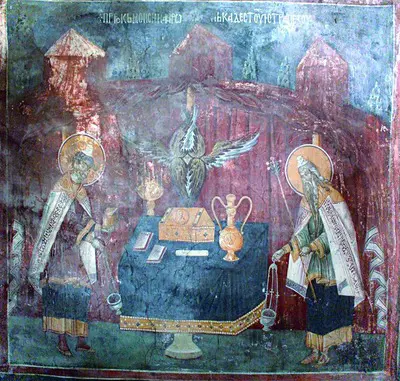
Illustration: The Ark of the Covenant and a vessel containing the image of the Mother of God in a scene depicting the service of the forefather Aaron and the prophet Moses. Painting on the northern altar wall of the Church of the Dormition of the Most Holy Theotokos, Gračanica Monastery (Kosovo and Metohija). Circa 1320.
Source: Petrov, A. E. “The Image of the Ark of the Covenant in the Exegesis of the Ancient Church.” – In: The Orthodox Encyclopedia, vol. 36, pp. 184-192.




![[Press Release] Milestones for the Tulsa Oklahoma and Victoria British Columbia Temples](https://i3.wp.com/newsroom.churchofjesuschrist.org/media/640x480/Victoria-British-Columbia_Canada_Temple_Map-02.jpg?resize=1,1&ssl=1 "[Press Release] Milestones for the Tulsa Oklahoma and Victoria British Columbia Temples")
![[Press Release] The Church of Jesus Christ Feeds Families in All 50 States for America250](https://i1.wp.com/newsroom.churchofjesuschrist.org/media/960x540/Boston-A250-8.jpeg?resize=1,1&ssl=1 "[Press Release] The Church of Jesus Christ Feeds Families in All 50 States for America250")