“I intended to purchase falafel,” recounts Mohammed Hassan. “As I was heading home, I glanced up and saw a rocket coming towards me. I attempted to flee, but it was too quick. I ended up pressed against the wall, and my foot was blown off.” Transported to Al-Shifa Hospital in Gaza City, the young boy gazes down at his heavily bandaged left leg, where his foot once was.
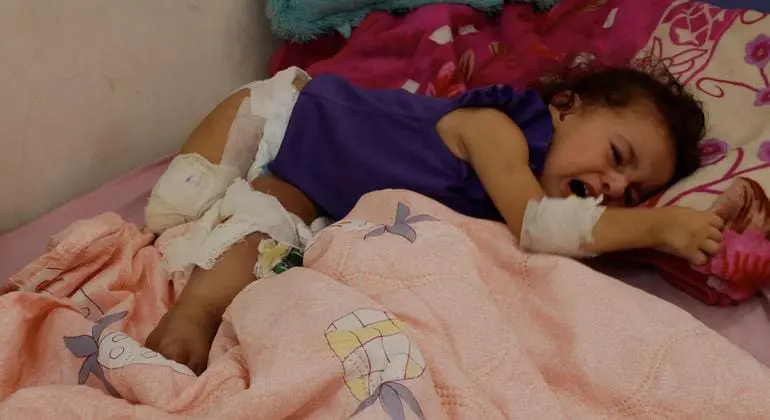
In another section of the hospital, a young girl, Maryam Abu Alba, sobs in agony. “The neighbor’s residence was bombed, and their home was struck,” her grandmother explains. “One of her legs had to be amputated, and metal plates were inserted into the other, which was broken. She is suffering tremendously.” Earlier this year, the UN humanitarian coordination office, OCHA, estimated that approximately 4,500 new amputees would need prosthetics, in addition to the 2,000 existing cases requiring ongoing maintenance and care, while around 24,000 injured individuals needed rehabilitation services. Health facilities are overwhelmed, with many patients undergoing multiple surgeries amidst a severe shortage of medical supplies, including anesthesia.
As Mr. Hassan recovers in the hospital, the fight for food continues outside.
In May, disruptions in supply routes for UN humanitarian convoys reduced the number of aid distribution points from 400 across the Gaza Strip to a few hubs managed by the Gaza Humanitarian Foundation. Due to the scarcity of humanitarian assistance and limited operational capacity, thousands of Palestinians have been killed or injured while searching for food since May. Among the injured are parents and children who, despite losing limbs, persist in their quest for sustenance and water. This situation is exacerbated by a recent UN report confirming famine conditions in Gaza governorate, where half a million individuals are trapped in starvation, malnutrition, and mortality.
Ibrahim Abdel Nabi was among many Palestinians who went to the aid hubs in search of essential supplies for their families. In a tent at a displacement site in the coastal Al-Mawasi area of Khan Younis, Mr. Nabi, surrounded by his wife and children, narrates the tragic events that led to life-altering injuries. “Upon reaching the Al-Alam area, west of Rafah, I was struck by an explosive bullet in my leg. I bled for nearly an hour and a half without assistance, as everyone was focused on finding food for their children.” Eventually, a group came to his aid and took him to a nearby Red Cross hospital. “I spent about a month and a half there, undergoing around 12 surgeries. I became malnourished and lost a significant amount of blood. Infection set in, necessitating further amputation of my leg.”
As Mr. Nabi worked on his recovery, he remained aware of his family’s urgent need for food. Despite his pain, he opted to create a rudimentary prosthesis from available materials to regain mobility and resume his search for food and water. “The prosthesis hurts my leg,” he admitted. “It causes inflammation and amplifies the pain. We lack medical care and supplies, but I will use it regardless of the discomfort.” As he speaks, Mr. Nabi’s wife begins to weep. “With God’s help, we will endure this ordeal,” she states. Mr. Nabi then rises on crutches and makes his way to a nearby tent, where his wife assists him in fitting the makeshift prosthesis. “Don’t overexert yourself,” she repeats gently. “Take your time. Walk slowly.”