In a resolution passed with 28 votes in favor, six against, and 13 abstentions, the Human Rights Council, comprising 47 members, endorsed a call to “halt the sale, transfer, and diversion of arms, munitions, and other military equipment to Israel, the occupying Power…to prevent further breaches of international humanitarian law and human rights violations.” Pakistan, representing the Organization of Islamic Cooperation, presented the resolution, which was also driven by the urgency to address “egregious” human rights abuses in the Occupied Palestinian Territory. The resolution was co-sponsored by Bolivia, Cuba, and the State of Palestine, garnering support from more than two dozen nations, including Brazil, China, Luxembourg, Malaysia, and South Africa. Although resolutions from the Human Rights Council are not legally binding, unlike those from the UN Security Council, they carry significant moral authority and are aimed at intensifying diplomatic pressure on Israel and potentially influencing national policies.
Opposition Voices
Among those who abstained or opposed the resolution, Germany expressed concern that it “fails to mention Hamas and denies Israel’s right to defend itself.” The German ambassador criticized the document for its “prejudged” claims, asserting that it characterizes Israel’s actions as apartheid, collective punishment, and the deliberate targeting of Palestinian civilians, including the use of starvation as a warfare tactic. Meirav Eilon Shahar, Israel’s Permanent Representative to the UN in Geneva, denounced the resolution as indicative of the Council’s perceived bias against Israel. She stated, “This resolution suggests that States should not provide arms to Israel for its defense, while continuing to supply Hamas.” Shahar further emphasized the Council’s inability to condemn the violence against Israelis, including the murder of over 1,200 individuals and the abduction of more than 240 people, including infants.
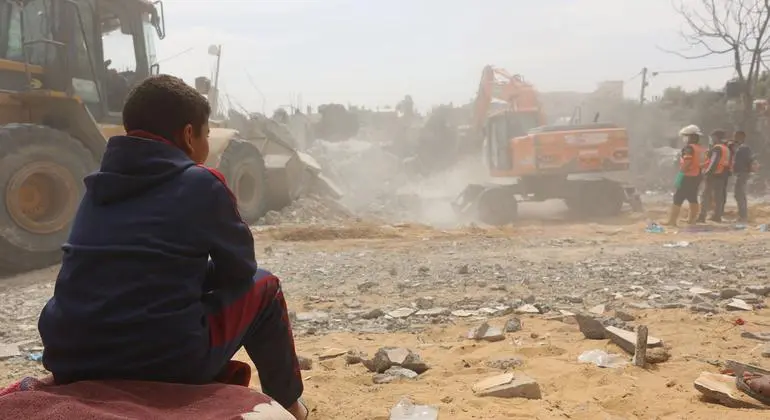
The resolution criticizes Israel’s use of explosive weapons with wide-area effects in densely populated areas of Gaza, highlighting the detrimental impact on hospitals, schools, water, electricity, and shelters, which are affecting millions of Palestinians.
AI in Military Use
The Human Rights Council’s resolution also condemns the application of artificial intelligence (AI) in military decision-making during conflicts, which could lead to international crimes. It specifically denounces the targeting of civilians, particularly referencing incidents on October 7, 2023, and calls for the immediate release of all hostages and individuals detained arbitrarily, in addition to ensuring humanitarian access in accordance with international law. This resolution was adopted on the final day of the Council’s recent session, along with more traditional resolutions addressing accountability and justice in the Occupied Palestinian Territory, the right to self-determination for Palestinians, Israeli settlements in the Occupied Territories, and the occupied Syrian Golan.
Focus on Gaza Crisis
At the opening of the Council’s 55th session, UN Secretary-General António Guterres reiterated his appeal for a humanitarian ceasefire and the unconditional release of all hostages. He stated, “Nothing can justify [Hamas’s] deliberate killing, injuring, torturing, and kidnapping of civilians, nor the use of sexual violence or indiscriminate rocket fire towards Israel,” while asserting that collective punishment of the Palestinian people is also unjustifiable. Presenting his report on justice and accountability in the Occupied Palestinian Territory, UN High Commissioner for Human Rights Volker Türk urged an end to the “carnage” in Gaza, asserting that “clear violations of international human rights and humanitarian laws, including war crimes, have been committed by all parties. It is time – well past time – for peace, investigation, and accountability.” Francesca Albanese, the Special Rapporteur on human rights in the Palestinian territories occupied since 1967, also shared her findings with the Council, indicating that reasonable grounds exist to believe that the actions against Palestinians in Gaza meet the threshold for genocide.
Emergency Forum
The Human Rights Council addressed various serious human rights violations, including those in Iran and Haiti. The Independent International Fact-Finding Mission investigating protests in Iran highlighted severe violations by state authorities following the death of Jina Mahsa Amini in September 2022. The Council decided to extend the mission’s mandate for another year, along with that of the Special Rapporteur on human rights in Iran. Regarding Haiti, the Council received a comprehensive update from the UN Human Rights Office as High Commissioner Türk stressed the urgent need for intervention amid rising violence impacting the population. The mandate for the expert on human rights in Haiti was also renewed. Investigations in Ukraine, Syria, and South Sudan were similarly extended.
The Council also adopted several thematic resolutions, including one aimed at combating discrimination, violence, and harmful practices against intersex individuals. Additionally, the mandate for the Special Rapporteur on human rights and the environment was updated to reflect its focus on “the human right to a clean, healthy, and sustainable environment,” acknowledging its recognition by both the Council and the General Assembly.