A passport stamped in one queue but waved through in another can make Schengen travel look arbitrary. It is not. The rules are structured, but they are applied in different places by different authorities, and that is exactly why a practical guide to Schengen border checks matters for residents, tourists, students, cross-border workers and families alike.
For many travellers, the confusion starts with a basic misunderstanding. Schengen is not the same thing as the European Union, and crossing a Schengen border is not always the same as crossing a national border. Some countries are in the EU but not fully in Schengen. Others are in Schengen but operate temporary internal checks under specific legal conditions. If you are moving between Paris and Rome, or Berlin and Vienna, you may not expect to face routine border control. Yet in practice, police checks, airline document controls and temporary internal border measures can still affect your journey.
What Schengen border checks actually mean
Schengen border checks are the controls applied at the external borders of the Schengen area, and in some cases temporarily at internal borders. External border checks happen when a person enters or leaves the Schengen area from a non-Schengen country. Internal border checks are, in principle, abolished, but member states can reintroduce them for limited periods on grounds such as security, migration pressure or major international events.
That legal distinction matters because your experience depends on where you are travelling from and what status you hold. A British traveller flying from London to Madrid is crossing an external Schengen border. A resident travelling by train from Brussels to Paris is usually moving within the area without systematic border checks, but may still face police identity controls. Those are not identical legal situations, even if they feel similar on the platform or at the gate.
Guide to Schengen border checks for different travellers
The first question border authorities ask, whether explicitly or not, is simple: who are you in legal terms? The answer shapes what officials can request and how long checks may take.
EU, EEA and Swiss citizens
If you are an EU, EEA or Swiss citizen, you have strong free movement rights. At an external Schengen border, you must hold a valid passport or national identity card, depending on the route and national rules. The check should usually be relatively quick and focused on verifying identity and the authenticity of the document.
That does not mean there is no scrutiny. Officers may still examine whether a document is valid, whether there is an alert attached to it, or whether there are security concerns. But they are not supposed to ask you to prove hotel bookings, return tickets or sufficient funds in the same way often expected from third-country nationals.
Non-EU nationals with short-stay travel
If you are a non-EU national visiting for a short stay, external border checks are more detailed. Officials may verify that you meet entry conditions, including a valid travel document, visa if required, proof of the purpose of your stay, evidence of accommodation, sufficient means of subsistence and the absence of an alert refusing entry.
This is where travellers are often caught out. A valid passport alone may not be enough. If you say you are attending a conference in Lisbon, expect to be able to show registration or an invitation. If you say you are staying with family in Rome, having the address and contact details matters. Border checks are not meant to be arbitrary, but they do involve judgement. Sparse or contradictory answers can trigger deeper questioning.
Residents, students and workers with permits
If you hold a residence permit issued by a Schengen state, your position is different again. You should carry both your passport and your valid permit. For students, posted workers and long-term residents, expired cards, pending renewals or digital-only proof can create problems if the country concerned does not recognise them in the same way at the border.
This is one of the most common practical failures. Immigration status may be lawful in substance, but if the document in your hand is expired or incomplete, the officer at the checkpoint has limited room to improvise. Always check whether a renewal receipt, certificate or temporary extension is accepted for international travel before you leave.
Where checks happen, even when you do not expect them
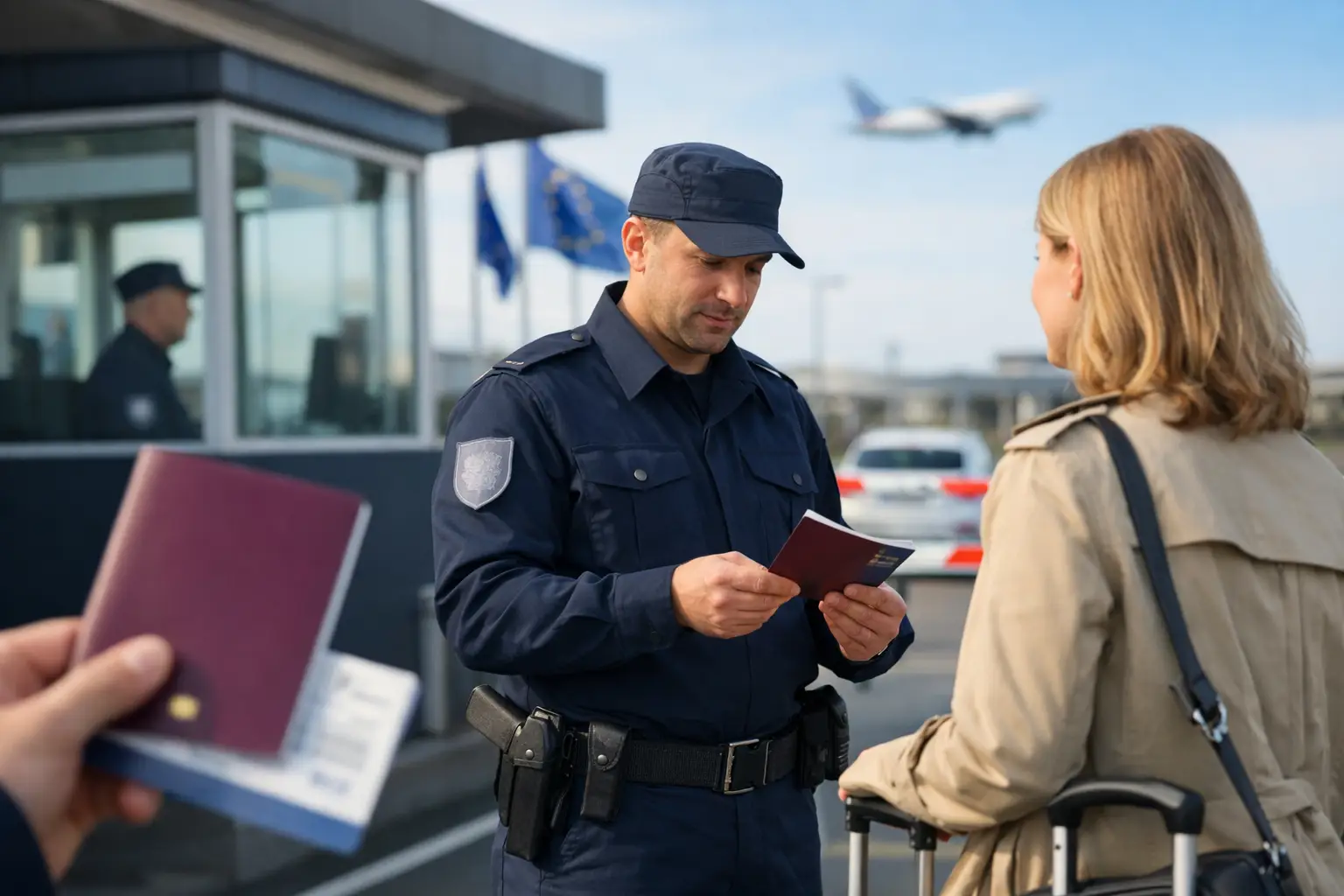
At airports, travellers usually encounter the most visible controls. Airlines conduct their own document checks before boarding because they can be fined for carrying improperly documented passengers. This is not the same as a state border check, but it can stop your journey all the same.
At land borders inside Schengen, formal booths may be empty while mobile police patrols carry out spot checks nearby. On trains, officers may board after departure. On ferries, checks can happen at embarkation, disembarkation or both. The absence of a permanent checkpoint does not mean the rules have disappeared.
Temporary internal border controls deserve particular attention. These measures have become more politically significant in recent years, especially in response to security concerns and migration management disputes. For travellers, the practical effect is straightforward: carry identification even on journeys that feel domestic. If you are lawfully present but unable to prove identity or status, a routine trip can become an avoidable detention or missed connection.
What officers can ask for
Border officials are entitled to verify identity, nationality and travel eligibility. For non-EU nationals entering for short stays, they may ask about the purpose of travel, intended duration, accommodation, onward travel and available funds. They may inspect stamps, visas and database records.
They can also ask questions that test whether your account is consistent. Where are you staying? Who paid for the ticket? How long will you remain? Vague or rehearsed answers can raise suspicion, especially where trafficking, smuggling or visa misuse is a concern.
That said, there are limits. Checks must have a legal basis and should be proportionate. Officials are not free to disregard residence rights, asylum obligations or anti-discrimination standards. In practice, however, travellers may still face ethnic profiling, language barriers or confusion over documentation. Knowing the rule does not always prevent bad enforcement, but it can help you challenge it later.
If you are delayed, questioned or refused entry
A secondary inspection does not automatically mean you have done anything wrong. It often means the officer needs more time to verify a document, resolve a database hit or clarify your status. Stay calm, answer directly and provide supporting papers in an orderly way.
If entry is refused at an external Schengen border, the decision should normally be given in writing with reasons and information on appeal rights. Ask for the written decision if it is not immediately offered. This matters later, especially if the refusal rests on an alleged lack of documents that you believe you did provide.
If you need an interpreter, ask clearly. If you are a family member of an EU citizen, say so and produce the evidence. If you are seeking international protection, state that plainly. An asylum claim changes the legal framework significantly, and it should not be treated as a standard tourist admission case.
For children, vulnerable adults and people with medical needs, border situations can become acute very quickly. Carrying prescriptions, consent letters for minors and relevant medical documentation is not bureaucratic excess. It is often the difference between a manageable check and a serious disruption.
A practical guide to Schengen border checks before you travel
Preparation is less about perfection than about reducing ambiguity. Make sure your passport has enough validity for your route and status. Check whether you need a visa, residence card, transit permission or supporting documents. Keep paper or offline copies available in case a phone battery dies at the wrong moment.
Do not rely on assumptions drawn from a previous trip. Border practice changes, temporary internal checks are reintroduced, and document rules tighten around large events or periods of heightened alert. A traveller who crossed without incident six months ago may face a very different process now.
It is also wise to distinguish inconvenience from illegality. A longer queue or extra question is not, by itself, evidence of a rights violation. But refusal without reasons, denial of interpretation where necessary, or disregard for residence rights may be. Where that happens, record names, times and documents as soon as you can.
Schengen was built on the promise that European movement could be freer without becoming lawless. Border checks sit at that fault line between mobility and control. The safest approach is to travel as if scrutiny is possible, know which rights attach to your status, and treat documentation not as a formality but as your first line of protection.
![[Press Release] Groundbreaking Date for the Coeur d’Alene Idaho Temple](https://i1.wp.com/newsroom.churchofjesuschrist.org/media/960x720/CoeurdAlene--Idaho-Temple-.jpeg?resize=1,1&ssl=1 "[Press Release] Groundbreaking Date for the Coeur d’Alene Idaho Temple")