

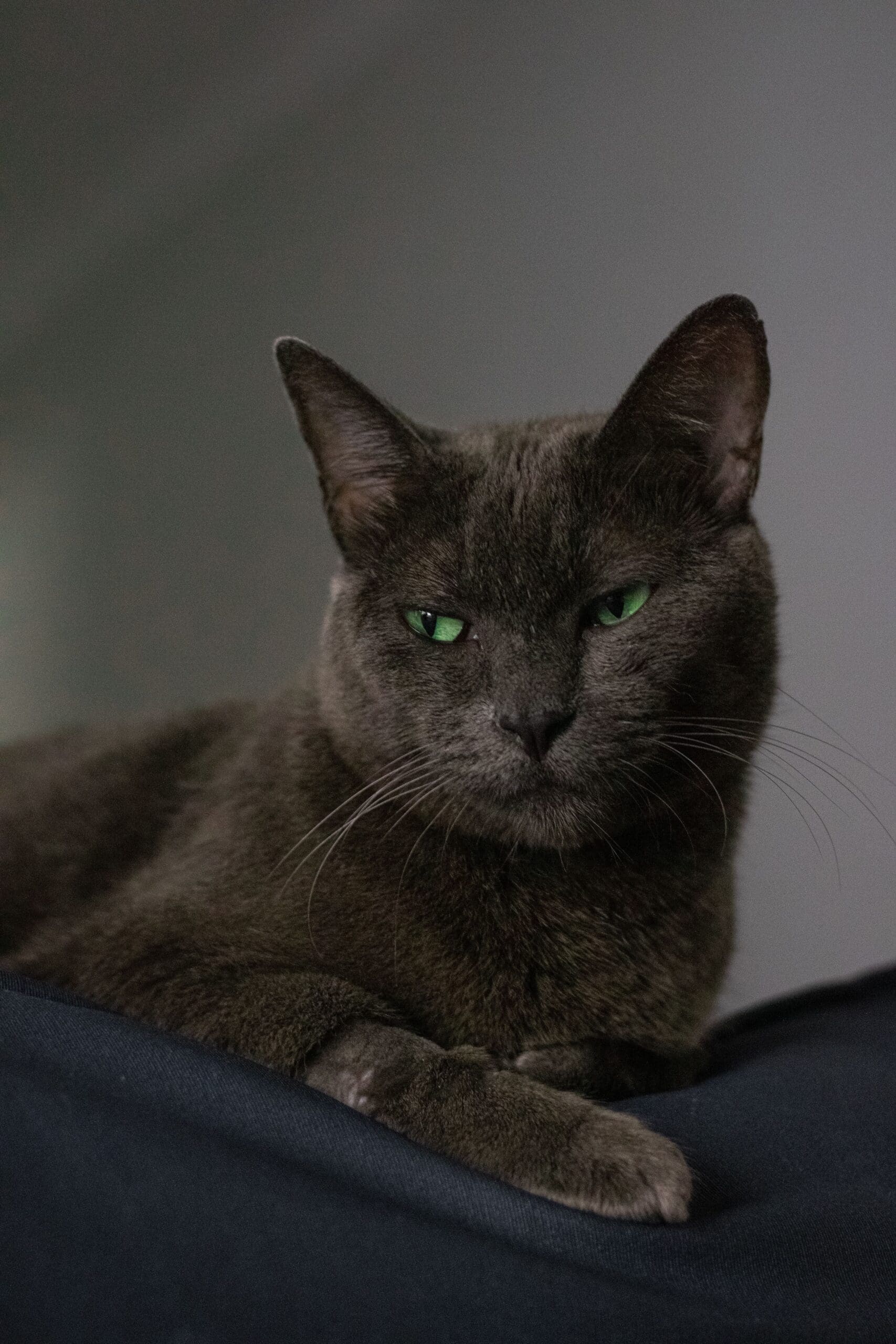
Cats have been shrouded in mystery for centuries. They are not as demonstrative as dogs, they do not constantly seek attention, and they rarely fully reveal their intentions. It is this enigma that makes many people wonder: do cats have special intuition? Can they “feel” which person is good and which is not? Or is their behavior simply the result of instincts and accumulated experience?
The truth lies somewhere in the middle – between biology, psychology, and an almost magical sense of the world that cats demonstrate in their own unique way.
The cat’s senses – a window to the invisible
To understand how purring animals perceive people, we must first look at their senses. They don’t just see and hear – they analyze.
A cat’s vision is tuned to detect movement, even minimal ones. This means that she notices gestures that a person may not be aware of – tension in the hands, sudden movements, nervousness. Her hearing is even more impressive – cats can distinguish frequencies that are outside the human range, as well as catch subtle changes in the voice. A slightly raised tone or hidden irritability do not go unnoticed.
But perhaps the cat’s most powerful tool is its sense of smell. Smell carries a huge amount of information – including about hormones such as adrenaline and cortisol, which are released during stress or aggression. Thus, the cat literally “smells” the emotional state of a person.
This is not a supernatural ability – but an extremely subtle biological tuning to the environment.
How cats “assess” people
Pets do not understand concepts such as “good” and “bad” in the moral sense in which people perceive them. For them, the world is divided in a different way: safe versus dangerous, pleasant versus unpleasant, predictable versus chaotic.
When a cat avoids a person, it doesn’t mean that they consider them “bad.” Rather, they are picking up on signals that make them feel insecure—such as sudden movements, a loud voice, erratic behavior, or even excessive insistence.
On the other hand, a person who moves calmly, speaks softly, and doesn’t invade the cat’s personal space is often perceived as “safe.” Over time, this can develop into trust and even strong attachment.
Socialization—the Key to Trust
In both humans and cats, early experience plays a huge role. Kittens that have been in contact with people since they were young tend to be more open and trusting. They accept new faces more easily and build positive associations more quickly.
Cats who have experienced trauma – abandonment, abuse or neglect – often develop a heightened sense of caution. They may seem “intuitive” in their choice of people, but they are actually reacting based on their past experiences. Each new person is evaluated through the prism of the past.
This means that “feline intuition” is largely learned, not innate in the mystical sense in which we often perceive it.
Do cats sense our feelings?
One of the most impressive aspects of feline behavior is their ability to respond to human emotions. Many owners say that their cat appears to them exactly when they are sad, anxious or sick.
Scientific studies have shown that cats can recognize emotional expressions and tone of voice. They do not “understand” emotions in a human way, but they sense changes in a person’s behavior and energy.
When a person is tense, their movements become sharper, their breathing faster, their voice sharper. The cat registers these signals and reacts – sometimes by backing away, sometimes by approaching, as if to “calm down” the situation.
Purring, for example, is not just a sign of pleasure. It is believed to have a calming effect on both the cat and the person. In this sense, the cat can act as a kind of emotional regulator in the home.
An interesting paradox: why do cats often like people who ignore them?
One of the most amusing and at the same time revealing phenomena is that cats are often attracted to people who do not pay attention to them.
The reason is simple: these people do not pose a threat. They do not try to control the cat, do not invade its personal space and do not put it under pressure. For the cat, this is a sign of safety.
In a sense, the “good person” in the cat’s eyes is not the one who tries to pet it constantly, but the one who gives it a choice. Therefore, it can happen that at first glance a person who really likes cats is avoided by the purring friend, because in his love he invades her personal space.
Microsignals and the body language of the cat
Pets are masters at reading microsignals. They pay attention to the direction of the gaze, the tension in the muscles, the rhythm of movement and the position of the body.
A person may seem calm, but if his body gives off tension, the cat will feel it. This is the reason why some people say: “The cat doesn’t like me, without me having done anything.” In fact, there is often something – it’s just too subtle to be realized.
Can cats “judge” us?
In the human sense – no. Cats do not form moral assessments and do not draw ethical conclusions. But they create associations. If a person brings positive experiences – food, warmth, peace – he will be perceived as “good”.
If he brings stress, noise or discomfort – he will be avoided.
This is a learning system based on experiences, not morality.
An unconventional perspective: cats as a “mirror” of humans
Perhaps the most interesting idea is that cats do not so much recognize good and evil as they reflect the inner state of a person.
If a person is calm, patient and consistent, a cat will relax around him. If he is tense, chaotic or aggressive, he will distance himself.
In this sense, a cat acts as a living indicator of the emotional climate. It does not “judge”, but reacts.
A cat’s “intuition” is impressive, but it is not mystical in the supernatural sense. It is the result of extremely developed senses, the ability to observe, accumulated experience and sensitivity to emotions and behavior.
Cats do not divide people into good and bad, but they very accurately sense who makes them feel safe and who does not. And in the end, this is perhaps more important than any moral assessment.
If you want a cat to “like” you, you don’t have to impress it. It’s enough to be calm, patient, and sincere. Because in the cat world, a person’s true worth is not measured by words – but by behavior.
Illustrative photo: pexels-gabrieluizramos-16476075