

By Aaron Rhodes
Human rights issues have been largely left out of international political discourse surrounding the current conflict in Iran, but the basic rights and freedoms of Iranian civil society are being egregiously abused, even in terms of Iran’s low standards. Arbitrary arrests and executions are accelerating as authorities seek to further intimidate the population and dissuade citizens from taking up calls for regime change, as regime security forces have been targeted by American and Israeli airstrikes. Some reports by human rights monitoring organizations say as many as 550 people have been executed this year, with a surge following the onset of the war, but this does not compare to the many thousands of peaceful protesters killed in recent months, which amount to summary political executions. With heavily armed state militia patrolling the streets, a brutal control has been imposed on the population, promising death if any form of dissent is expressed.
It is clear that, while some top American leaders may be indifferent to approaches toward human rights by Islamic Republic of Iran (IRI) authorities, as long as it gives up nuclear ambitions and its longstanding hostility to the U.S., and allows transit through international waters, good relations with European states will require concrete signs of improved respect for human rights.
And in fact, as many independent Iranian commentators and experts have said for many years, the U.S. and European states should use the Islamic Republic’s treatment of its people and in particular its minorities as a sign of its reliability in any new détente or grand bargain. A government that executes, persecutes, abuses and suppresses the rights of its own citizens, is hardly a trustworthy partner on the international stage.
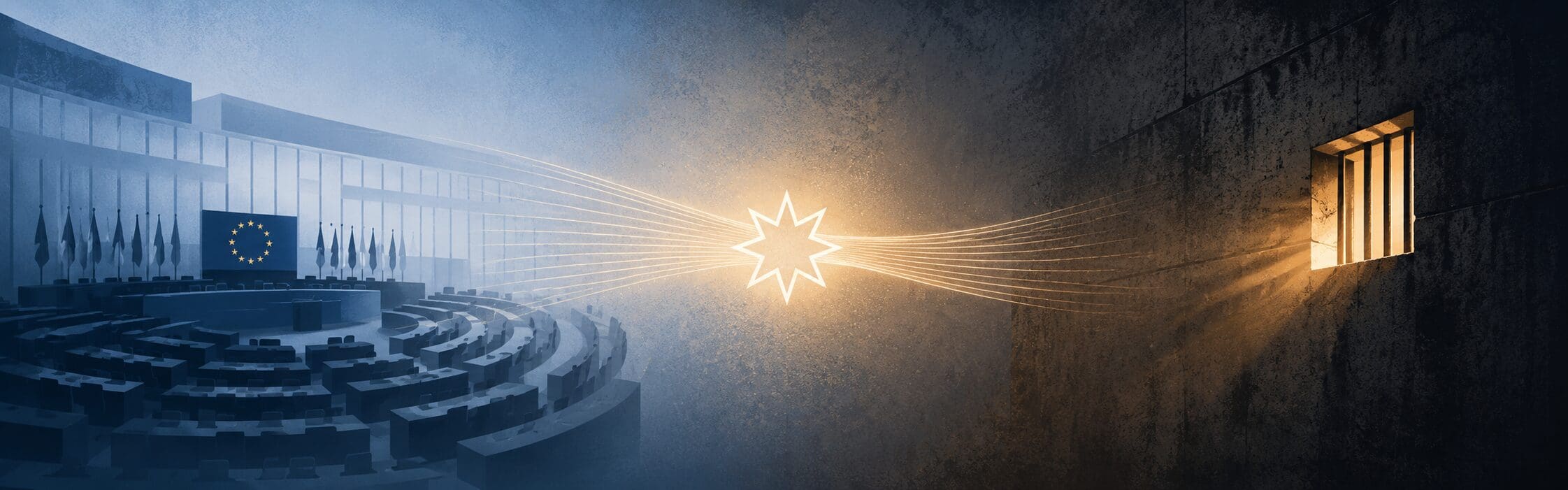
In this context, and with the Islamic Republic of Iran (IRI) and the United States circling around an accommodation that could end hostilities, Europe needs to step up. An appropriate way to do so would be to press for the release of unjustly detained members of the Bahai religious minority. In the ongoing human rights crackdown, persecution of the Baha’is has intensified. some of whom have been tortured, and could face execution.
The matter is of the utmost urgency. Borna Naimi, 29, was arrested at his workplace by members of the Islamic Revolutionary Guards Corps (IRGC) in Kerman on 1 March, and taken to an unknown location. He has been beaten, subjected to electrical shocks leaving extensive burns on his body, severe beatings, and at least two mock executions. Threats to his family, in combination with these abuses, have resulted in a false confession.
Borna’s cousin Peyvand was arrested on 8 January, and has also been severely tortured and subjected to two fake executions, leading to his forced confession to participating in protests. After more than three months, he remains confined in Kerman Prison in a state of legal limbo.
No evidence of the commission of crimes has been presented to justify the arrests, and neither man has been brought to trial. But short and unfair trails could be held at any time. Convictions would likely lead to death sentences and executions—for the “crime” of nothing else than being a member of the Baha’i faith.
In the course of the present conflict, the IRI has released some political prisoners, but not members of the Baha’i community. Numbering between 500,000 and one million citizens, the Baha’is are Iran’s largest non-Muslim minority, which has been regularly and baselessly accused of espionage on behalf of Israel since Iran’s Islamic Revolution 47 years ago. (The charges apparently stem from the fact that the Baha’i faith is headquartered in Haifa, Israel, following the death of its founder nearby in 1892.) Many have been executed after unfair trials; many more have been imprisoned and tortured. None have ever been proven to have taken up arms or otherwise subverted the regime, actions that are prohibited by the Baha’i faith.
Indeed, the persecution of the Iranian Baha’is is among the most tragic and prominent cases of religious discrimination in the world, damaging the reputation of the IRI and leading to harsh criticism in international forums.
The arbitrary arrests, which violated international legal norms, have done nothing to improve Iran’s security, yet have further harmed the IRI’s difficult diplomatic relations with Western governments. The arbitrary detention of Baha’is has needlessly added another point of contention to relations with European states that have not actively taken part in military activity against Iran. The arrests are thus not only illegal and wrong—they are irrational from the point of view of regime security.
A number of European MPs have raised their voices on behalf of persecuted Baha’is. Given the importance placed on European relations by the IRI, governments should use this leverage to forcefully engage for the release of Borna and Peyvand Naimi, and all others who have been arbitrarily detained in Iran’s wartime crackdown on minorities and civil society activists.
Based in Hamburg, Aaron Rhodes is a human rights advocate and writer. He served as Executive Director of the International Helsinki Federation for Human Rights and President of the Forum for Religious Freedom-Europe. He was also a founder and policy advisor of the International Campaign for Human Rights in Iran.