

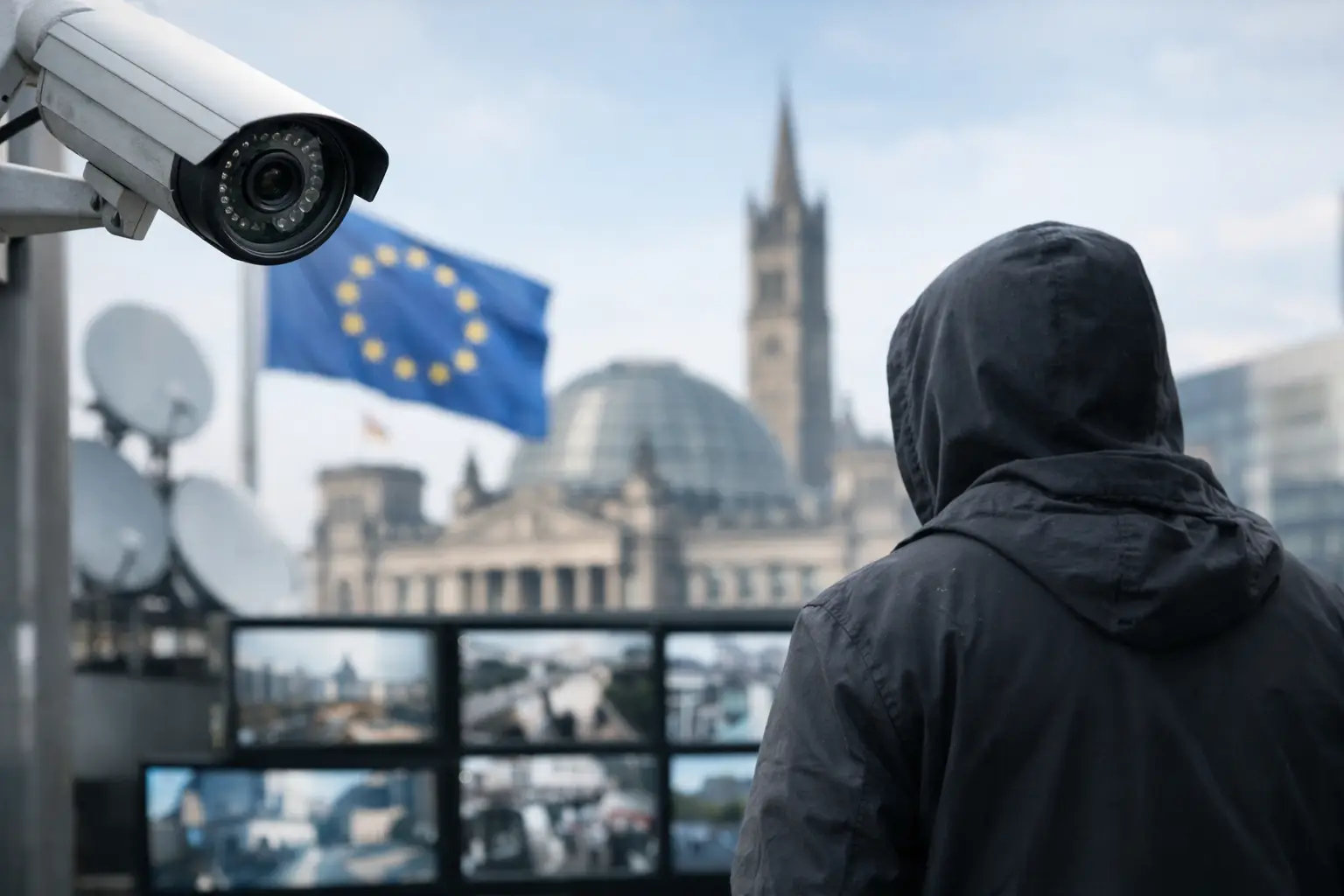
A journalist’s phone infected with spyware. A protester identified through facial recognition. A migrant’s data shared across borders with little clarity about safeguards. Surveillance abuses in Europe are not a fringe concern for privacy campaigners. They sit at the centre of a wider struggle over democratic accountability, state power and the credibility of the rule of law.
The uncomfortable truth is that Europe presents itself as a global standard-setter on rights and data protection, yet it has repeatedly shown how easy it is for exceptional powers to become normal administrative tools. The issue is not surveillance in the abstract. States need lawful intelligence capabilities, and police forces need investigative tools. The problem begins when necessity is invoked too loosely, oversight arrives too late, and those targeted have no realistic way to challenge what was done to them.
Why surveillance abuses in Europe matter beyond privacy
It is tempting to treat surveillance as a technical issue, best left to security agencies, data regulators and specialist lawyers. That is a mistake. Surveillance determines who can organise, who can dissent, who can protect sources and who feels safe enough to speak freely. When deployed without strict limits, it does not simply collect information. It alters behaviour.
That matters acutely in a European context. The European Union and the Council of Europe both rest on legal commitments to private life, free expression, association, religion or belief, non-discrimination and effective remedy. If surveillance practices erode those guarantees in practice, the damage is institutional as much as personal. Public trust weakens, courts face pressure to correct executive excesses after the fact, and minorities often carry the heaviest burden.
The effect is rarely evenly distributed. Investigative journalists, opposition figures, activists, religious minorities, migrants and diaspora communities are often more exposed than the average citizen. In some cases, surveillance is justified under national security language while serving plainly political ends. In others, systems introduced for border management or serious crime gradually expand into routine governance.
The main forms of abuse
The most visible scandals have involved spyware. Highly intrusive tools can extract messages, activate microphones, access files and monitor location with minimal awareness on the part of the target. In Europe, revelations around the targeting of journalists, political opponents and civil-society figures have shown how a capability marketed for exceptional threats can be redirected towards domestic scrutiny of inconvenient people.
But spyware is only one part of the picture. Facial recognition and other forms of biometric surveillance raise a different set of concerns. These systems promise efficiency, yet they increase the risk of constant monitoring in public space. Even where accuracy improves, the core democratic question remains: should the state be able to identify and track people at scale as they move through ordinary life?
There is also the quieter architecture of data abuse. Governments and agencies increasingly rely on large-scale data retention, automated flagging, cross-border information sharing and commercial data acquisition. Each may appear bureaucratic rather than dramatic. Taken together, they can produce deep visibility into a person’s life without the procedural safeguards that traditionally applied to searches or interception.
The private sector cannot be separated from this story. Surveillance technology is bought, sold, tested and integrated by companies operating across jurisdictions. That creates incentives to market powerful tools as routine solutions, while legal responsibility becomes diffuse. When harm occurs, states may blame vendors, vendors may cite lawful authorisation, and the individual is left facing a maze.
Oversight often fails for structural reasons
Europe does not lack legal texts. It lacks consistent enforcement, meaningful transparency and timely remedies. Oversight bodies may exist on paper yet remain underpowered, under-resourced or dependent on the very institutions they are meant to supervise. Parliamentary scrutiny can be partial. Judicial authorisation may rely on secret submissions that are hard to test. Data protection authorities may have competence in some areas and little access in others.
Secrecy complicates everything. Some confidentiality is unavoidable in intelligence work, but secrecy can also shield incompetence, overreach and political misuse. If a person never learns they were surveilled, their right to challenge the measure becomes largely theoretical. If they are informed years later, the practical damage may already be done.
Cross-border operation makes scrutiny harder still. Data gathered in one country may be stored in another, processed by a third-party contractor and shared through European or international channels. Responsibility fragments. Rights do not.
This is one reason surveillance controversies in Budapest, Warsaw, Madrid, Paris, Berlin or Brussels rarely remain purely national matters. The legal standards may differ at the margins, but the political pattern is familiar: powers expand quickly under urgency, while accountability arrives slowly through litigation, reporting or institutional scandal.
Security arguments are real, but so are the risks
Any serious discussion has to acknowledge the genuine security environment. European states face terrorism threats, hostile foreign intelligence activity, organised crime, cyber attacks and transnational extremism. It would be unserious to deny the need for lawful monitoring in specific circumstances.
Yet the existence of a real threat does not validate every tool or every deployment. That is precisely where democratic systems are tested. A targeted interception order based on evidence is not the same as indiscriminate bulk collection. Monitoring a credible terror suspect is not the same as placing journalists, lawyers or opposition figures under covert digital surveillance because they are politically troublesome.
The trade-off is therefore not privacy versus security in some neat binary. Poorly controlled surveillance can harm security as well. It can discredit institutions, taint prosecutions, chill legitimate civic activity and create vulnerabilities through excessive data storage. The more data states collect, the more attractive those systems become to abuse, breach or politicised access.
The legal framework is stronger than the practice
European human-rights law sets out clear principles: legality, necessity, proportionality, independent oversight and effective remedy. Data protection law adds rules on purpose limitation, minimisation and accountability. In theory, this should create a demanding threshold.
In practice, broad mandates and vague statutory language still leave room for abuse. Terms such as national security, public order or serious crime can become catch-all justifications unless courts insist on precision. Emergency measures may become semi-permanent. Pilot schemes may be normalised before democratic debate catches up.
Another problem is asymmetry. States possess technical expertise, classified evidence and institutional patience. Individuals challenging surveillance often rely on fragmentary disclosures, expensive litigation and years of delay. Rights that depend on extraordinary persistence are not equally accessible rights.
That is especially troubling when the people affected are already vulnerable. A refugee, a small faith community, an exiled dissident or an investigative freelancer is less likely to have the legal resources required to contest covert monitoring. Abuse thrives in that gap.
What better accountability would look like
If European institutions and national governments are serious about restoring trust, the first step is precision. Surveillance powers should be tightly drafted, limited to clearly defined purposes and subject to authorisation that is genuinely independent rather than administratively convenient.
Second, notification must become more meaningful. Delayed notice will sometimes be necessary, but permanent secrecy should be exceptional. Without eventual notice, there is rarely an effective remedy.
Third, oversight bodies need real technical capacity. It is not enough to have legal authority if regulators and parliamentary committees cannot audit code, procurement, data flows or spyware deployment logs. Contemporary surveillance is technical. Oversight must be as well.
Fourth, procurement deserves far more scrutiny. Public authorities should not be able to buy intrusive tools through opaque channels and reveal little about testing, lawful basis or safeguards. Contracts, authorisation procedures and audit trails matter because abuse often enters through acquisition as much as through use.
Finally, Europe needs a more coherent response to transnational repression. Exiled activists, minority advocates and religious communities should not find that they escaped intimidation at home only to face digital monitoring or data misuse on European soil. That is not a niche issue. It goes to the heart of what European democratic space is supposed to protect.
A test of Europe’s political honesty
The real question is whether Europe is prepared to apply to itself the standards it often promotes abroad. Condemning authoritarian surveillance elsewhere is easy. Examining the misuse of powers within democratic systems is harder, particularly when it implicates security agencies, allied governments or politically sensitive cases.
For readers of The European Times and for anyone concerned with rights-based public policy, surveillance should not be treated as a specialist silo. It intersects with journalism, freedom of religion or belief, migration governance, electoral fairness and civil society resilience. Once that is understood, the stakes become clearer.
Europe does not need fewer security debates. It needs more honest ones – grounded in law, evidence and the recognition that democratic legitimacy depends not only on what states prevent, but on what they refuse to permit themselves to do.