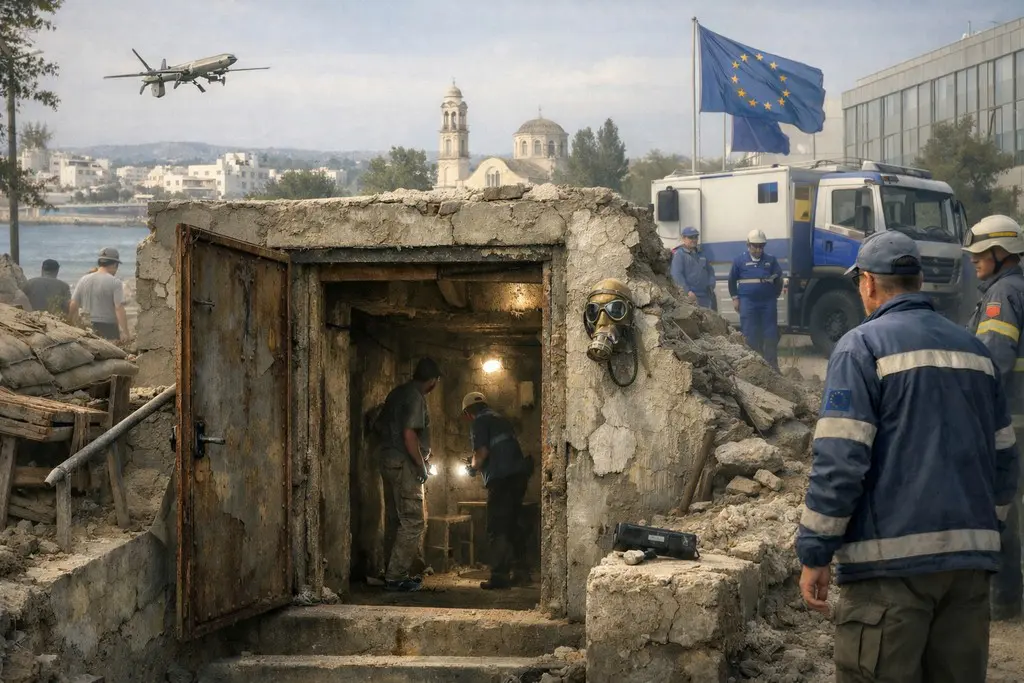
The recent drone strike near the British RAF Akrotiri base in Cyprus has brought to light a significant issue affecting many European countries: the deterioration of civil shelter networks. Inspections conducted after the incident revealed that about 200 of Cyprus’s 2,500 registered civil shelters were unusable. This discovery has reignited discussions on civil protection and highlighted the European Union‘s limited role in addressing such infrastructure issues.
Inspection Findings and Immediate Actions
Following the suspected Iranian-made drone strike in March, emergency inspections were carried out across Cyprus to assess the condition of civil shelters. The findings were alarming: many shelters were blocked by parked vehicles or repurposed as storage spaces; some were filled with waste, and others listed on safety apps like SafeCY could not be located at all. In response, specialised teams, including civil engineers from the Interior Ministry and other agencies, were quickly mobilised to conduct thorough checks and facilitate the cleaning of these shelters.
This situation in Cyprus is not isolated. It reflects a broader problem across Europe, where civil shelter networks developed during the Cold War era have fallen into disrepair. Despite their critical role in civilian safety during emergencies, these shelters have been largely neglected.
The EU’s Limited Role
Under Article 196 of the Treaty on the Functioning of the European Union, responsibility for civil protection primarily lies with individual member states. The EU can assist and coordinate but lacks direct authority to enforce construction standards or fund bunker projects. This limitation is rooted in the principle of subsidiarity, which restricts Brussels from intervening unless all member states agree to amend existing treaties.
The EU does maintain an emergency response capacity through mechanisms like the Union Civil Protection Mechanism (UCPM). This allows member states to request assistance when their national capacities are overwhelmed. The EU’s rescEU reserve provides deployable temporary shelters designed for displacement scenarios such as natural disasters or conflicts. However, these are not suitable replacements for permanent, blast-resistant bunkers required during attacks.
RescEU Reserves: A Temporary Solution
The rescEU initiative has seen significant investment, with over €196 million committed to shelter reserves across six member states from 2021 to 2027. Sweden holds the largest stockpile, capable of accommodating 36,000 people with winterised units equipped with essential amenities. Poland is also developing deployable “container towns” that can be assembled rapidly.
While these resources are invaluable during emergencies like floods or mass displacements due to conflict, they do not address the need for permanent civil defence infrastructure. Cyprus has yet to apply for its own rescEU reserve despite having the option to do so under EU funding schemes.
Lessons from Ukraine
The EU’s response to Russia’s invasion of Ukraine in 2022 demonstrated its capability to mobilise aid swiftly and at scale. Through the UCPM, over 140,000 tonnes of aid were delivered to Ukraine, including €62.3 million worth of shelter-specific assistance. This included prefabricated housing units and essential supplies distributed via logistics hubs in Poland and Romania.
While this operation underscored the EU’s ability to respond effectively to large-scale crises, it also highlighted its limitations regarding long-term infrastructure needs. Ukraine’s reliance on hardened metro stations and bomb shelters further emphasises the gap between temporary aid solutions and permanent civil defence requirements.
Looking Forward: A Call for Reassessment
The current state of Europe’s civil shelter networks calls for a reassessment of how civil protection is managed at both national and European levels. While individual countries must take responsibility for maintaining their infrastructure, there is a growing argument for increased EU involvement or at least better coordination among member states.
As geopolitical tensions continue to rise, ensuring robust civil protection measures becomes increasingly critical. Whether through treaty amendments or enhanced cooperation frameworks, finding a sustainable solution will be essential for safeguarding European citizens against future threats.
Original source: Latest News From Euronews