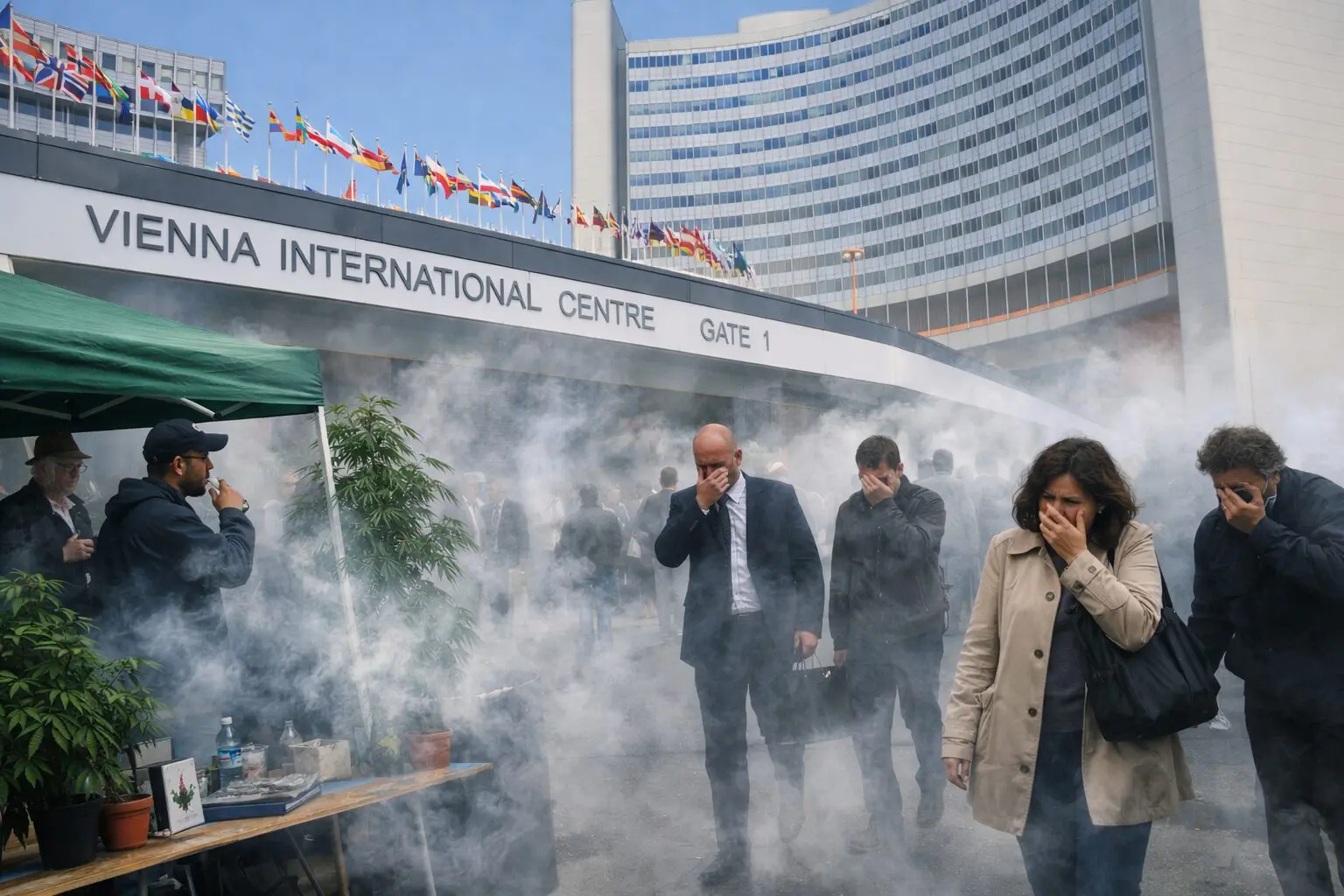
Delegates, diplomats, journalists and civil-society representatives arriving at the United Nations in Vienna on 12 March 2026 for the 69th session of the Commission on Narcotic Drugs were met with a bitter irony outside the venue: the smell of openly smoked cannabis near the main pedestrian approach to the Vienna International Centre. For many attendees, the issue was not simply political expression. It was involuntary exposure to a psychoactive substance in a shared public space at the very doorstep of the world’s leading multilateral forum on drug policy.
From 9 to 13 March, the 69th session of the Commission on Narcotic Drugs has been bringing together governments, UN officials, experts and NGOs in Vienna to debate prevention, treatment, trafficking, public health and international cooperation. The setting is meant to encourage serious discussion about one of the world’s most difficult policy areas. Yet outside the building, some participants arriving from the metro encountered a cloud of cannabis smoke before they even reached the entrance.
The location makes the incident especially troubling. The visitor entrance to the Vienna International Centre sits directly beside the Kaisermühlen/Vienna International Centre U-Bahn stop, meaning those approaching the UN complex on foot pass through a narrow and heavily used access route. When cannabis is smoked in that space, those who do not wish to consume drugs are left with little practical choice but to walk through the smell and smoke.
That is where the matter stops being a simple demonstration and becomes a question of public respect. Political activism does not include a right to impose drug smoke on others. No cause, however strongly held, justifies turning the entrance to an international institution into a corridor of involuntary exposure.
This point should not be softened. A person attending a UN meeting should not be required to inhale cannabis smoke in order to reach the building. Nor should journalists, staff, interpreters, NGO delegates or commuters be expected to accept that exposure as if it were an inevitable feature of public debate. Shared space imposes shared responsibilities, and one of the most basic is not forcing substances onto other people.
The public-health concern is not imaginary. The US Centers for Disease Control and Prevention states that secondhand cannabis smoke contains many of the same toxic and cancer-causing chemicals found in tobacco smoke, and in some cases in higher amounts. The CDC also notes that secondhand cannabis smoke contains THC, the psychoactive component of cannabis.
The US Environmental Protection Agency similarly warns that secondhand marijuana smoke can expose bystanders to potentially harmful substances, and that prohibiting smoking near buildings and enclosed spaces is the only reliable way to eliminate such exposure. While the intensity of risk varies according to distance, ventilation and duration, the principle remains obvious enough: non-users should not be made to absorb someone else’s smoke against their will.
The comparison with tobacco control is unavoidable. Across Europe, smoke-free laws were built on a simple and widely accepted principle: one person’s freedom to smoke ends where another person’s lungs begin. It would be extraordinary to defend that principle in offices, restaurants and transport zones, only to suspend it the moment the smoke comes from cannabis and the people producing it claim a political motive.
That contradiction was on display outside the UN in Vienna. At a summit where states are discussing prevention, health, organized crime and the social consequences of drugs, people arriving at the venue were confronted not by reasoned argument but by the physical reality of cannabis smoke in a shared access point. That is not persuasive advocacy. It is an imposition.
It also sends the wrong message. Campaigners who seek to present cannabis normalization as responsible and modern weaken their own case when they show so little regard for those who want no contact with the drug at all. If their argument rests on freedom, they should begin by respecting the freedom of others not to inhale what they are smoking.
What happened outside the Vienna International Centre on Thursday should concern more than those who oppose legalization. One need not take any side in the broader policy debate to see the basic problem. Public protest is one thing. Filling the approach to the United Nations with cannabis smoke is another.
The line matters because civilized public life depends on it. In a democratic society, people may campaign, persuade, protest and advocate. But they do not acquire the right to make unwilling strangers participate physically in their cause. The threshold of the United Nations is precisely the sort of place where that boundary should have been respected most carefully.
If there is a lesson from this episode, it is a simple one. Drug-policy debates are already polarized enough without activists turning shared public space into a vehicle for forced exposure. The entrance to the UN in Vienna should remain what it is meant to be: a route into international dialogue, not a gauntlet of cannabis smoke.
Because whatever one’s position on legalization, one principle should remain beyond dispute: nobody should have to walk through drug smoke to enter the United Nations.