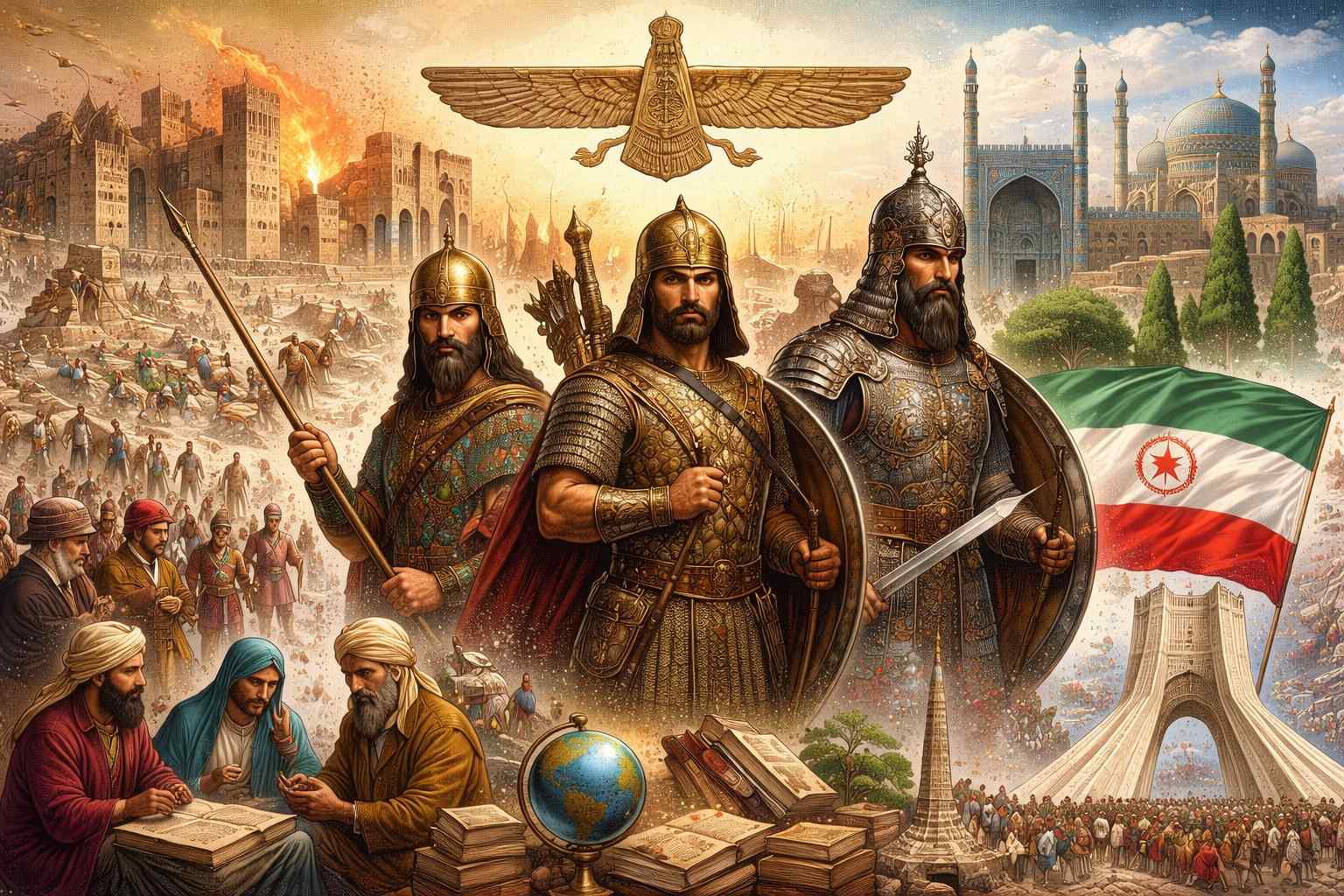
When in 330 BC the army of Alexander the Great captured the capitals of the Achaemenid Empire, it seemed that ancient Persia was finally destroyed. The palace in Persepolis was burned down, and the last king of the Achaemenid dynasty, Darius III, was killed during his escape.
But the history of Persia did not end with the fall of this empire. On the contrary, in the following centuries the region experienced a complex political transformation, in which Persian culture survived and gradually became the basis of new states. It was this long process that ultimately led to the emergence of the modern state of Iran.
After Alexander’s death in 323 BC his vast empire collapsed. His generals, known as the Diadochi, began a struggle for succession. Persia fell under the rule of Seleucus I Nicator, who created one of the largest Hellenistic states – the Seleucid Empire.
For almost two centuries, it ruled vast territories from Asia Minor to Central Asia. During this period, Greek culture penetrated the Persian cities, new centers of Hellenistic civilization were founded, and the Greek language was widely used in administration and trade.
Despite the strong Hellenistic influence, local traditions did not disappear. A new power gradually emerged in the eastern provinces – the Parthian Empire.
The Parthians were an Iranian people from the northeastern steppes, who in the 3rd century BC began to slowly push out the Seleucid power. By the 1st century BC, they created a powerful state that became one of the main opponents of the Roman Empire. It was the Parthians who inflicted one of the heaviest defeats on Rome at the Battle of Carrhae, where the Roman commander Marcus Licinius Crassus died.
However, the Parthian state was relatively decentralized and based on broad autonomy of local rulers. In the 3rd century AD In the 1st century BC, a new dynasty emerged on the historical scene, seeking to restore the glory of ancient Persia – the Sassanid Empire.
Its founder, Ardashir I, defeated the last Parthian ruler and created a centralized state that existed for more than four centuries.
The Sassanid Empire became one of the most powerful political centers of late antiquity. It entered into prolonged wars with the Byzantine Empire and controlled key trade routes between the Mediterranean, India and China.
During this period, Zoroastrianism was established as the official religion of the state, and Persian culture experienced a significant flourishing.
However, this world changed dramatically in the 7th century. After the advent of Islam, Arab armies began a rapid expansion. In 651, the last Sassanid ruler, Yazdgird III, was killed and Persia fell under the rule of the Arab caliphates.
Although political power passed to the Arab dynasties, Persian culture remained extremely influential. Gradually, a new Persian identity was formed, combining the Islamic religion with ancient cultural traditions.
The Farsi language played a particularly important role in preserving the Persian identity. After the Arab conquest in the 7th century, Arabic became the language of religion, science, and administration in the Islamic world. However, the Persian language did not disappear.
On the contrary, it gradually revived as a literary and cultural language in the eastern parts of the Islamic world. In the 10th century, dynasties such as the Samanid state actively promoted the use of Persian in administration and literature. It was then that great works such as the epic poem “Shahnameh” by Firdausi appeared, which tells the mythical and historical story of ancient Persia.
Thanks to a strong literary tradition and its widespread use in administration and culture, Farsi became a key factor in preserving the continuity of Persian civilization even during periods when the country was ruled by dynasties of Turkic or Mongol origin.
It is the language that proves to be one of the most enduring links between ancient Persia and modern Iran.
Over the following centuries, numerous dynasties of Iranian, Turkic, and Mongol origin emerged in the region. States such as the Samanid Empire, the Seljuk Empire, and the Timurid Empire played an important role in the development of Persian culture and language. Despite political changes, Persian civilization remained a central force in the region.
The decisive stage in the formation of modern Iran occurred at the beginning of the 16th century. In 1501, Ismail I founded the Safavid Empire and proclaimed Shiite Islam as the official religion.
This decision has enormous historical significance, because it permanently distinguished Persia from most Sunni states in the Middle East and shaped the country’s religious identity.
The Safavid Empire became one of the three great Muslim states of the early modern era, along with the Ottoman Empire and the Mughal Empire. The capital, Isfahan, became one of the most beautiful cities in the Islamic world and a center of art, architecture, and trade.
After the fall of Safavid Empire entered a period of political instability, during which the region became an arena of rivalry between the great powers of the Middle East. Among them, the Ottoman Empire was particularly influential.
For centuries, the Ottomans and Persians fought fierce wars for control of the Caucasus, Mesopotamia, and Anatolia. The conflict also had a religious dimension – the Sunni Ottoman Empire and the Shiite Persia sought to impose influence on the Muslim communities in the region.
The border between the two states gradually stabilized only in the 17th century, but their rivalry remained an important factor in Middle Eastern politics.
In the 19th century, Persia faced a new challenge – the expansion of the Russian Empire to the south. The Russo-Persian wars led to heavy defeats for Tehran. With the treaties of the Treaty of Gulistan and the Treaty of Turkmenchay, Persia lost vast territories in the Caucasus, including present-day Azerbaijan, Armenia, and parts of Georgia. These losses left a deep mark on the country’s historical memory and shaped its relations with its northern neighbor for decades to come.
At the same time, Persia also fell into the orbit of the rivalry between the British Empire and Russia, known as the “Great Game”. London sought to limit Russian influence in the region in order to protect the route to its most valuable colony – British India.
As a result, Persia gradually became a buffer zone between the two empires. In 1907, the two powers signed an Anglo-Russian agreement, which effectively divided the country into spheres of influence – the northern part fell under Russian control, the southern part under British, and the central regions formally remained independent.
This external intervention coincided with internal political changes. At the beginning of the 20th century, Persia experienced an important period of reform and modernization. The constitutional revolution of 1905-1911 led to the creation of a parliament and the limitation of the absolute power of the Shah. Although the reforms faced many difficulties, they laid the foundations of the modern state system.
A decisive moment came in 1921, when the military officer Reza Khan Pahlavi carried out a coup and gradually consolidated power in the country. In 1925, he founded the Pahlavi dynasty and began an ambitious program of modernization, centralization of power, and nation-state building.
As part of these reforms, the country officially adopted the name Iran in 1935, which emphasized the ancient Iranian origins of the state and symbolically linked it to the long historical tradition of Persia.
Thus, modern Iran was formed as the result of the complex interaction between an ancient civilizational tradition, regional conflicts, and the intervention of major world powers.
The history of Persia after Alexander the Great demonstrates the remarkable ability of this civilization to adapt to changing political realities and to preserve its cultural identity over the centuries.
Modern Iran is a multinational state in which, in addition to the Persians, many other peoples live. Although Persian culture and the Farsi language play a leading role in statehood and cultural tradition, the country’s ethnic picture is significantly more diverse.
Large communities are made up of the Azeris, who live mainly in the northwestern provinces of the country, as well as the Kurds in the western mountainous regions.
The Baluchis live in the southeastern parts of the country, and on the southern shores of the Caspian Sea – peoples such as the Gilani and Mazandaran.
In Iran, there are also ancient historical communities such as the Armenians and Assyrians, who have deep cultural and religious traditions in the region.
In addition to ethnic diversity, the country is also distinguished by religious diversity.
Although the majority of the population professes Shiite Islam, Iran is also home to Sunnis, Christians, Jews, and Zoroastrians – heirs of one of the most ancient religions in the world.
This ethnic and religious diversity is the result of the region’s millennia-old history, which for centuries has been at the crossroads of the Middle East, Central Asia, and the Caucasus. It is this historical legacy that makes Iran one of the most culturally rich and complex countries in the region, and one wonders whether it will ever rediscover a new era of peace and prosperity.
Illustrative Photo by Essi Sani: https://www.pexels.com/photo/ancient-wall-decoration-5624531/