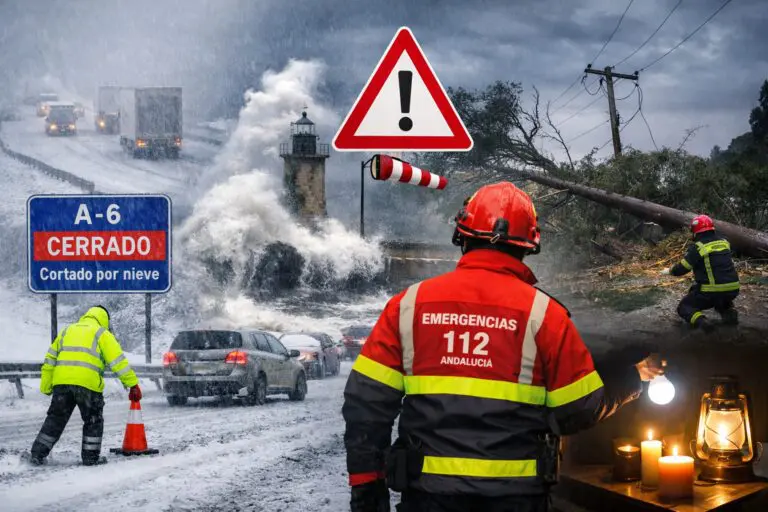
A fast-moving Atlantic storm, named Kristin, swept across the Iberian Peninsula on Wednesday, disrupting travel, closing schools and triggering emergency responses from Madrid to Andalusia. Spain’s traffic authority reported more than 130 roads affected by snow and heavy rain by late afternoon, while Portugal’s civil protection service said the same system had left four people dead and knocked out electricity to hundreds of thousands of customers.
Spain woke to a mid-winter mix of snow, rain and strong winds as Storm Kristin advanced from the Atlantic, bringing hazardous conditions to large parts of the country. By 18:33 local time, the national traffic authority (DGT) said 133 roads were affected nationwide, including nine on the main network, urging drivers to take extra precautions and warning that some secondary routes were fully closed due to snow or heavy rainfall.
The evolving situation was tracked in a live stream of updates by elDiario.es, which cited transport, weather and emergency officials as the storm’s impact shifted south and east through the day.
Road closures and travel warnings
Transport disruption was felt across several regions, with snow particularly affecting higher ground and key corridors into and out of the capital. The A-6 motorway connecting Madrid with north-west Spain was temporarily closed for much of the morning because of accumulating snow, before reopening with restrictions for heavy vehicles. Other stretches saw limits on trucks and calls for winter tyres or chains.
Authorities repeatedly urged residents to postpone non-essential journeys and to consult official traffic bulletins before setting out. DGT publishes rolling updates and downloadable bulletins on road conditions through its public information services, including its traffic incident portal.
Classes suspended and local emergency plans activated
School disruptions spread as the storm moved through multiple autonomous communities. In Castilla y León, local reporting cited by elDiario.es indicated that more than 13,000 pupils did not attend classes due to snow. In Castilla-La Mancha, the city of Albacete suspended in-person teaching in schools and at the local university campus during the afternoon, while municipal services activated emergency planning measures and responded to incidents such as falling branches and wind-blown debris.
Elsewhere, municipal leaders emphasised caution over normal routines. Madrid’s mayor described conditions in the capital as stable later in the day, while ordering the closure of large parks as a safety measure during strong gusts.
Andalusia becomes the centre of impact
By mid-afternoon, the most severe conditions had shifted towards southern Spain. In Andalusia, emergency services logged close to 2,000 incidents, and local reporting cited five injuries alongside delays to rail services. Spain’s national weather agency, AEMET, maintained a red-level warning for extreme wind in parts of Almería, where gusts were forecast to reach up to 130 km/h, while other provinces remained under orange warnings for heavy rain and dangerous seas.
Power supply was also affected. Utility company Endesa said it had deployed teams across Andalusia to deal with storm-related damage, with around 8,000 customers experiencing outages at certain points as repairs progressed.
For the latest official warnings, AEMET updates regional alerts in real time via its meteorological warning service.
Portugal: four deaths and major electricity outages
Across the border, the same weather system hit Portugal with a heavi