* By Martin Hoegger
For Chiara Lubich, founder of the Focolare Movement, nature is not a neutral backdrop but a word of God in the open air. Without directly addressing ecology in Paradise of 1949, her seminal mystical text, she nevertheless offers a powerful key: learning to see the world through the loving eyes of the Father. This ‘spirituality of unity’ transforms our relationship with creation and establishes a lucid and loving ecological responsibility. It is this vision, received in the heart of the Dolomites, that I recently highlighted at a conference on ‘ecotheology’ in Heraklion (Crete)[1].
Another view of nature
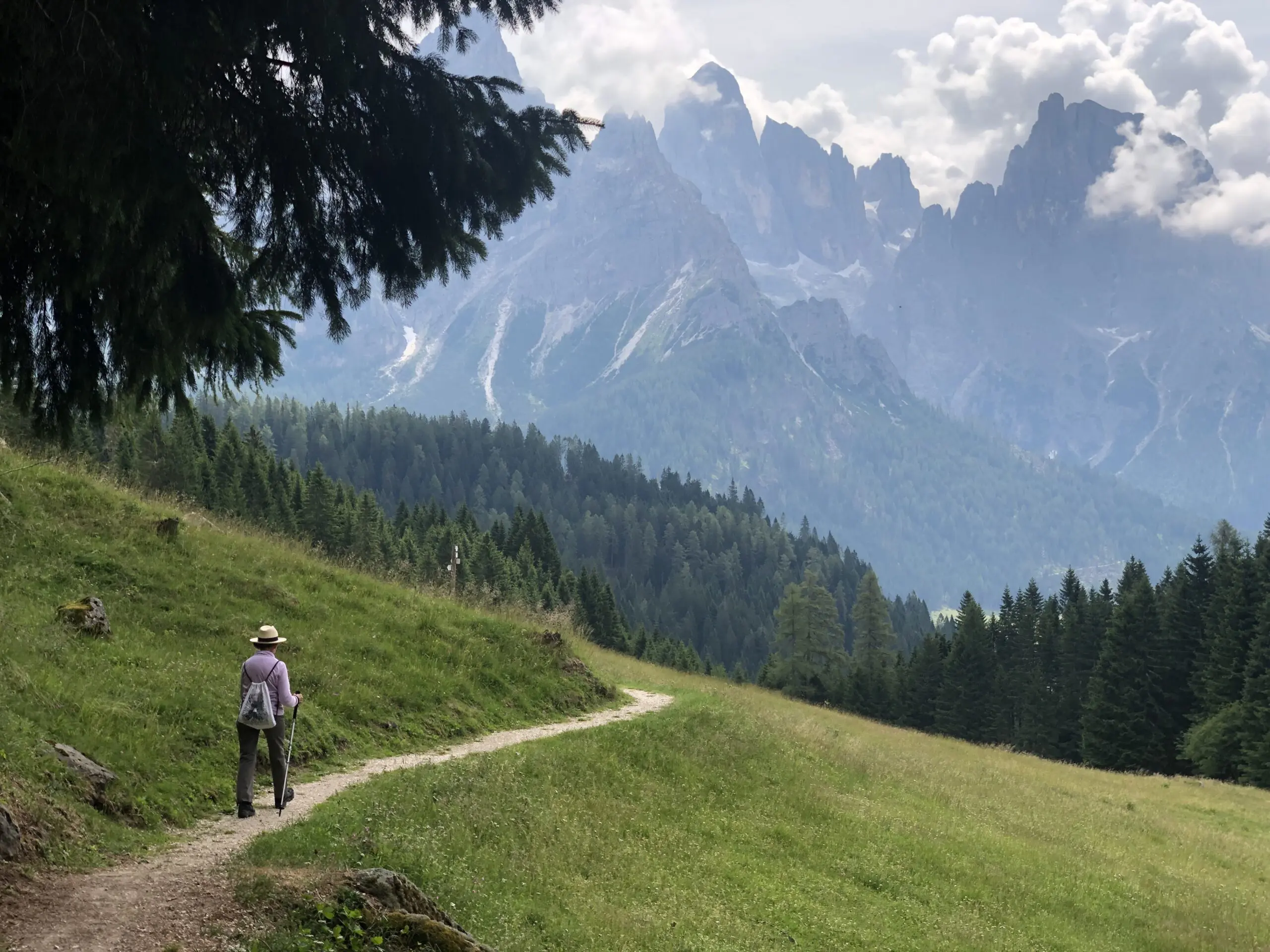
It was in the magnificent natural setting of the Dolomite mountains that Chiara Lubich had a unique experience, preceded by an intense period of evangelical life, where the Word of God was taken seriously and changed the way people thought and lived.
So when she and her companions decided to go to the mountains to rest, the consequence of this life nourished by the Word was that their view of nature had changed:
“None of us will ever forget the nature that surrounded us and the events of that day. Everything was a celebration… God in all things changed our view of them: they were all connected by love, all – so to speak – in love with each other. So that if the stream flowed into the lake, it was out of love. If one pine tree stood next to another, it was out of love.”
The suffering and redemption of nature
This vision does not ignore the wounds of the world. Lubich speaks of a ’dark night” when reality seems emptied of God, like a setting without depth. Our modern world sometimes goes through a cultural night: technology surpasses ethics, and the heart disconnects from intelligence. The answer is not to flee, but to encounter “Jesus forsaken”, where emptiness is accepted and transfigured.
But Jesus’ abandonment is a passage to his resurrection and his continual presence among us. The fire that Chiara Lubich and her companions perceived within themselves during their stay in the Dolomites, thanks to the Word lived, they also perceived in their midst and in all creation. They quickly understood that this fire is the Risen One.
Chiara Lubich’s ecological vision
Above all, for Chiara Lubich, the path to forming an ecological conscience is love. She would later develop this ecological vision, implicit in Paradise of 1949. For her, we must acquire God’s loving gaze on all things:
“Everything must be treated with the Father’s love for the Son: a big heart and God’s smile on things through our gaze.”
Similarly, ecology is an act of love towards our children and our children’s children who will follow us:
“Restoring a harmonious relationship with nature is for us an act of love towards the humanity of tomorrow. In the same way that we live for others today, we must work for our brothers and sisters who will come after us.”
Conclusion: “The whole universe is a living Gospel.”
With these words, Chiara Lubich opens our eyes to the deepest truth of creation. The world is not silent: it speaks, it sings of its Creator.
From the beginning, the Word of God tells us that everything exists in a divine communion of love.
In the Dolomites, Chiara Lubich saw God “in all things.” She perceived creation as ablaze with divine love: every stream, every pine tree, every ray of light connected to each other by love.
It is the same intuition as St. Francis: a universal brotherhood born of the fatherhood of God.
But creation also suffers. It groans, as Saint Paul says, awaiting redemption. Chiara Lubich saw this too: in Jesus abandoned, even the pain of creation is taken up, healed and transfigured.
The risen Christ is the new sun shining at the heart of the universe. His resurrection is the dawn of a renewed creation.
To live the Gospel is therefore to love the world as God loves it: with tenderness, respect and gratitude.
From this perspective, ecology is not an ideology, but an act of love. And when love becomes our way of seeing, we discover the hidden truth of all things: “the whole universe is a living Gospel.”
This is what motivates our ecological responsibility to the highest degree. Let us therefore live the Gospel, all the words of God, so that “a spiritual fire burns within us” and our view of nature is transformed into a permanent celebration.
Photo: Walking in the Dolomites
* Martin Hoegger is a Reformed theologian and author living in Switzerland. He participated in the Heraklion conference. https://www.hoegger.org
For other articles on the theme of this Symposium, see here: https://www.hoegger.org/article/eco-theology
[1] Scientific and theological symposium on ecology at the Patriarchal Academy of Crete, 8-9 October 2025. Its theme was: ‘Towards a just, participatory and sustainable society based on responsibility: ecotheology as a challenge for contemporary ecumenical Christianity’. My text, of which this article is a summary, will be published shortly in the Proceedings of this Congress.