

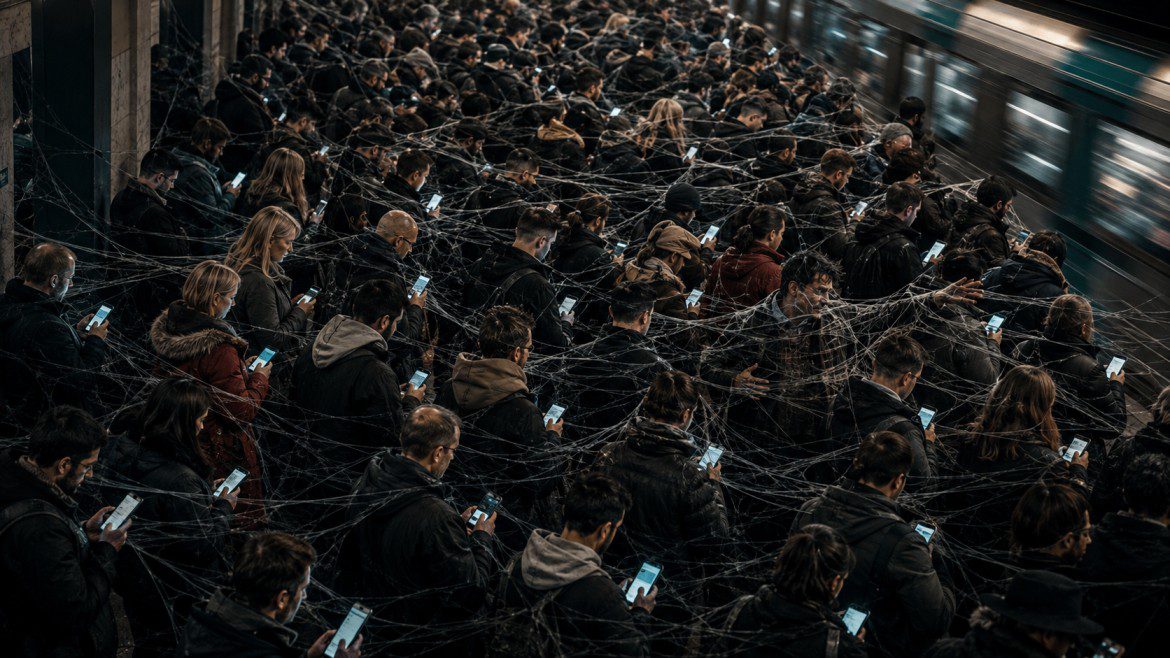
From obesity to suicide, including violence, self-harm, and certain collective behaviors, scientific research has shown that our behavior is influenced by the people around us. But experts caution: talking about “social contagion” does not mean that a behavior is mechanically transmitted from one person to another.
There are behaviors that seem to spread as if they were a disease. One person begins a certain behavior, and shortly thereafter, others in their circle do something similar. This can happen among a group of friends, at a school, within a community, or—with extraordinary amplifying power—on social media. Because of this, it is difficult to understand how millions of people follow radical ideologies that curtail women’s rights or nullify human rights in countries with a clearly Muslim or communist ideology (Iran, Cuba, Nicaragua, Russia, China, etc.).
The term “social contagion” attempts to describe precisely this phenomenon: the possibility that certain ideas, emotions, attitudes, or behaviors spread through social relationships. Hence, the internet—due to its rapid development and integration with new forms of communication—has become a tool that those in power use to manipulate people. The aim is to influence voting behavior, generate consumer trends, create habits, instill new ideas, and so on.
But the word “contagion” can be misleading. There is no psychological virus that automatically spreads from one person to another. What does exist is a complex combination of imitation, learning, peer pressure, identification, social norms, and repeated exposure. All of this creates such a powerful spectrum of manipulation that very few people are able to resist it.
One of the researchers who has contributed most to the study of this phenomenon is Nicholas Christakis, a physician and sociologist at Harvard University, who, together with political scientist James Fowler, has spent years investigating how human social networks can influence behaviors as diverse as obesity, smoking, cooperation, and happiness. Their work suggests that certain phenomena can spread through the existing connections between people like a perfectly woven spider’s web. We all know we’re living within that web, but even though we’re aware of being trapped, we tend to believe that “we’re in control.”
Christakis and Fowler even proposed the existence of what they called a “three-degrees” influence: certain behaviors may be linked to people located even several steps away within a social network. However, the researchers themselves emphasize a fundamental point: demonstrating that two behaviors are correlated within a network does not automatically prove causality. Although, given the penetration of certain social spheres (political, religious, business, etc.) into social media and the mass media, it is becoming increasingly rare to find the limits of the manipulation they exert over us and to discover even small glimpses of personal freedom.
SOCIAL CONTAGION IS NOT A DISEASE. But it disguises itself very well.
The distinction is important.
When we speak of social contagion, we are not claiming that a person loses their ability to make decisions simply because another person has engaged in a certain behavior. The phenomenon is much more complex. A person may observe what another person does, interpret that behavior as acceptable, possible, or even desirable, and subsequently modify their own behavior. A process of normalization can also occur: what initially seemed strange begins to be perceived as commonplace when it is repeated within the group. For example, we may have an unhealthy relationship with a particular political party or religion that constantly commits all sorts of abuses; because these abuses are so common, society—or people within a certain sector—may come to view them as natural. If we add to that—as I mentioned earlier—media control or the use of people with a certain social standing, we have the perfect recipe for deceiving society, because social contagion is deceptive.
The other day, while listening to a talk show in Spain, I saw a Catalan journalist call a woman from Ceuta Garrula as she expressed her astonishment and blamed her nation’s government. Well, the hosts of the show, instead of sending him home—at least for a while—decided to reprimand him as if, deep down, he hadn’t actually done anything serious. That insult, in that context, disparaged the citizen from Ceuta in the presence of the gentleman journalist from a major pro-government newspaper. It demonstrated, on the one hand, “homophobia”; on the other, “sexism”; and on yet another, “classism.” The self versus others—and if those others aren’t on my level, “well, screw them.” Kudos to the journalist and, above all, kudos to the program’s management for not reprimanding that individual aligned with the powers that be as he deserved.
Peer pressure can play a particularly important role during adolescence. The desire to belong to a group, the search for identity, and the need for recognition mean that certain behavioral models have a special capacity to influence. The “id” prevails over the “ego.” And if the “id” is dictated by those in power, “it’s as bad as it gets.”
Social media has added a new dimension to the problem.
In the past, influence was limited primarily by physical proximity. Today, a person can spend hours observing the behaviors, opinions, and emotions of thousands of individuals they do not even know. The screen has turned social exposure into something potentially permanent.
Faced with this influence, the medical establishment is beginning to diagnose “screen addiction” among certain groups, classifying it as a disease so they can profit from it. The only thing that exists is social contagion. The influence of what we’re told on social media is exciting; it alienates and represses us or drives us, and this shapes our relationship with ourselves. If we’re not interested in war, we swipe past it; if we’re not interested in religion, we swipe past it; if we’re not interested in politics, we swipe past it, and so on. This undoubtedly leads us toward a constant danger.
One of the areas where the term “social contagion” has gained the most relevance is that of suicidal behavior.
For decades, researchers have studied the so-called Werther effect, a term used to describe the increase in certain suicidal behaviors following public exposure to a suicide, especially when media coverage presents certain elements that viewers can identify with or turns the event into a spectacle.
By this, I do not mean that such a phenomenon or case should be hidden. Most cases are rushed through on programs that mix celebrity gossip, murder stories, opinions on food, and so on, and are given only a few seconds of airtime; thus, nothing is clarified, and the idea is perpetuated that it is a topic that must be hidden—it becomes a source of shame, when it should be addressed in depth. On one occasion, I participated in a national television program as a field producer, where we addressed the topic of suicide in one of the episodes, bringing to light all kinds of possible causes. Only information can bring about a shift in social contagion. Poor communication, silence, or leaving the information to the whims of social media or AI creates more dangers than benefits.
A recently published systematic review analyzed 25 studies on social media and suicide. Its authors concluded that there is evidence consistent with both a possible Werther effect—of an imitative nature—and the so-called Papageno effect, whereby certain stories can have precisely the opposite effect and promote prevention.
The difference between these two concepts is fundamental. Information that portrays suicide as an inevitable, romantic, or heroic act can increase certain risks. Conversely, showing how a person overcomes a crisis, finds help, or manages to rebuild their life can have a protective effect. Psychiatrist and communication specialist Thomas Niederkrotenthaler of the Medical University of Vienna is one of the leading international researchers on the so-called Papageno effect. His research has examined how stories of hope, recovery, and seeking help can contribute to prevention. An experimental study published in 2025 found precisely such protective effects in social media posts focused on hope, recovery, and overcoming adversity.
THE GROUP CAN ALSO MODIFY BEHAVIOR.
Social contagion is not limited to suicide either. Scientific literature has studied mechanisms of social influence in phenomena as diverse as tobacco use, obesity, certain cooperative behaviors, and even emotional states. The work of Christakis and Fowler is one of the seminal studies in this field.
The explanation can be found in part in something seemingly simple: we constantly observe others to decide what is normal. What do they eat? How do they speak? What do they consider acceptable? How do they react to a situation? What do their friends do? What behaviors are approved of?
The answers to these questions can shape our own decisions. A sociologist might speak of social norms. A psychologist, of observational learning. A network researcher, of social transmission. These are different ways of approaching a phenomenon that shares a common element: we are not completely isolated individuals—hence social contagion.
Another area in which social contagion has been studied is non-suicidal self-injury, especially among adolescents and young adults. A literature review published by Stephanie Jarvi and other researchers examined precisely the social influence on self-injury and identified exposure to similar behaviors as one of the factors that may contribute to its onset and continuation. But once again, a fundamental caveat arises: exposure does not mean causation. Just because a person knows someone who self-harms does not mean they will do so. Individual, family, psychological, and social factors play a role in each case. That is why researchers prefer to speak of risk factors and social influence rather than automatic transmission.
Personal relationships.
The most recent research provides a better understanding of the extent to which personal relationships may play a role.
A meta-analysis published in 2026 in Comprehensive Psychiatry drew on 59 studies and more than one million people. The researchers found that exposure to suicidal thoughts or behaviors within social networks was associated with an increased likelihood of also experiencing suicidal thoughts or behaviors. By sociological extension, this finding can be applied to other topics.
The association was particularly strong when the exposure came from close friends or peers, whereas it did not appear to the same degree when it came simply from acquaintances. The finding is significant because it points to a specific idea: social proximity matters. We are not influenced equally by just anyone. The behavior of someone with whom we have a strong emotional bond can have a different impact than that of a stranger who appears on a screen for a few seconds.
At the same time, the authors point out a key limitation: much of the available research is observational. Therefore, the existence of an association alone does not establish that one person’s behavior caused another’s.
This phenomenon also places a responsibility on journalists and the media. The World Health Organization (for which this writer has little regard) has warned for years that certain ways of reporting on suicides can contribute to a contagion effect, while coverage handled appropriately can have a protective effect. It is not a matter of hiding the facts. It is a matter of deciding how to report them.
The difference may lie in avoiding glorification, not turning the subject into a mythical figure, not presenting suicide as an inevitable solution, and providing information on prevention and seeking help. The so-called Papageno effect demonstrates that the media need not merely amplify risk; they can also become a preventive tool.
An experimental study led by Benedikt Till and Thomas Niederkrotenthaler, among others, found that certain educational news articles on prevention were associated with a reduction in suicidal ideation and an increase in knowledge about prevention among participants.
The big question is what happens when traditional mechanisms of social influence shift to TikTok, Instagram, YouTube, X, or any other platform capable of reproducing content thousands or millions of times. A behavior that might once have taken weeks to become known within a community can now go viral in a matter of hours.
But there is also a paradox. The very same social media platforms capable of encouraging certain behaviors can also spread prevention messages, foster supportive communities, and facilitate access to professionals. Research on the Papageno effect on social media points precisely in that direction: stories of hope and recovery can reduce suicidal thoughts and increase the intention to seek help.
CONTAGION OR IMITATION? Scientific research itself has for years questioned exactly what “contagion” means. A systematic review of the concept found that the term is used to describe different mechanisms: transmission, imitation, contextual influence, or affiliation, among others.
Therefore, when a series of similar behaviors emerges, it’s important to ask several questions before speaking of contagion: Was there a common factor present beforehand? Did the people belong to the same group? Was there media exposure? Were there pre-existing vulnerabilities? Did the behavior actually spread, or did several cases simply coincide?
These are essential questions to ensure that a scientific hypothesis is not reduced to a simplistic explanation. Because the true significance of social contagion does not lie in asserting that “one person causes another to do the same”, but rather in understanding to what extent our decisions are shaped by our environment.
Contemporary research is painting an increasingly complex picture of the individual. We are autonomous, but not completely independent. We make personal decisions, but we make them influenced by what or whom (social media, religious, political, social, ethnic, or geographic groups, etc.).
Emotions, opinions, and certain behaviors can circulate among us. Some disappear quickly. Others take root. And some—especially when they affect vulnerable people—can become a public health issue. The great challenge for scientists, educators, and journalists is to distinguish between influence and determinism. Because talking about social contagion does not mean saying that people are puppets of their environment.
It means acknowledging something far more uncomfortable: others influence us far more than we’re usually willing to admit.
And in the age of social media, perhaps the question is no longer just who influences us. The question is how many people might be influencing us simultaneously, without us even being aware of it.


