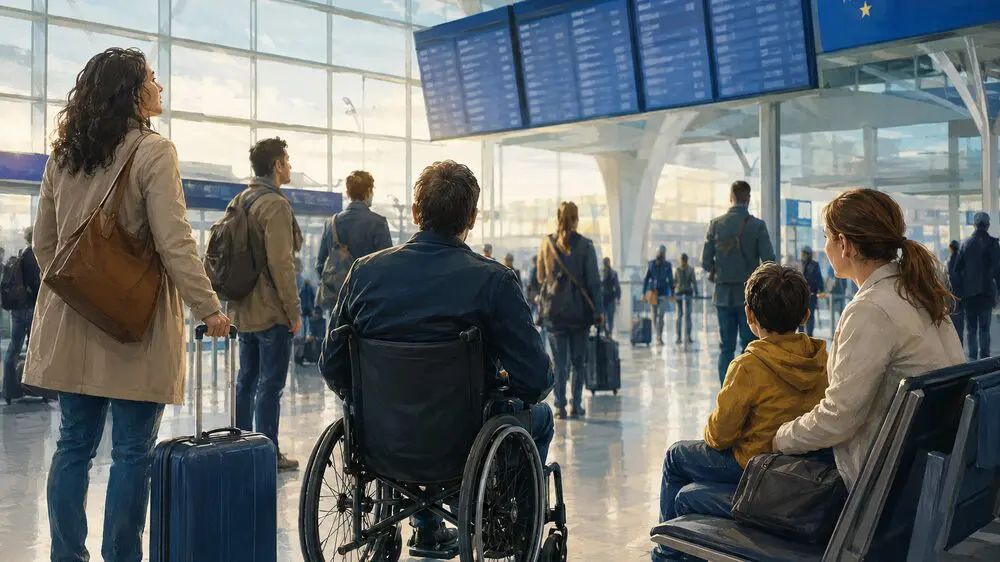
Parliament is set to approve clearer flight compensation, family seating and accessibility rules after years of institutional deadlock
The European Parliament is expected on Tuesday to approve revised EU air passenger rights rules, preserving compensation after three-hour delays while adding clearer claims procedures, fee-free child seating and stronger protections for passengers with reduced mobility. The vote closes a long institutional dispute over how far Europe should go in protecting travellers while keeping aviation rules workable for airlines.
MEPs are due to vote in Strasbourg on the compromise reached with EU governments in conciliation, the final stage of a legislative file that began in 2013. The reform updates rules first introduced in 2004, when Europe set a global benchmark for passenger protection but left many practical questions to courts, national authorities and airline complaint systems.
According to the European Parliament’s plenary briefing, the agreement keeps passengers’ right to compensation when a flight arrives more than three hours late, is cancelled less than 14 days before departure, or when boarding is denied. It also keeps the existing compensation scale of €250, €400 or €600, depending on distance.
A right is only useful if passengers can claim it
The most significant change may be procedural rather than headline-grabbing. Airlines would have to inform passengers electronically within 96 hours after arrival when a delay could give rise to compensation, and provide clear instructions on how to claim it. Carriers would also have to acknowledge a claim and reply within 30 days, either by paying compensation or giving a reasoned refusal.
That matters because EU rights have often been stronger on paper than in practice. A passenger stranded after a missed connection, a family facing surprise fees at the gate, or a wheelchair user left without adequate assistance may technically be protected by European law. The harder question has been whether that person can enforce the right without months of opaque correspondence or legal pressure.
The Commission, which welcomed the June political agreement, said the overhaul would bring clearer rules on compensation, extraordinary circumstances, fare transparency, hand baggage, passenger information and accessibility. It also confirmed that the revised rules would apply 12 months after adoption and publication in the EU’s Official Journal, following formal endorsement by Parliament and the Council.
Families, disabled passengers and fare transparency
The agreement would require airlines to seat a child under 14 next to an accompanying adult without an extra charge. It would also make prices easier to compare by requiring airlines, intermediaries and search platforms to display fares including carry-on luggage at the start of the booking process.
For passengers with reduced mobility and disabilities, the package strengthens assistance rights during disruption and improves protection for essential mobility equipment. The Council’s account of the agreement says passengers with reduced mobility would gain new compensation rights where airport assistance is insufficient, priority in assistance and rerouting, and replacement of mobility equipment at no cost if it is lost or damaged.
The reform also bans airlines from denying passengers a return flight because they did not take the outbound leg, a practice known as “no-show” cancellation. For many travellers, especially those dealing with illness, disruption or complex family arrangements, that change turns a technical booking rule into a question of fair access.
A compromise shaped by aviation pressure
The agreement is not a passenger-rights revolution. It is a compromise between Parliament’s effort to preserve existing protection and governments’ concern that airlines need predictable rules in a sector still exposed to fuel costs, labour shortages, air traffic control disruption and climate-related operational pressure.
Airlines will still be able to rely on “extraordinary circumstances” to avoid compensation in cases outside their control, but the reform seeks to make that concept clearer. If a carrier invokes extraordinary circumstances, it would have to provide a substantiated explanation, and the burden of proof would remain with the airline.
For EU institutions, the file is also politically useful. It shows the Union acting on an everyday cross-border problem at a time when many citizens judge Brussels less by treaty language than by whether common rules make travel, work and family life less arbitrary. As The European Times has reported in relation to capital market integration, the EU’s single-market agenda increasingly depends on whether technical reforms can be made visible and trusted by ordinary Europeans.
The Parliament vote will not end every dispute between airlines and passengers. National enforcement will remain decisive, and claim-handling practices will need close scrutiny once the rules begin to apply. But if the compromise works as intended, Europe’s passenger-rights regime will become easier to understand, easier to invoke and harder to ignore.