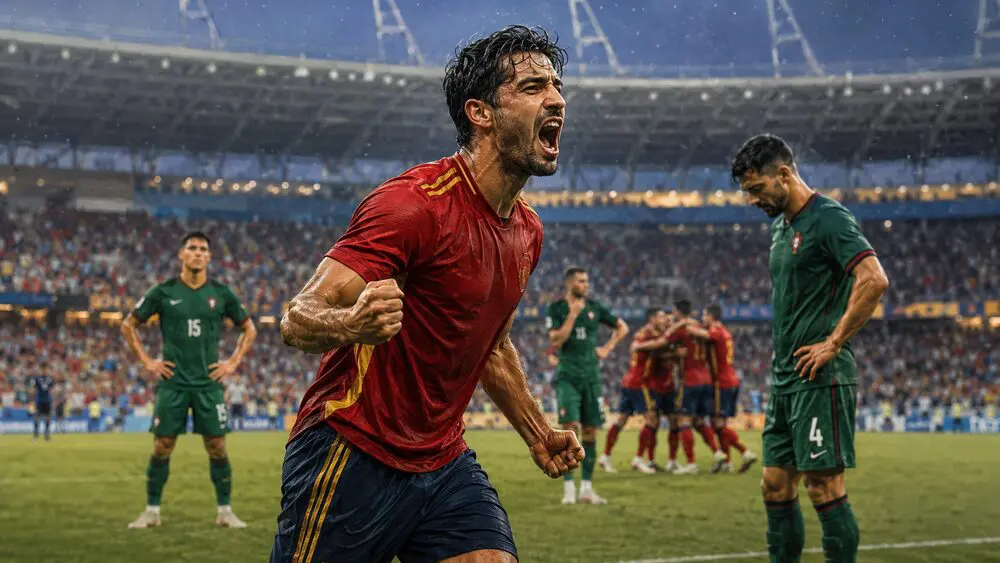
A stoppage-time winner in Dallas carries Spain into the World Cup quarter-finals and closes Cristiano Ronaldo’s final World Cup chapter
Spain moved into the FIFA World Cup quarter-finals with a 1-0 victory over Portugal in Dallas, decided by Mikel Merino’s stoppage-time goal. The result gave Spain a hard-earned Iberian knockout win, ended Portugal’s campaign, and turned one of Europe’s most anticipated World Cup ties into a story of patience, control and generational change.
The match had promised spectacle. It delivered something tighter and more revealing: two elite European teams trying to manage risk under the pressure of elimination. Spain had more of the game’s rhythm, particularly after half-time, but Portugal stayed close enough to make every Spanish attack feel exposed to a counter-punch.
Then, in the 91st minute, Merino broke the resistance. FIFA’s official match report described the midfielder’s goal as the decisive moment in a 1-0 round-of-16 victory, one that sends Spain forward to face Belgium in the quarter-finals.
Spain’s Control Finds Its Reward
For Spain, this was not a night of overwhelming brilliance. It was a night of trust in structure. Luis de la Fuente’s side did not always open Portugal cleanly, but they kept returning to the same principles: possession with purpose, pressure after loss, and the belief that a narrow match can still be won through collective discipline rather than emotional rush.
That matters for a team carrying the expectation that follows recent European success. Spain’s younger players have given the side freshness and speed, but this victory was also shaped by maturity. Knockout football often asks less for beauty than for timing. Merino’s late finish gave Spain both.
The result also turns the pre-match question into a sharper tournament statement. As The European Times preview noted, this fixture was about more than a border rivalry. It was a measure of how Europe’s strongest football cultures are adapting to a wider, less forgiving World Cup. Spain have now answered twice in the knockouts, first against Austria and now against Portugal.
Portugal Leave With More Than Regret
Portugal’s defeat will hurt because it came so late. Roberto Martínez’s side had done enough to keep the match alive, and there were moments when Portugal’s experience and individual quality threatened to pull Spain into a different kind of contest. But the final action belonged to Spain, and Portugal were left with the familiar cruelty of knockout football: a campaign can be competitive, serious and still end in one lapse.
The evening also carried the weight of Cristiano Ronaldo’s farewell to the World Cup. Now 41, he acknowledged after the match that this was his final appearance on the sport’s largest international stage. Ronaldo told reporters he was leaving with “a clear conscience”, according to post-match reporting, while stopping short of an immediate decision on his wider international future.
It would be too easy to reduce Portugal’s exit to Ronaldo alone. This squad has more than one era inside it: veterans shaped by the country’s first major titles, and younger players formed in the elite club game. The harder question is how Portugal now turns that depth into a clearer tournament identity without the same gravitational pull around one figure.
A Quarter-Final With Wider Stakes
Spain’s reward is Belgium, another European side with its own blend of experience, technical quality and unfinished World Cup ambition. That quarter-final will ask Spain to do more than control possession. It will ask them to defend transitions, manage physical pressure and keep their attacking patience from becoming caution.
For now, though, Spain’s victory stands as one of those World Cup results that looks narrow on paper but broadens in meaning. It extends a project built around renewal. It removes a rival whose history and proximity gave the tie uncommon emotional charge. And it marks the end of Ronaldo’s World Cup story without making the match only about his departure.
Spain go on because they stayed calm long enough for one late chance to matter. Portugal go home because, at this level, dignity and effort do not always protect a team from the smallest decisive margin.