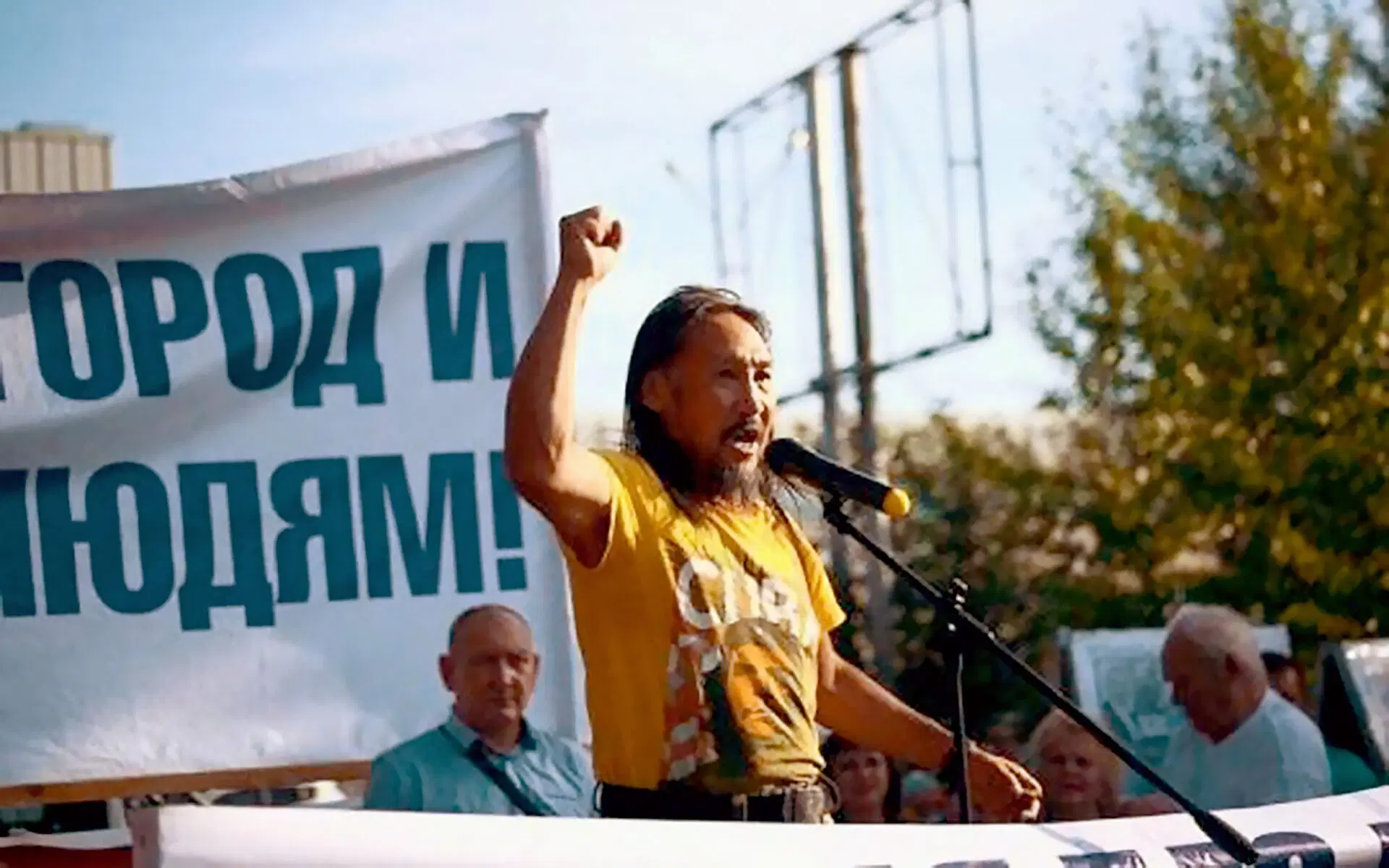
Alexander Gabyshev has been held in Russia’s psychiatric system for more than five years because of a spiritual and political act that began on a road in eastern Siberia.
In March 2019, Gabyshev, a Sakha shaman from Yakutia, left the regional capital, Yakutsk, and began walking toward Moscow. He said he wanted to reach Red Square and perform a ritual to drive Vladimir Putin from power. The act was framed by Gabyshev in religious and spiritual terms. It was also understood by many observers as a form of political protest. Russian authorities soon treated it as a matter of state security.
On June 19, 2026, the Yakutsk City Court extended Gabyshev’s compulsory psychiatric confinement for another six months, until December 18, 2026, according to information provided by Indigenous and human rights organizations following the case. The court also refused a request by his defense team for an independent psychiatric assessment at the V.P. Serbsky National Medical Research Center for Psychiatry and Narcology in Moscow.
The decision means that Gabyshev remains in the Republican Psychoneurological Dispensary in Yakutsk, where he was transferred in September 2025 after years in psychiatric institutions in other parts of Russia. His lawyers argue that the medical basis for his continued confinement is weak. An independent psychiatric review submitted by the defense reportedly found that the conclusions used to justify his detention were methodologically flawed and not supported by objective facts. The specialist concluded that Gabyshev could receive outpatient care and did not require further involuntary hospitalization.
Gabyshev’s case first became widely known in 2019, when his march from Yakutia began attracting public attention. He spoke in simple language about fear, freedom and the need to remove Putin from power. His message was unusual because it did not come from conventional opposition politics. It came from a shamanic worldview rooted in the traditions of the Sakha people. His journey gradually acquired a public dimension, with people following his progress and joining him on the road before his arrest.
Security forces detained him in Buryatia in September 2019 and returned him to Yakutia. After that, he was subjected to psychiatric examinations and restrictions. In 2020, the Yakutsk City Court ordered his involuntary hospitalization. In 2021, he was again detained and sent for compulsory treatment in a specialized psychiatric hospital with intensive supervision in Novosibirsk. He was later transferred to a psychiatric hospital in Ussuriysk, in Russia’s Far East, where the conditions were less severe. According to the organizations supporting him, medical staff there repeatedly recommended that he be moved to a general psychiatric facility with a less restrictive regime, but prosecutors and courts opposed the transfer for years.
Amnesty International has described Gabyshev as a prisoner of conscience and has called for his immediate and unconditional release. The organization has argued that the authorities used psychiatric detention to punish him for his criticism of Putin and for his declared intention to carry out a ritual against him. The U.S. Commission on International Religious Freedom also lists Gabyshev among victims of violations of freedom of religion or belief. It notes that his prosecution and detention are linked to his religiously framed opposition to the Russian president. (amnesty.org) (uscirf.gov)
The psychiatric dimension is what makes the case especially serious. Russia has a long history of using psychiatry against political and religious dissent. During the Soviet period, dissidents were sometimes diagnosed with mental illness and confined in psychiatric hospitals instead of being tried in ordinary criminal courts. This practice allowed the authorities to remove them from public life while portraying their views as symptoms of illness.
Gabyshev’s supporters argue that this pattern is being repeated. His spiritual language, his shamanic identity and his criticism of Putin have been treated not only as politically unacceptable, but as evidence of mental disorder. Amnesty reported in 2020 that hospital officials had referred to his ideas as being directed against the government when arguing for his hospitalization. That kind of reasoning is troubling because it blurs the distinction between medical assessment and political conformity.
A state has the right to respond to genuine threats of violence. But involuntary psychiatric confinement requires strict safeguards. It must be based on clear medical necessity, individualized assessment, independent review and the least restrictive possible form of care. In Gabyshev’s case, those safeguards appear to have been repeatedly contested. Independent psychiatrists and physicians who treated him in Novosibirsk and Ussuriysk reportedly concluded at different stages that his condition was stable, that he was not aggressive and that he did not pose a danger to society.
The names of the doctors currently involved in his care have also become a matter of public concern for his defenders. His case at the Yakut Republican Psychoneurological Dispensary involves Dr. Glekova Yulia Semenovna, described as an attending physician; Dr. Terentyeva Lena Mikhaylovna; Dr. Grigoryev Aleksandr Aleksandrovich; and Dr. Reshetnikova Tuyara Semenovna, described as the head of the institution. Public Russian medical directories identify doctors with matching or closely corresponding names, including Glekova and Grigoryev, as psychiatrists associated with the Yakutsk dispensary. The medical file itself has not been independently reviewed, and no individual allegation can be made without access to it. The concern is institutional: continued forced treatment in a politically sensitive case requires transparency and accountability. And a cautious approach when it comes to administering powerful psychiatric drugs to patients
This is also a freedom of religion or belief case. Gabyshev’s beliefs may be unfamiliar to many people outside Yakutia, but that does not make them less deserving of protection. His stated plan to perform a ritual against Putin was part of his spiritual understanding of political power. Unless the authorities can demonstrate a concrete and immediate danger, such expression should not be treated as a medical emergency.
The case also raises questions about the treatment of Indigenous spiritual traditions in the Russian Federation. Shamanic practices have deep roots among several Indigenous peoples of Siberia and the Russian Far East. They do not always fit the institutional forms usually associated with religion, such as churches, clergy or written doctrine. That makes them more vulnerable when state authorities decide which beliefs are legitimate and which are pathological.
Gabyshev is now expected to remain confined at least until December 2026, unless a higher court changes the decision. His defense intends to rely on the independent psychiatric opinion in appeal proceedings before the Supreme Court of the Republic of Sakha.
His situation should be understood as more than an isolated human rights case. It shows how psychiatric institutions can be drawn into political repression, especially when dissent is expressed through religious or spiritual language. For Gabyshev, the consequence has been years of forced confinement. For others in Russia, the message is clear: even spiritual opposition can be treated as illness when it challenges power.
![[Press Release] Scientology Network’s “Voices for Humanity” Highlights Rahul KC’s Human Rights Work in Nepal](https://europeantimes.news/wp-content/smush-webp/2026/06/voices-for-humanity-rahul-kc-press-release_en.jpg.webp "[Press Release] Scientology Network’s “Voices for Humanity” Highlights Rahul KC’s Human Rights Work in Nepal")