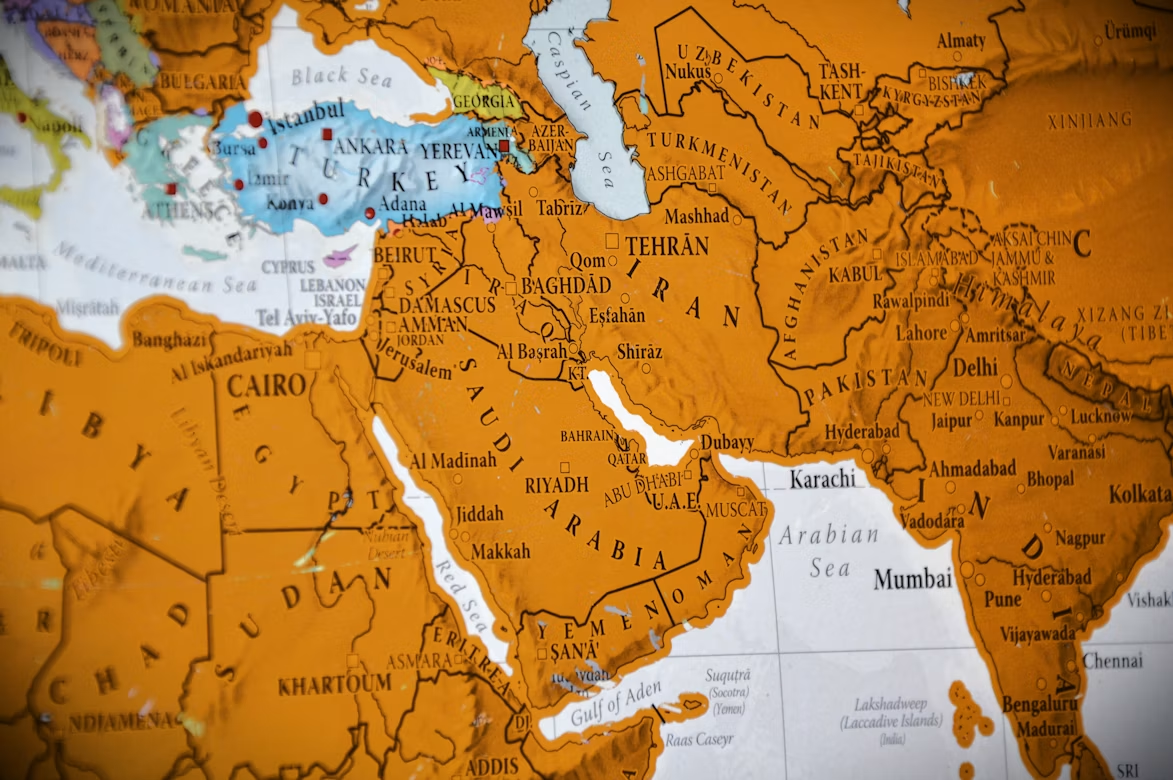
The region of the Middle East and North Africa is a good example of how imperialism actively underdeveloped a place, resulting in inequalities present until today. Issues often explained by failed economic policies are in fact caused by years of unjust social and economic developments. It is really rare to see in the world a straightforward cause-problem relation. What we see as problems now are often the results of many intertwining causes, which in turn are themselves the result of unjust developments and so on. But a few steps back are necessary before turning to current issues in the region.
The Middle East as a term is a bit problematic. Problematic, because it carries with itself European imperialism. What do I mean? Simply ask yourselves the question ‘middle to what is this East we are talking about?’. The answer is simple – it is the middle East as looked at from London. These would be countries like Syria, Lebanon, Iraq. The far East, then, if looking at a map which centres London (like most maps nowadays, no wonder why…) would be countries like Japan, China, South Korea. There is also another term, more rarely used in English – the near East, which despite currently being used primarily to refer to the Ancient Near East (Mesopotamia, Ancient Egypt), was coined in the 19th century to refer primarily to the Balkan parts of the Ottoman Empire.
These terms (Near East, Middle East, Far East) might seem very useful and almost natural to some. To others, however, they carry painful history – the history of (mainly French and British) imperialism. The name Middle East reached its imperial peak at the beginning of the 20th century. With British and French control all over the place, the name reflected the power relations between the Mashriq and the colonial powers. Think about it – if we position London in the centre, then everything else which is not London is somewhere in the periphery. The centre, would then be considered the more important part, and then the periphery – a periphery like all others. While the term was used purely for convenience reasons back then, with time it got loaded with power dynamics. Critically speaking, mentioning the term Middle East now talks not only about countries, such as Lebanon and Syria, but also about their colonial past, as places controlled by France and Britain, located eastern from London.
Even more critically speaking, using the term nowadays also reinforces these old dynamics. A term loaded with history might cause more damage than one might expect. Especially from a de-colonial perspective. Despite successful decolonialisation attempts, some argue, the remnants of old vocabulary loaded with colonial language and relations only institutionalise old hierarchies. What to use then? Purely geographical terms are preferred in order to escape the trap of reinforcing colonial hierarchies only using everyday language. Instead of the Middle East, then, Southwest (or West) Asia is preferred.
Yet, being critical about the critical is also a very good exercise here. Constantly inventing words and terms so that specific connotations are avoided does not necessarily mean that the problem is tackled the best way. Just getting rid of the colonial term Middle East does not simply erase the history behind it. In fact, if not used, the term remains as it is, buried under new terms, calmly waiting for its return. Which might even be more dangerous than one could imagine. But then what? How do we move on?
Instead of burying the term under the carpet, we could re-invent it. We could give it a new meaning. By relating it to something else, while also acknowledging its past meaning, we could achieve more. The biggest impact of this would be, of course, the decolonialisation of the term itself, not only the region. Because decolonialisation must happen on all fronts, language included. Let us do it step by step now – we take the term Middle East. We understand where it comes from – British imperial times naming places they conquer, as positioned to London. Back then – pure convenience for the colonisers. With time – a history-loaded term re-enforcing old hierarchies and power structures.
Having acknowledge the old power structures, we could continue re-inventing the term by loading the it with new meanings, ones that defy the negative connotations, without forgetting them. Giving a new meaning to the term Middle East would then make it easier to continue the long process of decolonialisation, continuing until today. This will slowly stop reinforcing old hierarchies, and, at the end of the day, would go beyond imperial power structures of the past. Of course, this is not easy. Perhaps not as easy as inventing a new term, coming from a non-loaded linguistic background. But it is worth the try. Especially when one seeks a more just future.
Okay, but how does this relate to the economy? Well, the issue of colonial imperialism is an economic issue in and of itself. It all began with the willingness to expand and continued with the willingness to exploit and extract. Imperial power relations, such as the ones we see translated through the term Middle East, are not purely geo-political. They are very much economic, too. They are seen in post-colonial relations between countries in the Middle East and former colonisers in terms of developmental relations, policy advice, international trade, oil… and while it might seem that they are not as present nowadays, especially in oil-rich countries, they are still there – hiding under new terms, carrying their old meaning
Names are powerful because of the weight they carry. They are loaded with meaning, which has an impact on the places with these names. Such is the case of the term Middle East. Middle to what? But forgetting about these names, and swapping them with new ones, would not solve the issues that they create. It might slow them down, but once they resurface, their impact might be more powerful than imagined. Economically speaking, colonial imperialism has actively created inequalities in the Middle East. And continues to do so, from inter-state unequal developments and exchange, to intra-state hierarchies. More on that in the article to follow.