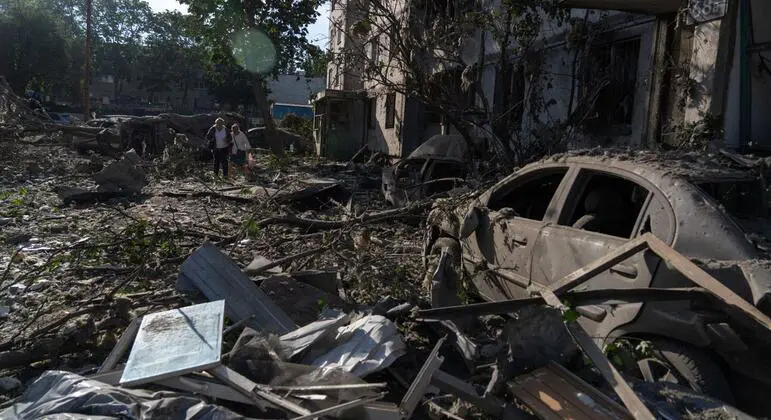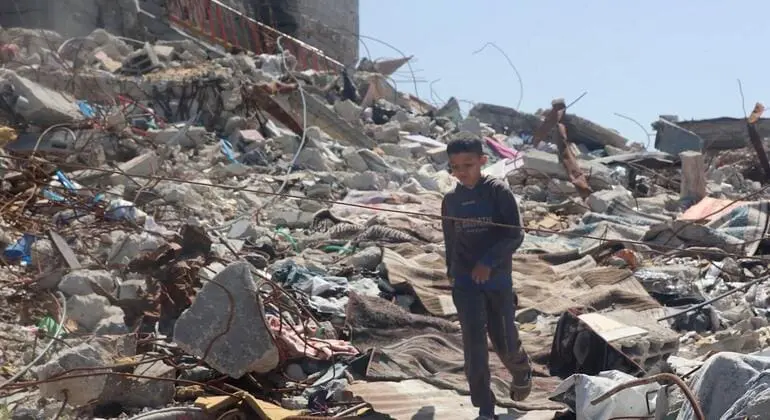
The United Nations Relief and Works Agency (UNRWA) has reported a marked increase in military activity within the Gaza Strip in recent weeks, leading to a rise in casualties and displacement among the population. “By God, we are very afraid and we keep sheltering inside the house,” Ahmed Talal, a resident of the al-Shaaf area of al-Zeitoun, shared. His home is located a mere 100 meters from the boundary of Israeli control. He recounted instances of “heavy gunfire” from tanks, stating that “bullets hit the upper part of our house.” Mr. Talal and his family have been forced to flee their neighborhood 12 times, with their most recent displacement leaving them homeless for over six months.
Independent human rights experts have issued a warning regarding the rising violence perpetrated by Israeli settlers across the Occupied Palestinian Territory, including East Jerusalem. A group of 13 Special Rapporteurs appointed by the Human Rights Council reported that such attacks are increasingly leading to the displacement of Palestinian communities. In the first five months of the year, at least 13 Palestinians lost their lives, and nearly 500 were injured. The experts highlighted that communities in Area C of the West Bank are facing heightened risks of displacement and the expansion of settlements, particularly in regions like the Jordan Valley and the South Hebron Hills.
The experts, who are not UN staff members and do not receive compensation for their efforts, pointed to specific communities such as Umm al-Kheir in the South Hebron Hills. Residents there have endured repeated raids, demolitions, and damage to essential infrastructure. The pressures on the community have intensified due to increased restrictions on access to land and vital services. The rapporteurs called on Israel to cease its support for settlements and settler violence and to ensure accountability for such attacks. They also emphasized the need for enhanced protection for Palestinian communities and advocated for the safe return of those who have been displaced.
In a separate development, the UN Secretary-General addressed the need for renewed support for reforms in the UN development system, stating that these changes have made the system more coherent, accountable, and aligned with national priorities. However, he cautioned that diminishing funding could jeopardize these advancements. During remarks to the Economic and Social Council (ECOSOC), he noted that 94% of governments now consider UN development support effective, with recognition of Resident Coordinators as crucial figures in their respective countries rising from 62% in 2019 to 90% in 2025.
“The UN Development system delivered in 2025 – 121 million people were reached with food assistance, 191 million children were vaccinated against measles, often in conflict zones, social protection was extended to 80 million people, and over half a billion individuals gained access to central health services since 2018,” stated Stéphane Dujarric, the UN spokesperson.
Despite these achievements, the Secretary-General warned that declining development funding is leaving the UN system increasingly under-resourced. “With less than 1,700 days remaining until the 2030 deadline, many countries are experiencing growing pressures, including slowing growth, rising vulnerabilities, increasing debt, and reduced fiscal space,” he cautioned. He urged Member States to provide more stable and flexible funding, including meeting the 30% core funding target outlined under the Funding Compact.
In another significant development, Secretary-General António Guterres expressed appreciation for Cindy McCain as she steps down from her role as head of the World Food Programme (WFP). He acknowledged her efforts in transforming the agency into a more efficient and effective entity in the fight against global hunger.
“Under her leadership, WFP became leaner, faster, and more agile in responding to global crises,” Guterres remarked. During her time in charge, WFP conducted life-saving operations that reached nearly 100 million individuals annually. She also enhanced accountability, promoted humanitarian diplomacy, secured new funding avenues, and expanded vital partnerships while prioritizing staff safety and the well-being of beneficiaries.
Stéphane Dujarric emphasized Guterres’s gratitude for McCain’s unwavering commitment to combating global hunger and malnutrition. Carl Skau, who has served as WFP’s Deputy Executive Director since May 2023, has now been appointed to lead the agency. With extensive operational expertise and institutional knowledge, Mr. Skau is positioned to guide the WFP as it tackles the significant challenge of acute food insecurity impacting over 360 million people worldwide.
In a concerning development, a panel of independent child rights experts from the UN condemned the de facto Taliban authorities in Afghanistan for enacting a new decree that legitimizes child marriage and regards a girl’s “silence” as consent. They characterized this decree as a serious and systematic violation of international human rights law.
The new policy, sanctioned by top Taliban clerics, allows for the marriage of girls upon reaching puberty and implies that a girl’s lack of vocal opposition may be seen as agreement to the union.
“Any legal framework that normalizes or facilitates the marriage of children violates their rights, undermines their inherent dignity, and deprives them of their autonomy and future opportunities,” the experts stated, asserting that such provisions are fundamentally incompatible with the UN’s Convention on the Rights of the Child. This latest decree is part of a broader trend of discriminatory measures from the Taliban authorities, including restrictions on girls’ secondary and higher education and the curtailment of women’s and girls’ rights across all facets of public life.