

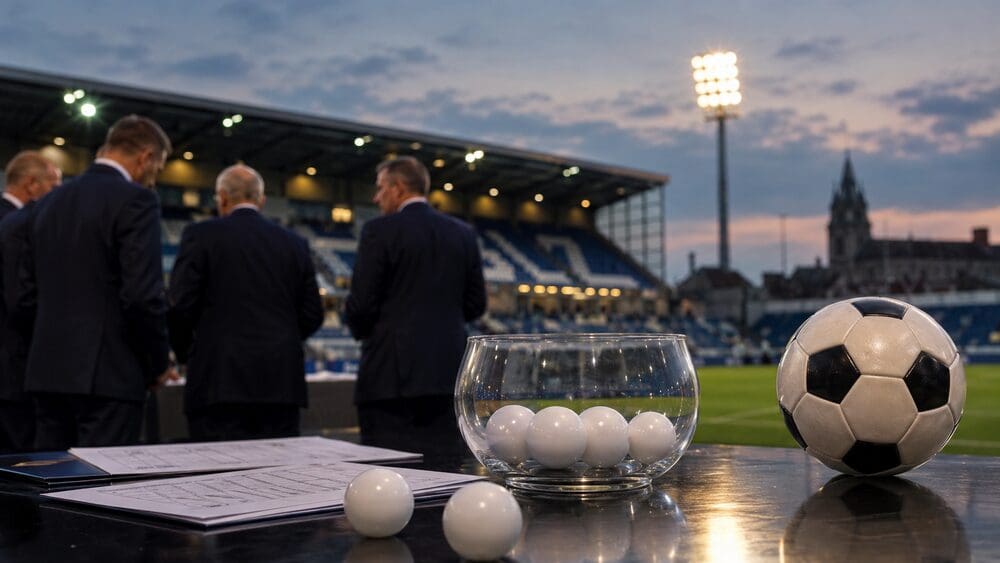
Tuesday’s first-round draw gives smaller national champions their first route toward the continent’s richest club stage
The Champions League rarely begins with floodlit glamour. It begins with a draw, a calendar, and clubs from Europe’s smaller football economies trying to turn a narrow summer opening into something transformative. UEFA’s 2026/27 first qualifying round draw on Tuesday marks the first formal step in a season that will end in Madrid, but for many teams its importance is immediate: two July matches can reshape budgets, visibility and belief.
By Daniel Mercer, Sports Correspondent, The European Times
UEFA has confirmed that the first qualifying round draw takes place on 16 June, with first legs scheduled for 7/8 July and return matches on 14/15 July. The timing is familiar, but its meaning is often understated. Before the league phase fills television schedules and before Europe’s wealthiest clubs enter the main narrative, the competition belongs briefly to champions whose seasons are built with tighter margins.
A Doorway Before the Spotlight
The Champions League’s modern format has increased the scale and commercial weight of the league phase, but qualification still carries an older European idea: domestic success should offer a path, however difficult, into continental competition. UEFA says 29 teams qualify directly for the league phase, while seven places are decided through qualifying and play-offs under the current structure.
That imbalance is part of the reality. Clubs from smaller leagues are not competing on equal financial terms with the giants of England, Spain, Germany, Italy or France. Yet the qualifying rounds remain one of the few mechanisms through which domestic champions outside the largest markets can claim a meaningful route upward.
For these clubs, the draw is not ceremonial. It can decide travel costs, preparation windows, player recruitment and the tone of an entire summer. A favourable pairing can create momentum; a difficult one can narrow ambition before a ball is kicked. The margins are sporting, but they are also institutional.
Access Still Matters
The debate around European football is often dominated by revenue distribution, breakaway projects, ownership models and the pressure of crowded calendars. Those questions matter. But the first qualifying round reminds the continent that legitimacy also depends on access.
European football’s strength has never rested only on its elite clubs. It also depends on local stadiums, regional rivalries, volunteer structures, youth academies and national competitions that give supporters a reason to believe their domestic league is connected to something larger. As The European Times has argued in its wider coverage of Europe’s sports culture, the continent’s influence is built not just on spectacle, but on institutions, civic habits and public arguments about fairness.
That is why these early rounds deserve attention beyond specialist followers. When smaller champions enter Europe, they carry more than a badge. They carry the credibility of domestic competitions that risk becoming feeder ecosystems for wealthier leagues. A strong qualifying run can keep players longer, draw new supporters, and give young footballers a visible local pathway.
The Long Road to Madrid
The 2026/27 Champions League season will begin competitively on 7 July and conclude with the final at Madrid’s Estadio Metropolitano on 5 June 2027, according to UEFA’s competition calendar and format guide. Between those dates lies a vast gap in resources, expectation and visibility.
The clubs drawn on Tuesday will not all dream realistically of Madrid. Many will measure success in stages: surviving one round, earning a larger tie, reaching another UEFA competition, or using the experience to strengthen a domestic season. Those ambitions may sound modest beside the vocabulary of superclubs, but they are not small inside the communities that sustain them.
There is also a sporting value in the unpredictability of qualification. Two-legged ties in July are rarely polished. Squads are still forming, travel is demanding, and pressure often falls unevenly. That gives the early rounds a human texture that the later competition can sometimes lose: coaches improvising, players trying to be noticed, supporters planning trips that feel larger than the fixture itself.
A Competition Must Be More Than Its Final
The Champions League’s global identity is built around its biggest nights, but its European legitimacy depends on the whole ladder. If the competition becomes only a closed theatre for the richest brands, its cultural claim weakens. If the pathway remains visible, even when steep, it preserves something important about football’s public contract.
Tuesday’s draw will not decide the next champion of Europe. It will decide something quieter: who gets the first chance to step from domestic achievement into continental consequence. For smaller clubs, that chance is never abstract. It is income, recognition, pressure, travel, hope and risk packed into two July evenings.
That is where Europe’s club season truly begins: not with certainty, but with an open draw and the fragile belief that the distance between a local title and the continent’s biggest stage can still be crossed.