
A comparative analysis of expansive prosecutorial practices and their impact on freedom of religion or belief and due process
In recent years, Argentina has witnessed a series of criminal cases that reveal a troubling pattern: prosecutors expanding their mandates far beyond the limits set by law, interpreting statutes creatively, and handling evidence with a degree of carelessness that raises serious human rights concerns. As an international human rights lawyer, I have followed these developments with increasing apprehension. The issue is not confined to one field or one community. It affects religious minorities stigmatized as cults, dissidents, indigenous activists, and ordinary citizens caught in the gears of a prosecutorial system that sometimes appears to operate without adequate checks.
The work of the special anti-trafficking office, PROTEX, offers a clear example. Argentina’s human trafficking legislation is already unusually broad by international standards, yet PROTEX and prosecutors influenced by its approach have stretched it further. Provisions originally conceived to combat the exploitation of prostitutes by organized crime, or the forced labor of migrants, have been applied to spiritual minorities and to the voluntary work that is common in both new and mainline religions. Courts have sometimes upheld these theories, but in other cases they have issued strong warnings. Judges have criticized the reliance on stereotypical notions of coercive persuasion, the automatic labeling of believers as victims, and the cavalier treatment of evidence.
Several recent rulings illustrate the problem. On October 13, 2025, Federal Judge Roberto Falcone acquitted evangelical pastor Roberto Tagliabué after three years of pretrial detention. The accusations included human trafficking for labor exploitation, unlawful deprivation of liberty, and illegal medical practice, all allegedly facilitated through coercive persuasion. Falcone found no factual basis for the narrative constructed by Prosecutor Laura Mazzaferri and PROTEX, and he denounced the uncritical use of reports from the National Rescue Program (NRP) that had classified church members as victims without verifying their circumstances.
In 2022, the Federal Court of Tres de Febrero dismissed charges against members of the movement Cómo Vivir por Fe, warning that the influence of anti-cult activist Pablo Salum had distorted the investigation. The court emphasized that treating voluntary adherence to a minority faith as a criminal act introduces a paternalistic concept incompatible with democratic principles.
In 2024, the Federal Oral Court of Paraná acquitted defendants of the International Tabernacle Church. It documented serious abuses by PROTEX and the NRP, including coercing believers to identify themselves as victims and subjecting them to intolerable pressure.
These cases reveal a prosecutorial culture that sometimes privileges ideology over evidence. The problem extends beyond the field of religion. The case of Konstantin Rudnev, a Russian dissident and former spiritual teacher detained in Bariloche in 2025, illustrates this broader pattern. The lead prosecutor, Fernando Arrigo, head of the Decentralized Prosecutor’s Office of Bariloche, has been repeatedly criticized in the Argentine media for his handling of evidence.
Arrigo has often found himself in trouble. He is involved in the case of the death of Franco Casco, a young man who disappeared in Rosario in 2014 after being detained by the police. His body was later found in the Paraná River. The case became a national scandal, with Casco’s family and human rights organizations alleging police torture and enforced disappearance. Arrigo participated in the investigation, which was widely criticized for irregularities, delays, and the mishandling of forensic evidence. The courts eventually acquitted the police officers, and the case has been reopened under Arrigo’s insistence. The police officers involved have filed a complaint with the General Prosecutor requesting that a criminal case be opened against Arrigo on suspicion of falsifying evidence. This complaint has remained motionless on the General Prosecutor’s desk, creating the impression that there is no desire to move it forward.
I am not taking a position here on the substance of the Casco case. I am fully aware that accusations of brutality and abuse have often been raised against the Argentine police even after the end of the military dictatorship. My concern lies elsewhere: when prosecutors mishandle evidence, the result may be the conviction of the innocent or the acquittal of the guilty. Both outcomes undermine the rule of law.
A similar situation has emerged in the Rudnev case. The alleged victim filed a complaint with the General Prosecutor against Arrigo and other prosecutors, accusing them of forcing her to recognize herself as a victim and subjecting her to various forms of abuse. The complaint was forwarded to the Prosecutor’s Office itself and was quickly closed for lack of grounds. These examples illustrate a serious structural problem. In Argentina’s prosecutorial system, complaints against prosecutors are ineffective, and officials bear no responsibility for their actions, even in cases of alleged abuse of power.
Arrigo is also the prosecutor in the case of Mapuche leader Facundo Jones Huala, a proceeding that has generated intense debate. The prosecution claims that Jones Huala organized and promoted violent actions, although media reports indicate that the case rests largely on statements he made during a book presentation rather than on specific acts of terrorism. Human rights defenders note that, as of June 2026, the investigation remains incomplete and no formal charges have been filed despite the continued deprivation of liberty.
At each review of the preventive measure, the prosecution has sought to extend pretrial detention, citing the case’s complexity and the alleged threat posed by the defendant’s beliefs. When Judge Ezequiel Andreani ordered his transfer to Esquel, the Bariloche Prosecutor’s Office filed an appeal signed by Arrigo, freezing the execution of the decision. Relatives argue that this disregards the detainee’s health and social rights. Journalists and human rights defenders have documented premature disclosure of the arrest, automatic extensions of pretrial detention without charges, refusal to transfer him to a more humane facility, lack of medical assistance during a hunger strike, and the politicization of the case.
During this hunger strike, which included a dry phase, Jones Huala was urgently taken to intensive care with extensive internal bleeding and other serious health problems, a situation that has caused deep concern among relatives and observers. Critics argue that the prosecution has ignored these consequences, and the strongest criticism is directed at Arrigo, who appealed to overturn the court‑ordered transfer and, according to the defense, has delayed the investigation by failing to bring formal charges. These actions are perceived as abuses of power with potentially irreversible effects on a person’s life.
The Rudnev case raises similar concerns. Everything indicates that Arrigo is acting with personal animosity toward him. Rudnev entered prison as a healthy man. After fourteen months of inhumane conditions in Unidad 6 in Rawson, he came out practically disabled and immediately underwent surgery. His health is still recovering. The extreme cold, windows systematically broken during searches, lack of basic sanitary conditions, and severely weakened immunity due to eleven years of imprisonment in Russia make any new imprisonment a real threat to his life. Despite this, the prosecutor continues to insist on returning him to prison.
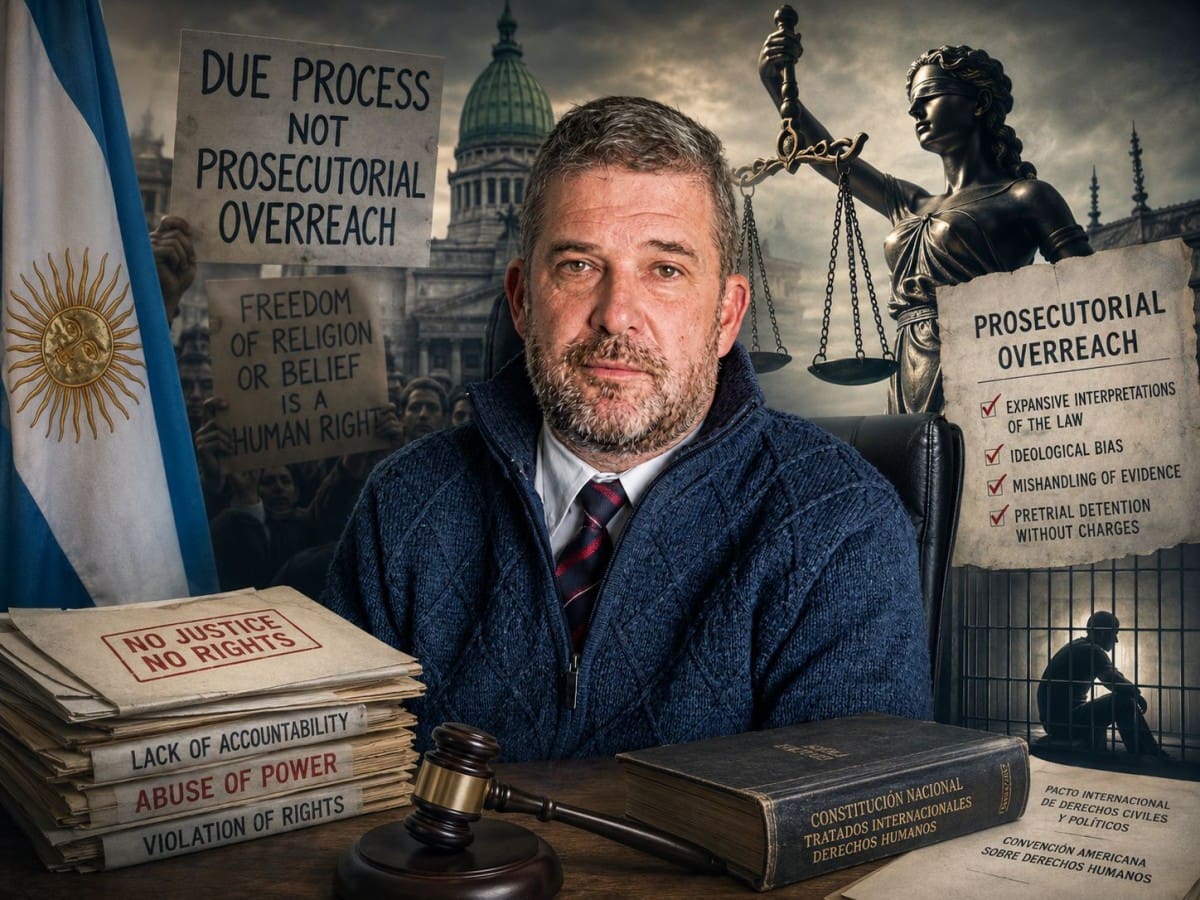
Taken together, the cases involving spiritual minorities accused of trafficking through coercive persuasion, the Rudnev case, and the other proceedings handled by Arrigo reveal a systemic problem in Argentina’s prosecutorial system. This includes expansive interpretations of the law, reliance on ideological constructs, mishandling of evidence, and prolonged pretrial detention without adequate justification. Argentina has a proud legal tradition and is a party to the International Covenant on Civil and Political Rights and the American Convention on Human Rights. These instruments require strict adherence to legality, proportionality, and due process. When prosecutors disregard these standards, the consequences are profound. The credibility of the justice system suffers, and the rights of individuals and communities are placed at risk.
The President of Argentina, the Ministry of Justice, and the Ministry of Security now have the opportunity to redress this situation. These institutions are called upon to ensure effective mechanisms of control, transparency, and accountability within the criminal prosecution system. They must guarantee that prosecutors, judges, and other public officials act strictly within the law and fully respect human rights, the principles of fair trial, and the human dignity of all participants in legal proceedings. A justice system that respects human rights is essential for a democratic society. The time has come for Argentina to reaffirm this commitment.