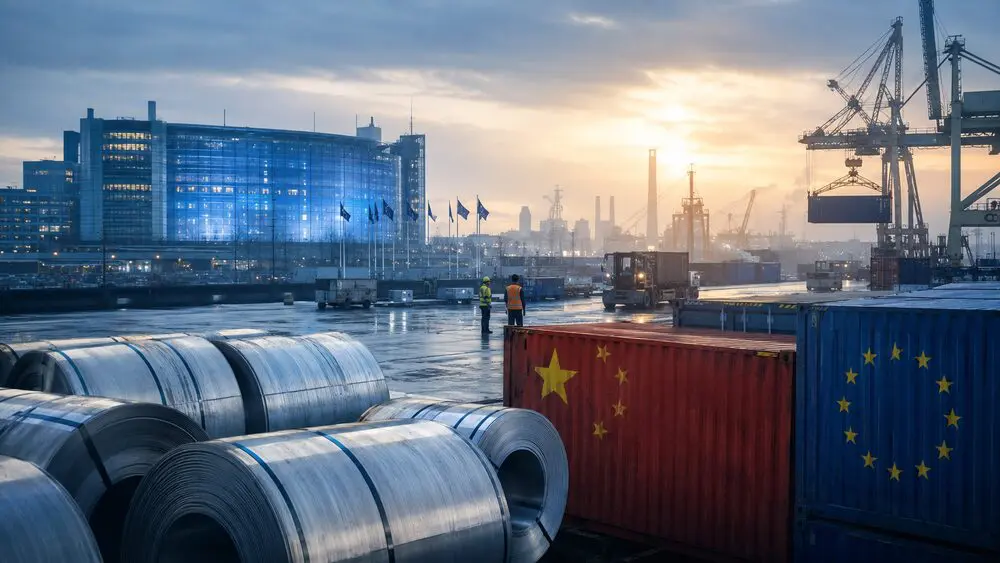
European leaders are facing renewed pressure to harden the bloc’s trade stance toward China, as warnings over industrial overcapacity, a widening goods deficit and fragile manufacturing sectors move higher on the EU agenda before the June European Council.
The debate sharpened on Sunday after Manfred Weber, chair of the centre-right European People’s Party, urged Europe to act more decisively against what he described as the risk of Chinese competition weakening European industry. His same-day warning on EU-China trade tensions reflects a broader shift in Brussels: China is no longer being treated only as a major export market, but as a test of Europe’s industrial resilience.
A widening imbalance
Official data give the political argument its force. According to Eurostat’s 2025 trade figures, the EU exported €199.6 billion worth of goods to China and imported €559.4 billion, leaving a goods trade deficit of €359.8 billion. Exports fell by 6.5% compared with 2024, while imports rose by 6.4%.
That gap is not only a matter for trade specialists. It has become a political symbol of Europe’s exposure in sectors that are central to jobs, climate policy and strategic autonomy, including machinery, chemicals, steel, batteries and vehicles. For trade hawks, the figures show that the EU’s traditional preference for gradual dialogue has not kept pace with the speed of China’s state-backed industrial expansion.
For more cautious governments and companies, however, the risk is that a tougher line could raise consumer prices, invite retaliation and complicate access to a market still important for European exporters. Germany’s industrial base, in particular, has long depended on Chinese demand, even as German manufacturers now face stronger Chinese competition at home and abroad.
Protection without panic
The EU’s dilemma is how to defend core industries without sliding into a generalised trade war. Brussels has already expanded its use of trade-defence tools, including investigations and tariffs, while stressing that its China policy is about “de-risking” rather than full economic decoupling.
Steel has been one of the clearest early battlegrounds. As European Times has previously reported, the EU has moved toward tougher steel trade defence measures in response to global overcapacity and pressure on European producers. Similar arguments are now spreading across other industrial sectors, where policymakers fear that low-cost imports could hollow out domestic capacity before new green and digital investments mature.
The human consequences are direct. Factory closures and weakened supply chains affect workers, regional economies and public finances. At the same time, poorly designed protection could burden households and smaller firms with higher costs. The challenge for EU institutions is therefore not only to shield large producers, but to show that trade policy can serve the wider public interest.
A test before the June summit
The issue is expected to feature in discussions ahead of the European Council on 18 June, where leaders will face pressure to define how far they are willing to go. France and several other member states have pushed for stronger instruments, while others remain wary of measures that could fragment the single market or expose exporters to countermeasures.
China remains a partner, competitor and systemic rival in EU language. That formula captures the complexity of the relationship, but it no longer resolves the policy dispute. Europe wants access to Chinese markets, cooperation on climate and stability in global trade. It also wants fair competition, supply-chain security and protection against subsidised overcapacity.
The coming weeks will show whether the EU can turn that balancing act into a coherent industrial strategy. If it cannot, the pressure may move from Brussels to national capitals, where governments facing factory losses and electoral anger may be tempted to act alone. For Europe, the trade question is becoming something larger: whether the single market can protect its productive base while remaining open, lawful and socially accountable.